
Revolutionary Cargo Operations
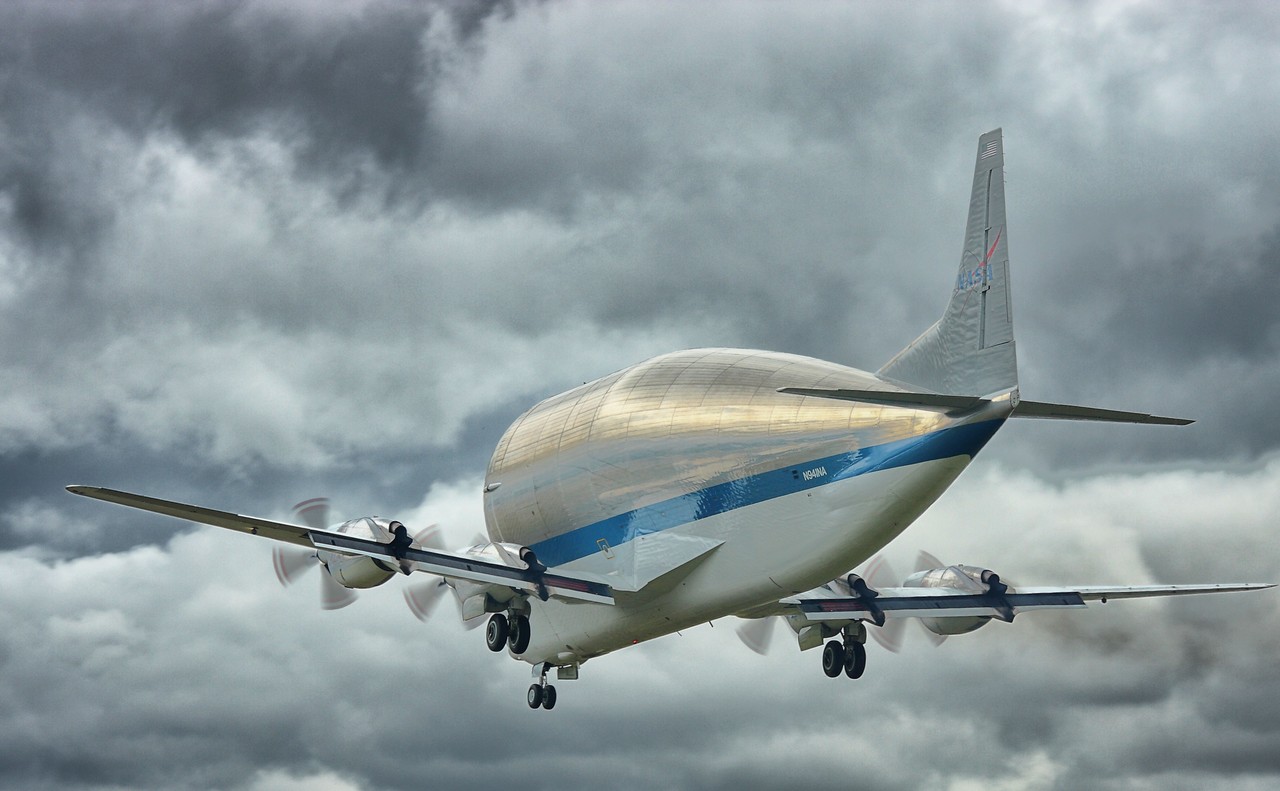
The 377SGT Super Guppy Turbine represented the pinnacle of specialized cargo aviation in the 1970s and 1980s, single-handedly enabling Airbus Industrie's distributed manufacturing strategy across Europe. All four aircraft were eventually acquired by Airbus, where they operated scheduled flights five days per week, transporting A300 and A310 fuselage sections from manufacturing facilities across Europe to the final assembly plant in Toulouse, France. This regular cargo service proved so vital to Airbus production that the company's entire manufacturing philosophy depended on the Super Guppy's unique capabilities.
Design Evolution and Innovation
Unlike its predecessors, the 377SGT featured an entirely new fuselage constructed from scratch rather than converted from existing aircraft. This revolutionary approach allowed engineers to increase the cargo compartment floor width from 8 feet 9 inches to 13 feet, doubling the usable space compared to earlier variants. The aircraft's 25-foot maximum interior diameter and 141-foot overall length created an absolute cargo volume of 49,750 cubic feet, with 39,000 cubic feet of usable space.
The design lineage traced back to the original Pregnant Guppy, which first flew on September 19, 1962, followed by the first Super Guppy (377-SG) in 1965. Each iteration grew larger and more capable, culminating in the turbine-powered 377SGT that represented the ultimate expression of the Guppy concept.
Manufacturing and Production
Production of the 377SGT occurred in two distinct phases across two continents. Aero Spacelines built the first two aircraft in the United States, with the initial example (N211AS, construction number 0001) taking flight on August 24, 1970. The second aircraft (N212AS, c/n 0002) followed exactly two years later on August 24, 1972. After Airbus Industrie purchased the manufacturing rights, Union de Transports Aériens Industries in France constructed the third and fourth aircraft, which flew in 1979 and 1980 respectively, with their sub-assemblies delivered in 1978 and 1979.
The Manufacturer's Journey
Aero Spacelines, Inc. operated as an independent manufacturer from 1960 to 1968, pioneering the concept of oversized cargo aircraft for the aerospace industry. The company's innovative approach to solving NASA's Saturn rocket transportation challenges led to a series of increasingly capable aircraft designs. However, the specialized nature of their products limited commercial opportunities, leading to multiple ownership changes.
In 1981, Tracor, Inc. acquired Aero Spacelines and renamed it Tracor Aviation, which assumed maintenance contracts for the existing Guppy fleet. The company changed hands again in the late 1990s when Lucas Aerospace purchased Tracor Aviation, renaming it Lucas Aviation. Lucas continued providing technical support for the Guppys until Airbus retired the fleet in favor of the larger A300-600ST Beluga.
Powerplant and Performance
The 377SGT's four Allison T-56 (501-D22C) turboprop engines, each producing 4,680 equivalent shaft horsepower, provided the massive thrust required to lift such an enormous fuselage. These proven engines were sourced from Lockheed Electra and P-3 Orion aircraft, while the propellers and spinners came from C-130 Hercules aircraft, demonstrating the practical approach to utilizing existing, reliable components.
The aircraft featured a pressurized cockpit and a hinged nose section that swung open to facilitate cargo loading, eliminating the need for complex ground handling equipment. This innovative loading system allowed ground crews to roll large components directly into the cavernous cargo bay on specialized dollies.
Space Program Support
Beyond commercial aerospace applications, the Super Guppy family provided crucial support to NASA's space programs. The aircraft transported components for the Apollo, Gemini, Skylab, and International Space Station programs, including segments of the Saturn rockets that powered America's lunar missions. This dual role in both commercial aviation and space exploration highlighted the aircraft's versatility and importance to the American aerospace industry.
Legacy and Replacement
The 377SGT's operational career spanned nearly two decades before Airbus introduced the A300-600ST Beluga in the late 1990s. The newer aircraft could carry twice the cargo weight of the Super Guppy while offering improved reliability and operating economics. Despite its retirement from active service, the Super Guppy concept influenced subsequent specialized cargo aircraft designs and demonstrated the viability of purpose-built oversized cargo transports.
Today, the second Super Guppy ever built (the earlier 377-SG variant) is preserved at the Pima Air & Space Museum, where visitors can appreciate the engineering audacity required to create such an unconventional aircraft. The 377SGT's contribution to both commercial aviation manufacturing and space exploration represents a unique chapter in aerospace history, proving that sometimes the most unusual solutions become the most successful.