
Service History
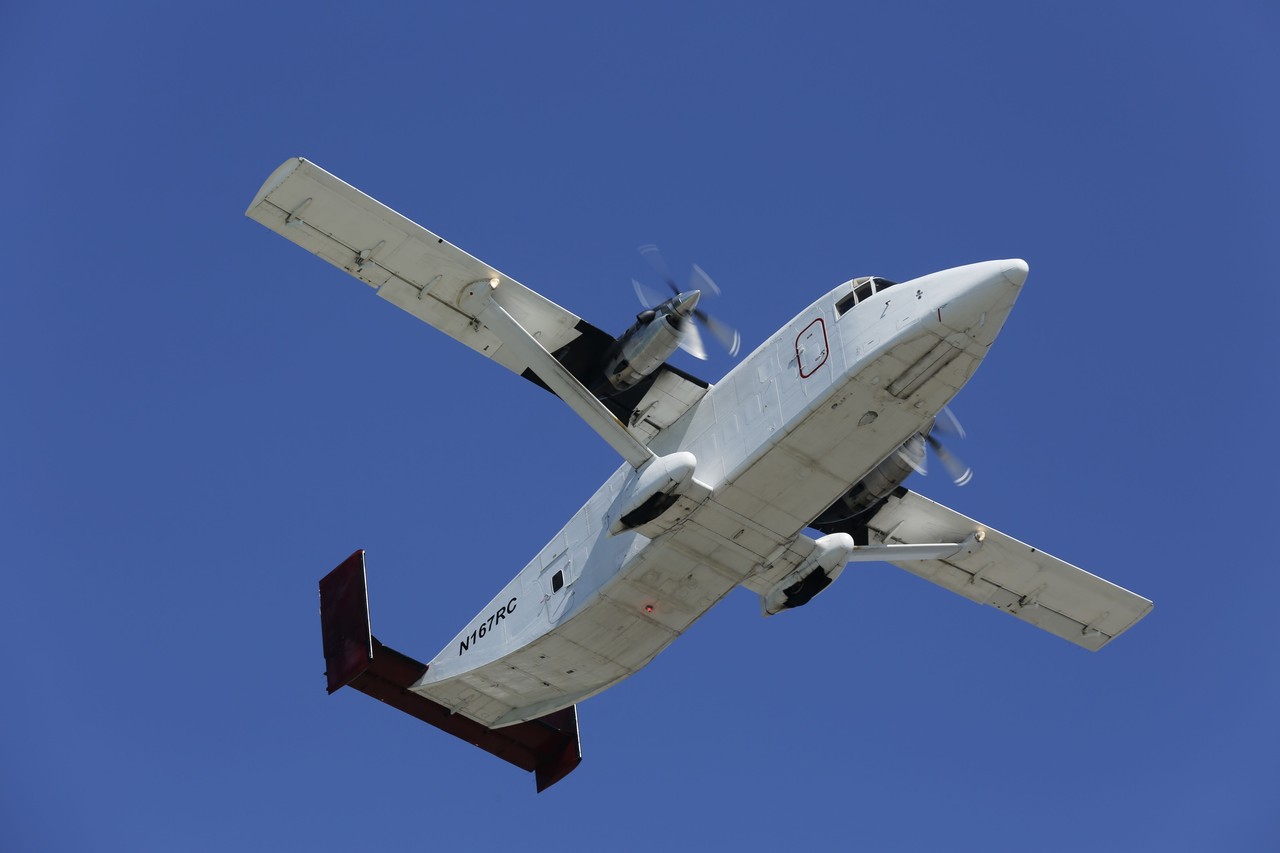
The Short 330 carved out a specialized niche in the deregulated airline market of the late 1970s, where its 30-seat capacity perfectly matched US Federal Aviation Regulations that allowed smaller commuter carriers to operate aircraft with up to 30 passengers under less restrictive certification requirements. Time Air of Canada became the first operator in 1976, followed by major carriers including Aer Lingus, Olympic Airways, and American regional airlines seeking cost-effective replacements for aging Beechcraft 99s and de Havilland Twin Otters. The aircraft's distinctive squared fuselage earned it the nickname "The Shed" among pilots and passengers, though this ungainly appearance translated into practical advantages for cargo loading and passenger comfort.
Military Operations
While the Short 330 never saw combat operations, it found important military applications as the C-23 Sherpa series. The United States Air Force ordered 18 C-23A variants in March 1983 for the European Distribution System Aircraft program, tasked with transporting spare parts and supplies between NATO bases across Europe. These military versions featured a rear cargo ramp and reinforced flooring, with the US Army subsequently ordering 16 C-23B aircraft for tactical transport duties. Thailand's Army also operated the specialized 330-UT variant for utility transport missions throughout Southeast Asia.
The Manufacturer
Short Brothers, established in 1908 by Oswald Short and his brothers Eustace and Gordon, ranks among the world's oldest aviation manufacturers. The Belfast-based company evolved from early balloon and aircraft production to become a major supplier of military bombers during World War I and innovative flying boats throughout World War II. On May 23, 1973, the UK government provided crucial financial backing to launch the SD3-30 project, recognizing the potential for British aerospace exports in the emerging commuter airline market. Bombardier Aerospace acquired Short Brothers in 1989, with the operation later transferred to Spirit AeroSystems in 2021, though manufacturing continues under the Short Brothers name in Belfast.
Engine and Technical Innovation
Powering the Short 330 were two Pratt & Whitney Canada PT6A-45R turboprop engines, each delivering 1,198 shaft horsepower through five-bladed Hartzell constant-speed propellers. This powerplant combination provided exceptional hot-and-high performance while maintaining the low operating costs essential for regional airline profitability. The aircraft retained the square cross-section fuselage of its Skyvan predecessor, optimizing cargo volume while incorporating retractable tricycle landing gear for improved aerodynamic efficiency and reduced maintenance compared to fixed-gear designs.
Pilot Experience
Pilots appreciated the Short 330's forgiving handling characteristics and robust construction, though few praised its aesthetic appeal. The aircraft cruised at 160 knots with a maximum speed of 190 knots, while maintaining excellent short-field performance with a stall speed of just 73 knots. Service ceiling and climb rate specifications varied between variants, but operators valued the aircraft's ability to access smaller regional airports that larger aircraft couldn't serve economically. The two-pilot crew configuration kept operating costs manageable while providing adequate safety margins for single-pilot operations under certain regulatory conditions.
Production Legacy
Short Brothers manufactured 141 Short 330s between 1974 and 1992, comprising 68 of the initial 330-100 variant and 73 of the improved 330-200 model. Production peaked in the early 1980s before declining as airlines shifted toward more refined competitors like the ATR 42 and Embraer Brasilia. The first prototype flew on August 22, 1974, followed by the second prototype on July 8, 1975, with the first production aircraft completing its maiden flight on December 15, 1975. Manufacturing ceased in 1992 as Short Brothers focused resources on the more successful 360 variant.
Current Operations
As of 2023, approximately 14 Short 330s remain in active service, primarily with cargo operators who value the aircraft's large freight door and generous payload capacity of 7,500 pounds. Air Cargo Carriers emerged as the type's most prominent current operator, utilizing the aircraft's ability to carry oversized cargo loads that would challenge more conventional designs. While museum preservation efforts have been limited, the aircraft's practical design philosophy influenced subsequent Short Brothers products and demonstrated the viability of utilitarian approaches to regional aircraft design during the critical deregulation period of the 1970s and 1980s.