
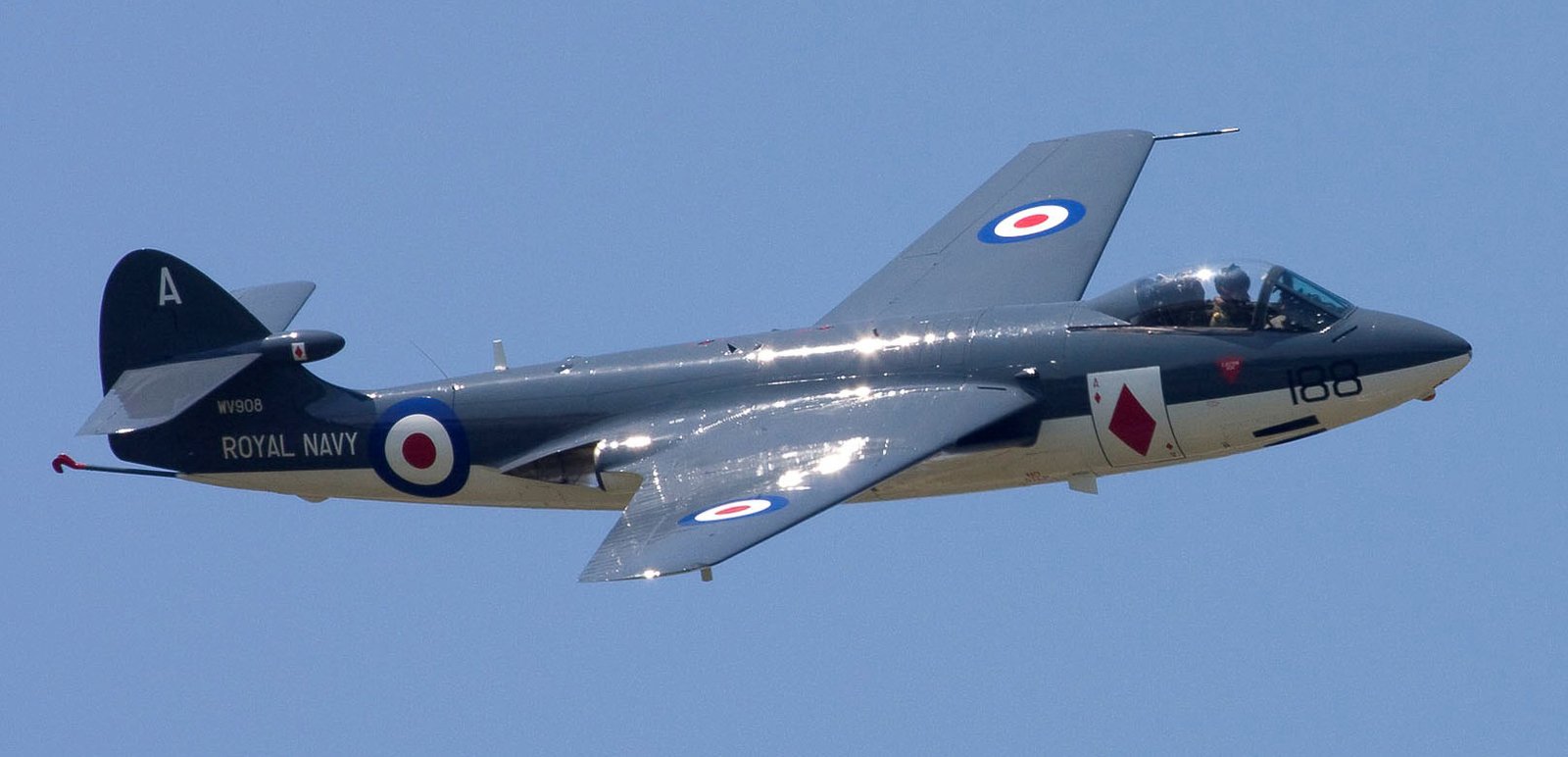
Service History
The Sea Hawk dominated Royal Navy Fleet Air Arm operations from 1953 to 1969, representing Britain's transition from propeller-driven naval fighters to jet-powered carrier aircraft. During its 16-year career with the FAA, the type equipped numerous front-line squadrons, with 806 Naval Air Squadron receiving the first F.Mk 1 aircraft in March 1953. The Sea Hawk's reliability and carrier-friendly handling characteristics made it the backbone of British naval aviation throughout the 1950s, with front-line service continuing until 1958 before transitioning to training and secondary roles.
Combat Operations
The Sea Hawk saw its most significant combat action during the 1956 Suez Crisis, where FAA squadrons 800 and 810 NAS flew ground-attack missions against Egyptian targets. Armed with four 20mm Hispano cannons and carrying up to 1,000 pounds of bombs or 72 60-pound rockets, the aircraft proved effective in the fighter-bomber role. Export operators also employed the Sea Hawk in combat, with Indian Navy and Air Force aircraft participating in both the 1965 and 1971 Indo-Pakistani Wars, conducting strikes against Pakistani naval vessels and airfields.
Design and Development
Sydney Camm, Hawker's legendary chief designer, led the Sea Hawk development team, building upon his earlier P.1040 prototype that first flew in 1949. The aircraft emerged from British Admiralty Specification N.7/46, which called for a general-purpose naval fighter capable of carrier operations, fighter interception, and ground attack missions. Interestingly, the Sea Hawk employed a straight-wing design derived from the swept-wing Hunter prototype, optimizing it for carrier operations with features like folding wings for shipboard storage. The Royal Navy ordered 151 aircraft on November 22, 1949, officially naming it the Sea Hawk.
Manufacturing Legacy
Hawker Aircraft Limited initially manufactured the Sea Hawk at their Kingston-upon-Thames facility, producing the first 35 F.Mk 1 aircraft. Production then shifted to Armstrong Whitworth Aircraft's Baginton facility in Coventry, where the remaining variants were built. Both companies operated under the Hawker Siddeley Group umbrella, which existed from 1935 until 1977 when it merged with British Aircraft Corporation to form British Aerospace. BAE Systems, the modern successor to this lineage, continues operations today as one of the world's major aerospace companies.
Technical Innovation
The Sea Hawk was powered by the Rolls-Royce Nene turbojet, an axial-flow engine that entered production in 1946. Different variants employed specific Nene models: the F.Mk 1 and F.Mk 2 used the Nene 101, while later variants like the FB.Mk 5 and FGA.Mk 6 incorporated the more powerful Nene 103. The engine provided up to 5,000 pounds of thrust, enabling the aircraft's impressive performance envelope. The Nene's reliability and global export success - including licensed production in the Soviet Union as the RD-45 - made it one of the most significant early post-war turbojets.
Production Variants
Production totaled between 542 and 547 aircraft across six major variants from 1951 to 1961. The F.Mk 1 fighter variant saw 95 aircraft built, followed by 40 F.Mk 2s featuring power-boosted ailerons. The FB.Mk 3 fighter-bomber accounted for 116 aircraft with strengthened airframes for external ordnance, while 97 FGA.Mk 4 fighter-ground attack variants followed. The final production variants were 50 FB.Mk 5s and 86 new-build FGA.Mk 6s, with the last aircraft delivered in 1961. Export customers included West Germany, India, and the Netherlands, extending the type's operational life well beyond British service.
International Operations
Beyond British service, the Sea Hawk achieved notable export success. The West German Navy operated the type until 1983, making it the last military operator of the aircraft. The Indian Navy and Air Force flew Sea Hawks from the mid-1950s through the early 1980s, with 14 FGA.Mk 6 aircraft delivered as late as 1961. The Netherlands also operated the type, though for a shorter period than other export customers.
Legacy and Preservation
Today, no Sea Hawks remain in flying condition, with the last airworthy example - Australian-based FGA.6 WV908 - having not flown since 2010. The Imperial War Museum in the United Kingdom displays a preserved FB.5 variant, representing one of several museum examples worldwide. The Sea Hawk's historical significance lies in its role as Britain's transitional naval jet fighter, bridging the gap between World War II-era propeller fighters and the swept-wing jets that followed, while proving the viability of single-engine jet operations from aircraft carriers.