
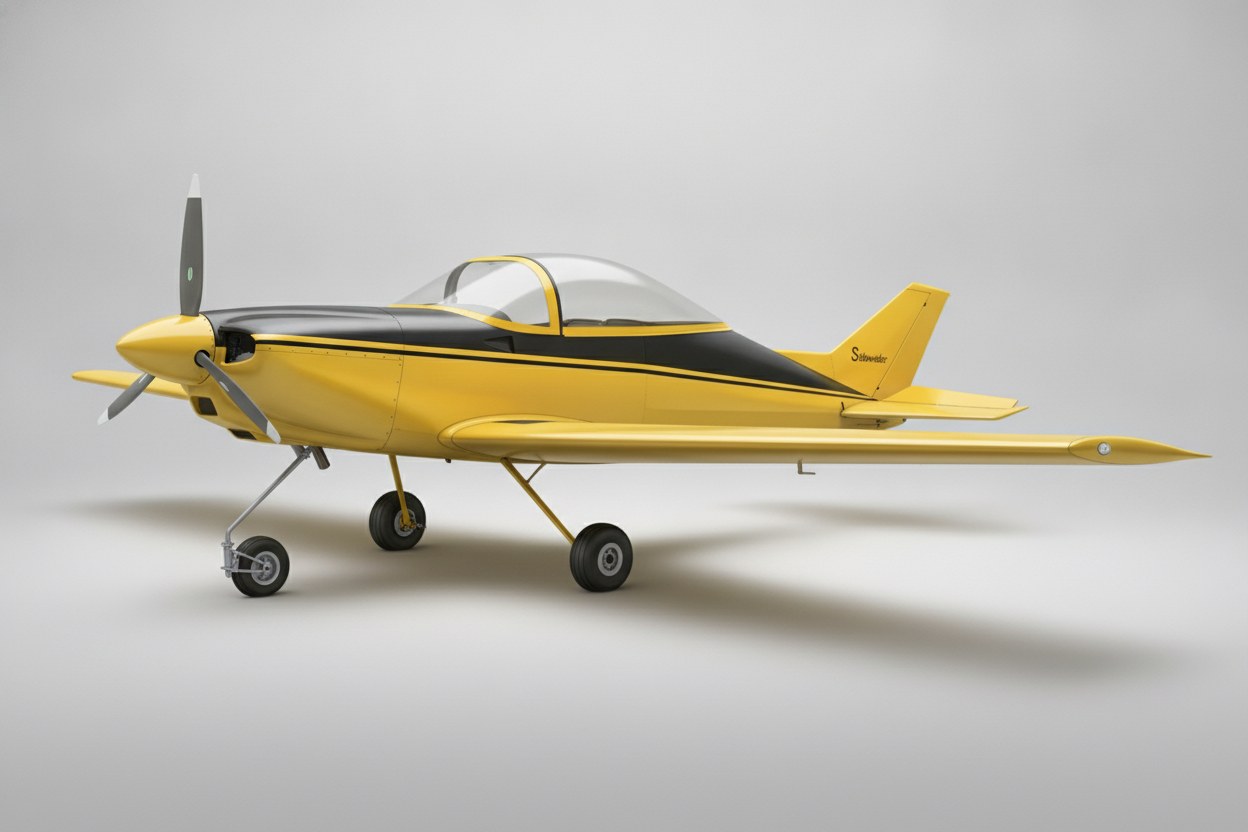
Design Genesis and Development
Jerry Smyth conceived the Sidewinder during his college aeronautical studies in the mid-1960s while serving as a Navy fighter pilot. Much of the preliminary design work occurred during his carrier deployments in the Vietnam War, where Smyth refined his vision of bringing military-style handling to civilian homebuilders. His design philosophy centered on creating an aircraft with "fighter-like control response" while maintaining accessibility for pilots with limited experience.
The prototype achieved its maiden flight in February 1969 and immediately garnered recognition within the experimental aircraft community. At the 17th Sport Aviation Convention in Rockford, Illinois, the Sidewinder earned the Outstanding Design award for 1969, establishing its reputation among homebuilders seeking performance-oriented projects.
Engineering and Construction
Smyth's engineering approach emphasized both performance and buildability through innovative material choices and proven components. The fuselage utilized welded 4130 aircraft-grade steel tubing covered with riveted aluminum skin, while the wings featured all-aluminum construction with internal fiberglass fuel tanks holding 17 gallons. The wing incorporated a NACA 64-212 laminar flow airfoil, contributing to the aircraft's impressive speed capabilities.
To simplify construction for amateur builders, Smyth specified readily available components from existing aircraft designs. The distinctive bubble canopy came directly from the Thorp T-18, while the landing gear system borrowed proven hardware from Wittman designs. This component-sharing philosophy reduced development costs and construction complexity while ensuring reliability.
The powerplant flexibility accommodated engines from 65 to 125 horsepower, though the prototype utilized a 125-hp Lycoming engine. With a 135-hp O-290 installation, the Sidewinder achieved its published 160 mph cruise speed and 185 mph maximum velocity. Builders installing the larger O-320 engine with fully faired landing gear and optimized exhaust systems reported cruise speeds reaching 180 mph.
Performance Characteristics
The Sidewinder's performance envelope reflected Smyth's military aviation background, delivering capabilities that rivaled factory-built aircraft. At its 1,450-pound gross weight, the aircraft demonstrated a 900 feet-per-minute climb rate and reached a service ceiling of 15,000 feet. Takeoff runs of 800 feet and landing rolls of 1,500 feet made the aircraft suitable for smaller airfields, while its 425-mile range provided respectable cross-country capability.
The structural design accommodated limited aerobatic flight with load factors of plus 6 and minus 3 Gs, enabling loops, rolls, and other basic maneuvers. The low stall speed of 55 mph combined with responsive controls made the aircraft forgiving for less experienced pilots despite its performance potential.
Production Philosophy and Distribution
Unlike contemporary manufactured aircraft, the Sidewinder existed solely as a plans-built design distributed to individual builders. This approach aligned with the experimental aircraft movement of the late 1960s, joining designs like the Tailwind, T-18, Cavalier, and Mustang II in offering high-performance alternatives to factory aircraft. Construction costs averaged approximately $10,000 based on documented builder experiences.
The plans-only distribution model meant each aircraft represented a unique construction project, with builders making individual modifications and improvements. This flexibility allowed for engine variations, equipment installations, and finish options that reflected each builder's preferences and budget.
Competitive Success and Legacy
Sidewinder aircraft have demonstrated their performance capabilities in competitive aviation events, participating in five AirVenture Cup races with a best finish of second place in class. The design also competed in the Copperstate Dash, achieving second place in class at 181 knots, validating Smyth's performance predictions.
The aircraft's continued presence in the experimental aviation community reflects the enduring appeal of Smyth's design philosophy. Examples remain active in private ownership, participating in fly-ins, air races, and recreational flying activities across the United States and internationally, including registered examples in New Zealand.
Contemporary Relevance
The Sidewinder represents an important milestone in homebuilt aircraft development, demonstrating how military aviation experience could translate into successful civilian designs. Smyth's emphasis on fighter-like handling characteristics influenced subsequent homebuilt designs, while his component-sharing approach became standard practice in the experimental aircraft community.
Today, the Sidewinder continues to attract builders seeking a challenging project with rewarding performance characteristics. Its combination of speed, agility, and structural strength maintains relevance in an era of increasingly sophisticated homebuilt designs, serving as both historical artifact and viable recreational aircraft for contemporary builders and pilots.