
Development and Design Innovation
The Sky Arrow emerged from Iniziative Industriali Italiane SpA, a company with remarkable aviation heritage dating to the late 1940s when it operated under the name Meteor. By the end of the 1950s, Meteor had established itself as a world pioneer in remotely piloted vehicles, collaborating with major aerospace companies including Northrop, Beech, Canadair, Ryan, and France's Nord Aviation as a successful defense contractor.
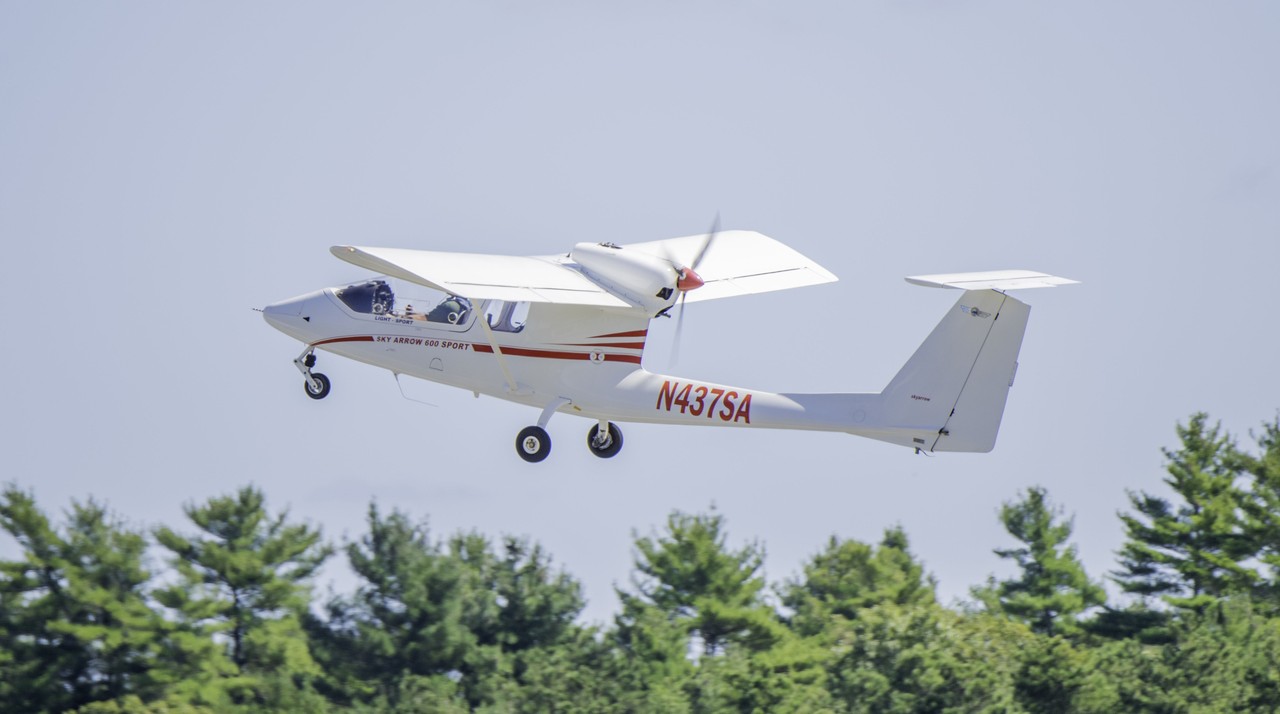
The Sky Arrow's design broke conventional light aircraft norms with its pusher propeller configuration, positioning the engine behind the cockpit rather than in the traditional nose-mounted arrangement. This tandem two-seat, high-wing layout provided pilots with unobstructed forward visibility and reduced propeller noise in the cockpit. The aircraft achieved JAR-VLA certification in its 650TC variant, meeting European light aircraft standards and later gaining FAA VFR certification through international agreement.
Production and Variants
Production commenced in 1993 following the prototype's successful first flight in March of that year. The manufacturer developed multiple variants with different maximum takeoff weights, including the Model 450, 480, 500, 650TC, and 1450. The Model 1450A variant utilized a Rotax 914 turbocharged four-cylinder engine producing 75 kW (100 horsepower), while most variants employed the Rotax 912 F2 generating 73.5 kW (98.6 horsepower).
The aircraft proved sufficiently successful to warrant international distribution, with examples operating across Australia, New Zealand, the United Kingdom, the Netherlands, and Italy. By July 2001, at least three Sky Arrows were registered and active in New Zealand alone, with the type making its first appearance in that country during 1996.
Operational Achievements
The Sky Arrow demonstrated remarkable long-distance capability when a Model 480T (registration ZK-EBR, construction number 135) completed a round-trip crossing of the Tasman Sea between July 23 and August 8, 1997. Each 15-hour crossing included fuel stops at Norfolk Island and Lord Howe Island, with the aircraft turning around at Coffs Harbour on the New South Wales central coast. This achievement highlighted the aircraft's reliability and range capabilities for such a light sport aircraft.
Technical specialists noted that the Sky Arrow could outclimb the Cessna, a significant performance advantage in the light aircraft category. The aircraft's cruising speed was later increased to 80 knots in subsequent variants after initial slower speeds proved unnecessary for its intended market.
Technical Specifications and Performance
The Sky Arrow's performance envelope included a maximum speed of 136 mph, cruising speed of 105 mph, and remarkably low stalling speed of just 43 mph. With a service ceiling of 25,000 feet and range of 360 miles, the aircraft provided substantial capability for a light sport aircraft weighing just 900 pounds empty. The useful load of 556 pounds allowed for two occupants plus equipment or baggage.
The rate of climb reached 800 feet per minute, contributing to the aircraft's reputation for strong climb performance. Wing area measured 13.5 square meters (145 square feet), providing adequate lift characteristics for the aircraft's weight class while maintaining reasonable ground handling dimensions.
Corporate Transitions and Revival
Initiative Industriali Italiane entered bankruptcy proceedings in 2008, temporarily ending Sky Arrow production after 15 years. However, Magnaghi Aeronautica, founded in 1936 to support the Italian Air Force with maintenance and spare parts production (primarily landing gears), purchased the design rights in 2012.
Magnaghi Aeronautica announced comprehensive upgrade plans including larger wing tanks, improved aerodynamics and stability, strengthened structural elements, and modern avionics packages. The company repositioned the aircraft for both traditional light sport applications and government utility roles such as border patrol, pollution monitoring, and aerial surveillance missions. Plans for a four-seat version were also announced, potentially expanding the aircraft's market appeal.
Current Status and Availability
Under Magnaghi Aeronautica ownership, Sky Arrow production resumed with both completed certified aircraft and kit versions available to builders. The design's flexibility in offering kit construction options broadened its accessibility to aviation enthusiasts willing to undertake assembly projects.
The Sky Arrow's legacy demonstrates successful Italian innovation in light aircraft design, combining unconventional configuration with proven Rotax powerplants to create a distinctive and capable sport aircraft. Its survival through corporate bankruptcy and subsequent revival under new ownership reflects the design's fundamental soundness and continued market relevance in the light sport aviation sector.