
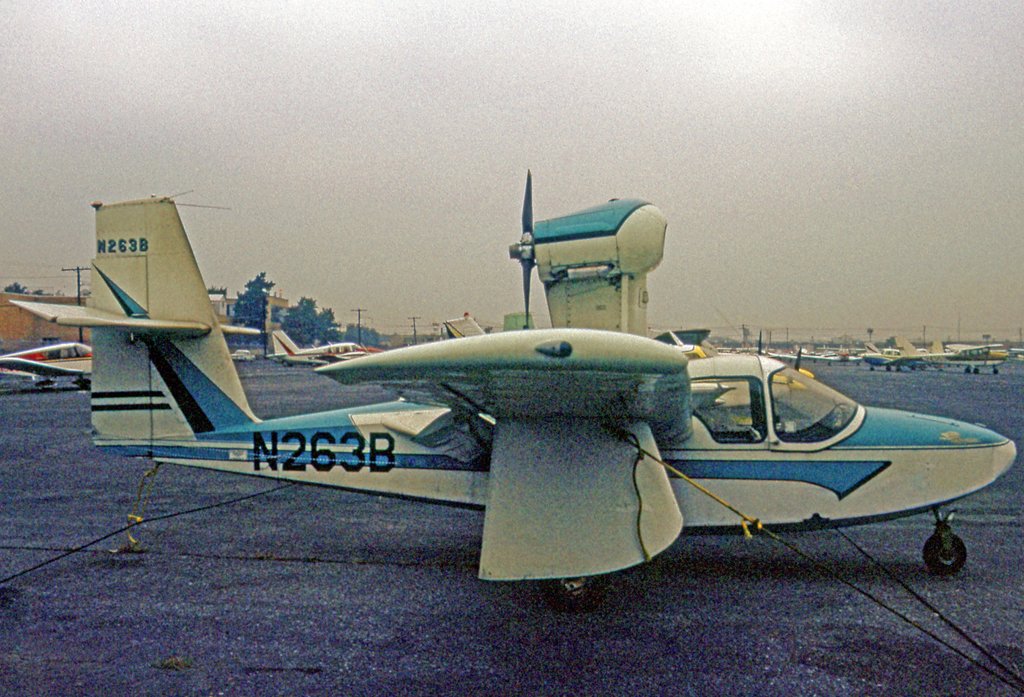
Revolutionary Design Concept
The Colonial C-1 Skimmer emerged from the ambitious vision of five former Grumman Aircraft Corporation and Republic Aviation engineers who formed Colonial Aircraft Corporation in December 1946. Led by designer David B. Thurston and joined by Herbert P. Lindblad, the team worked part-time on their revolutionary concept until March 1955, determined to create the first truly practical amphibian for private pilots. Their design broke new ground by combining water and land capability in an affordable package, challenging the notion that amphibious aircraft were exclusively for commercial or military use.
The prototype XC-1, registered N6595K, demonstrated the team's innovative approach when it first took to the skies on July 17, 1948. Unlike traditional flying boats with their complex hull designs, Thurston's team engineered a sleek single-step hull with stabilizing floats positioned beneath each wing. The pusher propeller configuration, mounted on a pylon behind the enclosed cockpit, eliminated spray ingestion problems that plagued conventional amphibians while providing excellent visibility for water operations.
Engineering Evolution
Early flight testing revealed that the prototype's original 115-horsepower Lycoming O-235C-1 engine provided insufficient performance, prompting the installation of a more powerful 125-horsepower Lycoming O-290-D. This pattern of continuous refinement characterized the Skimmer's development, with production C-1 aircraft ultimately receiving 150-horsepower Lycoming O-320-A1A engines driving Hartzell constant-speed propellers. The increased power transformed the aircraft's capabilities, delivering a respectable cruise speed of 110 mph with a gentle stall speed of just 50 mph.
The retractable tricycle landing gear represented another significant innovation, allowing seamless transitions between water and land operations. Pilots could taxi directly from water onto boat ramps or beaches, retract the gear for water takeoffs, or operate from conventional airports with equal facility. This versatility, combined with a useful load of 700 pounds and 40-gallon fuel capacity, made the Skimmer genuinely practical for recreational and business use.
Manufacturing Challenges and Triumph
Colonial Aircraft Corporation established its production facility in converted woolen mills at Sanford, Maine, chosen for its proximity to an airport and the availability of large factory spaces at a fraction of new construction costs. Production began in earnest after the company's September 1955 relocation, with the C-1 receiving certification that same month. Despite initial enthusiasm, Colonial managed to build only 24 examples of the original C-1 variant between 1956 and 1957, using construction numbers 1-14, 16-20, and 22-25.
The company introduced the improved C-2 Skimmer IV in December 1957, featuring a more powerful 180-horsepower Lycoming O-360-A1A engine and four-seat capacity. Approximately 18 to 20 examples of this variant rolled off the Sanford production line during 1958 and 1959, but financial pressures and limited market penetration constrained Colonial's operations to fewer than 50 total aircraft.
International Recognition and Service
Despite its limited production run, the Skimmer attracted international attention. In October 1959, Mervyn V. Richardson, managing director of Australia's Victa Consolidated Industries, imported the sole C-2 Skimmer IV to reach Australian shores. Registered as VH-ARB with construction number 133, Richardson operated the aircraft between his Pittwater residence on Sydney's northern beaches and Bankstown Airport near his company's facilities. This unique transport solution demonstrated the Skimmer's practical utility for business executives requiring flexible travel options.
The Australian Skimmer later served with Mesh Air of Biloela, Queensland, for charter operations throughout southeast Queensland before passing to private owner J.R. Marland of Avalon Beach, New South Wales. This operational history illustrated the aircraft's reliability and versatility across diverse geographic and climatic conditions.
Legacy and Transformation
Colonial Aircraft Corporation's brief but significant chapter in aviation history concluded in 1959 when former Grumman test pilot John F. Strayer purchased the manufacturing rights. Strayer's formation of Lake Aircraft Corporation marked not an ending but a transformation, with the Skimmer evolving into the Lake Amphibian and subsequently the Lake Buccaneer. This lineage continues today, making the Colonial Skimmer the progenitor of one of aviation's longest-running amphibian aircraft families.
The prototype N6595K achieved a remarkable second act when it was restored to flying condition and took to the skies again in 2010, more than six decades after its maiden flight. This restoration project demonstrated both the aircraft's fundamental soundness and its enduring appeal to aviation enthusiasts. The successful restoration flight validated Thurston's original design philosophy and highlighted the Skimmer's role as a pioneering achievement in light amphibian development.
Today, the Colonial C-1 Skimmer represents a pivotal moment when innovative engineering, entrepreneurial vision, and practical necessity converged to create something genuinely new in aviation. While Colonial Aircraft Corporation produced fewer than 50 examples, their impact on amphibian aircraft development proved far more significant than production numbers might suggest, establishing design principles that continue to influence amphibian aircraft development more than seven decades later.