
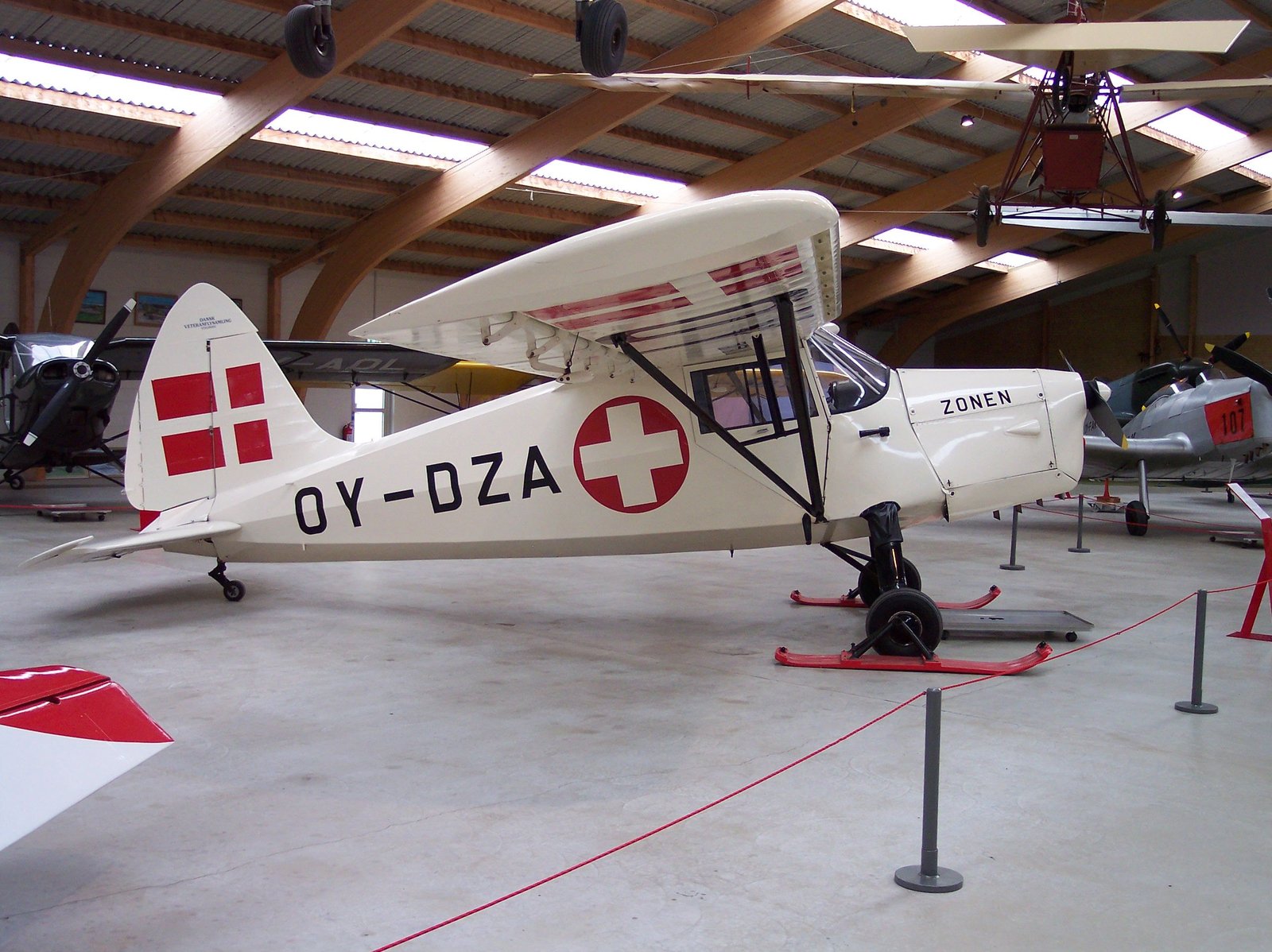
The Skandinavisk Aero Industri SAI KZ III was a Danish two-seat light utility aircraft designed for ambulance and general utility roles. Developed by the design team of Viggo Kramme and Karl Gustav Zeuthen—whose initials provided the "KZ" designation for the company's aircraft series—the KZ III first took flight on 11 September 1944. The aircraft was produced by Skandinavisk Aero Industri A/S (SAI) in Denmark, with a total of 64 units manufactured. While exact production dates are not recorded, the aircraft emerged during the latter stages of World War II and continued into the immediate post-war period.
Technically, the KZ III featured a high-wing, strut-braced configuration designed to provide a spacious cockpit for its two occupants. A distinctive design element was the unusual Y-shaped control stick mounted centrally between the side-by-side seats, allowing both the pilot and the passenger or medical attendant to access the flight controls. The aircraft was powered by a single Blackburn Cirrus Minor II four-cylinder, air-cooled inline piston engine, which delivered a maximum output of 75 kW (100 hp).
In terms of performance, the KZ III reached a maximum speed of 185 km/h and a cruise speed of 165 km/h. It possessed a range of 500 km and a service ceiling of 4,150 meters. The airframe had a wingspan of 9.60 meters and a length of 6.53 meters, with an empty weight of 419 kg and a maximum takeoff weight of 650 kg.
Although it flew during World War II, there is no documented evidence of the KZ III serving in formal military combat units. Instead, it focused on civil utility and medical transport. Its primary legacy lies in its role as the structural basis for the four-seat KZ VII Lærke, which first flew on 11 November 1946. SAI produced approximately 200 aircraft across its entire KZ range between 1937 and 1954, but the company eventually ceased operations in 1954 after post-war sales failed to meet expectations and production became unprofitable.