
Service History
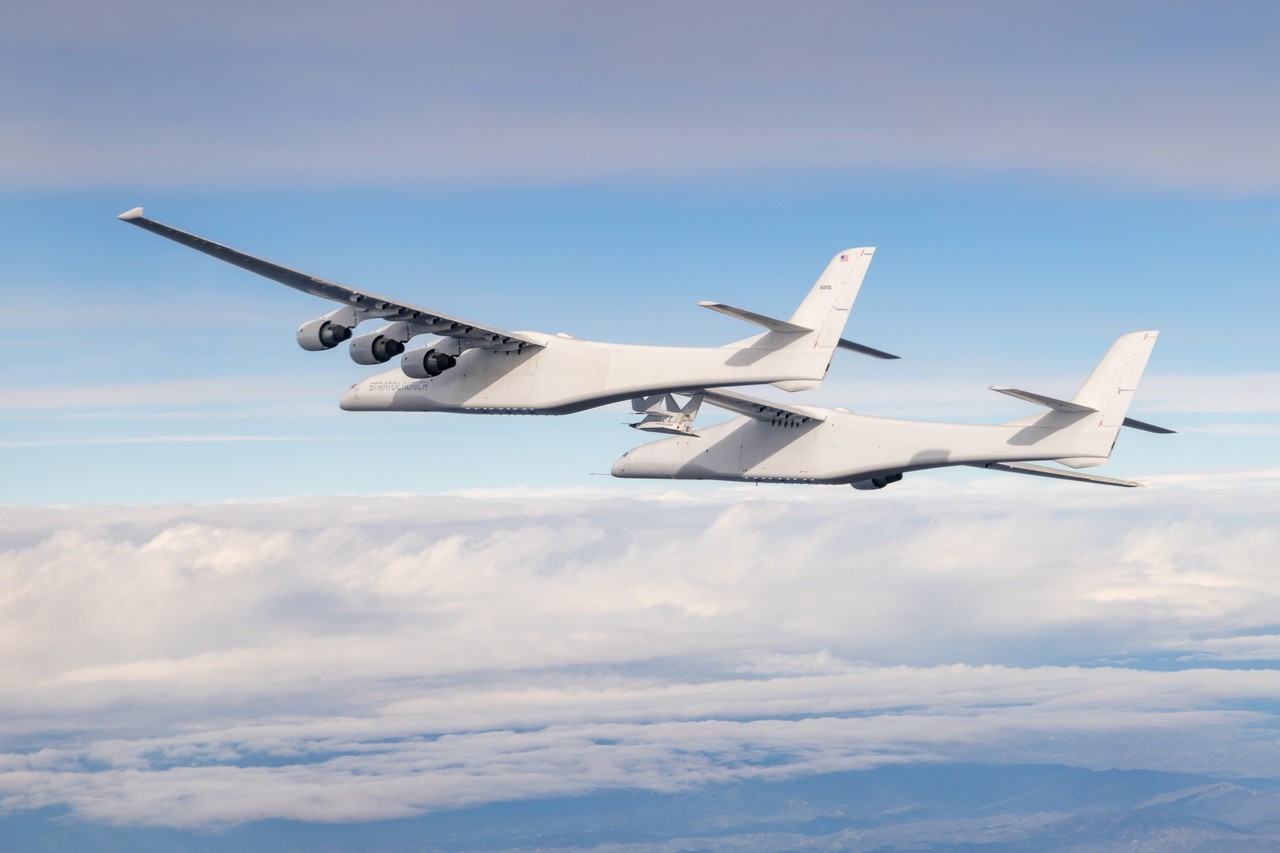
The Stratolaunch operates as a singular testbed for air-launch technology and hypersonic flight testing. Since its maiden flight in 2019, the aircraft has completed 24 flights through May 2025, including notable missions on April 29, 2021, and January 16, 2022, when it reached altitudes exceeding 23,490 feet during a 4-hour 23-minute flight. Following the death of founder Paul Allen in October 2018 and subsequent acquisition by Cerberus Capital Management in October 2019, the program shifted focus from orbital rocket launches to hypersonic vehicle testing.
The Manufacturer
Scaled Composites LLC, founded by legendary aircraft designer Burt Rutan in 1982, built the Stratolaunch at their Mojave facility. The company, acquired by Northrop Grumman in 2007, specializes in experimental composite aircraft and pioneered revolutionary designs including Voyager, which completed the first nonstop global flight in 1986, and SpaceShipOne, the first privately-funded spacecraft to reach space in 2004. For the Stratolaunch project, Scaled Composites constructed an 88,000-square-foot manufacturing facility specifically for composite wing and fuselage sections, opening in October 2012.
Design Innovation
Burt Rutan conceived the core air-launch concept over two decades before construction began, with his team at Scaled Composites leading development from 2011. The aircraft's twin-fuselage configuration features flat-sided fuselages for cost-effective fabrication, connected by a massive composite wing structure. At 385 feet, the wingspan surpasses the previous record-holder, Howard Hughes' H-4 Hercules, by 64 feet. The aircraft stands 50 feet tall with 95 feet separating the two fuselages, creating a central mounting point for rocket payloads.
Engine & Technical Details
Six Pratt & Whitney PW4056 turbofan engines, sourced from Boeing 747 aircraft, provide approximately 336,000 pounds of total thrust—the greatest thrust output of any aircraft ever built. Each engine delivers roughly 56,000 pounds of thrust, utilizing high-bypass ratio technology for fuel efficiency during extended missions. The aircraft requires a three-person crew consisting of two pilots and one flight engineer. During its first flight, pilots Evan Thomas and Chris Guarente flew the aircraft for 149 minutes, reaching 17,000 feet and 165 knots.
Performance Characteristics
The Stratolaunch demonstrates impressive capabilities despite its massive size. With an empty weight of 500,000 pounds and maximum takeoff weight of 1.3 million pounds, it maintains an operational range of 2,000 nautical miles with mission radius of 1,000 nautical miles. Mission duration typically spans 2 to 8 hours, allowing sufficient time for rocket deployment and return to base. The aircraft's composite construction makes it the largest all-composite aircraft ever built, weighing significantly less than conventional aluminum construction would permit.
Legacy and Current Operations
As the sole example of its kind, the Stratolaunch continues active flight operations from Mojave Air and Space Port. The aircraft holds multiple world records including longest wingspan, largest all-composite structure, and greatest total engine thrust. While the original vision of routine satellite deployment never materialized commercially, the platform now serves the growing hypersonic testing market. The aircraft symbolizes the ambitious private space ventures of the 2010s and demonstrates the continued innovation possible in aviation design.
The Stratolaunch's cultural impact extends beyond its technical achievements. Featured prominently in aerospace publications and air shows, it represents a bridge between traditional aviation and the commercial space industry. Though no museum examples exist due to the single aircraft remaining operational, the Stratolaunch has secured its place in aviation history as a testament to visionary engineering and the pursuit of routine space access through air-launch platforms.