
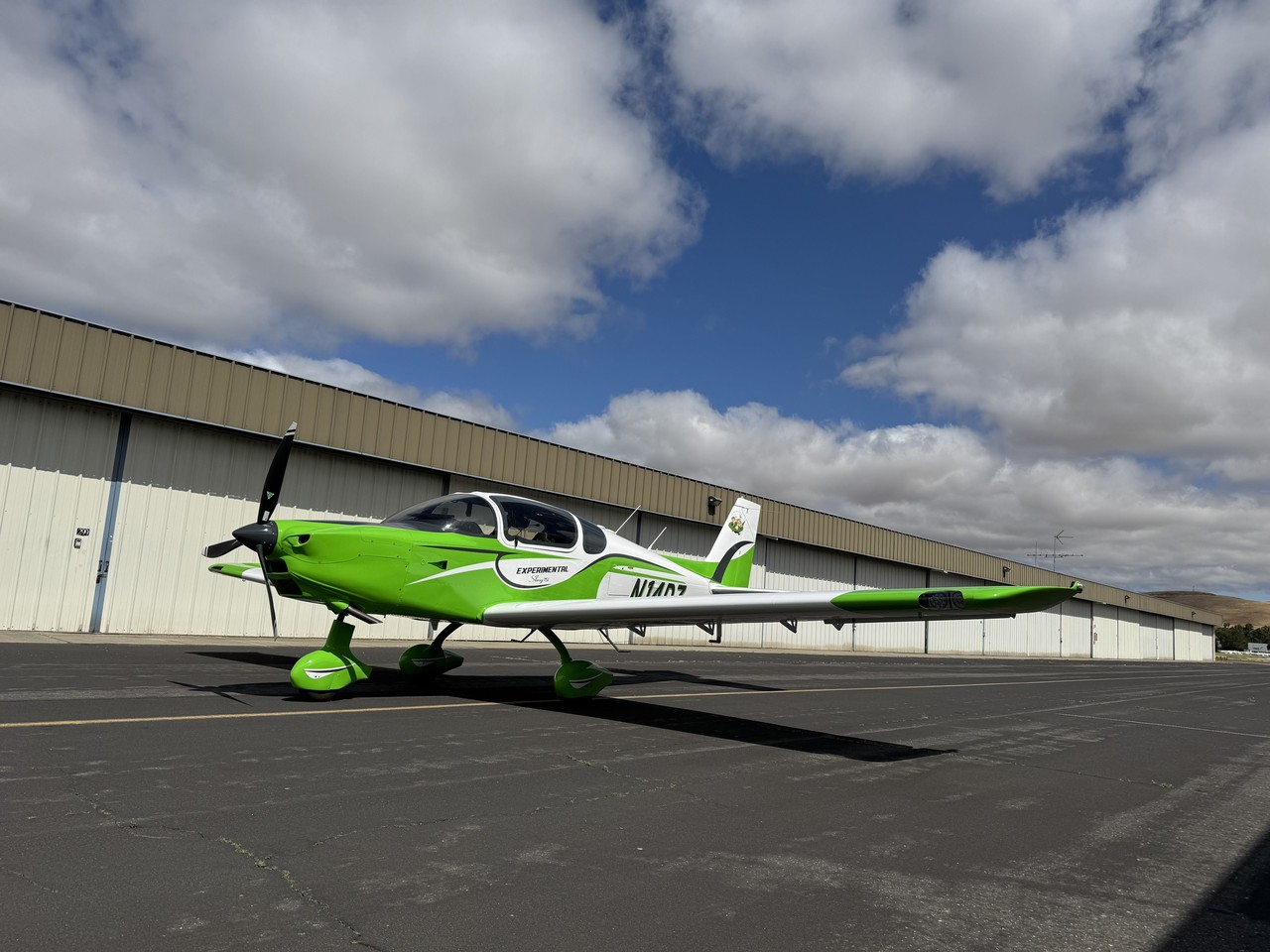
Design Origins and Development
The concept for the Sling 4 emerged during an ambitious 2009 global circumnavigation flight by Mike Blyth and James Pittman, co-owners of The Airplane Factory, flying their two-seat Sling 2. Rather than simply extending the existing fuselage and installing a larger powerplant, the design team completely reimagined their aircraft while preserving proven elements like the successful airfoil and interior configuration. Their objective was creating an economical four-place airplane with genuine fuel efficiency, addressing what they identified as an underserved market segment.
The resulting design incorporated several innovative features for a kit aircraft, including gull-wing entry doors providing easy cabin access, panoramic visibility through extensive glazing, and sandwiched fiberglass landing gear legs combined with traditional all-aluminum construction. The aircraft featured glass cockpit displays and provision for a full airframe parachute system as optional equipment.
The Airplane Factory
The Airplane Factory, established in Johannesburg, South Africa, began operations with the Sling 2's first flight in 2008. The company, now operating under the name Sling Aircraft, expanded its global presence significantly following the Sling 4's success, establishing production and distribution facilities in Torrance, California, Australia, New Zealand, and Taiwan. In the United States, Synergy Air of Eugene, Oregon, became the primary distribution partner, leveraging nearly 15 years of kit aircraft construction experience.
Engine and Performance Characteristics
The Sling 4 employs the Rotax 914UL turbocharged engine, an Austrian-manufactured horizontally-opposed powerplant delivering 115 horsepower for takeoff and 100 horsepower continuously. This lightweight engine maintains takeoff power performance to 15,000 feet, providing the aircraft with a service ceiling of 15,000 feet and a rate of climb of 800 feet per minute. The proven Rotax powerplant offered builders confidence in long-term service support and parts availability.
With 43.32 gallons of usable fuel capacity, the Sling 4 achieves a range of 810 miles with 45 minutes reserve fuel at 75 percent power settings. The aircraft's wing loading of 14.4 pounds per square foot contributes to its handling characteristics, while the constant-speed propeller with electric governor and feathering capability optimizes performance across various flight regimes.
Notable Flights and Demonstrations
The aircraft's capabilities received dramatic demonstration in July 2013 when Mike Blyth and his son departed South Africa for AirVenture in Oshkosh, Wisconsin. Their Sling 4 carried sufficient fuel for 20 hours endurance, enabling a 14-hour over-water segment that showcased the design's long-range touring capabilities. This flight effectively demonstrated the aircraft's suitability for serious cross-country travel.
In 2014, The Airplane Factory staged an impressive construction demonstration at the South African Airshow, where 40 factory workers assembled a complete Sling 4 kit in four days and flew the finished aircraft at the event. This demonstration highlighted the kit's comprehensive engineering and assembly-friendly design.
Construction and Assembly
The Sling 4 is available both as a kit for amateur construction and as a factory-completed aircraft. Standard kit assembly requires an estimated 900 to 1,200 man-hours of work for typical builders. However, the company offers a turbo-build option with factory assistance that enables completion in two weeks, appealing to buyers seeking faster project completion.
The all-metal construction follows traditional techniques familiar to amateur builders, while the innovative fiberglass landing gear legs provide durability advantages over conventional steel gear. This hybrid approach balances construction simplicity with performance optimization.
Production Success and Evolution
By 2020, The Airplane Factory had delivered 281 Sling 4 aircraft, establishing the type as a modest but steady success in the competitive kit aircraft market. The design's proven characteristics led to further development, including the Sling TSi variant introduced in 2018. The TSi incorporates the more powerful 141-horsepower Rotax 915 iS engine, improved aerodynamics, enhanced cruise speed, and slightly higher useful load.
The success of the basic Sling 4 platform also enabled development of the Sling HW high-wing variant, which achieved first flight in 2020, demonstrating the fundamental soundness of the original design concept. The aircraft continues receiving full manufacturer support, with Sling Aircraft maintaining production capabilities and worldwide parts distribution networks for all variants in their product line.