
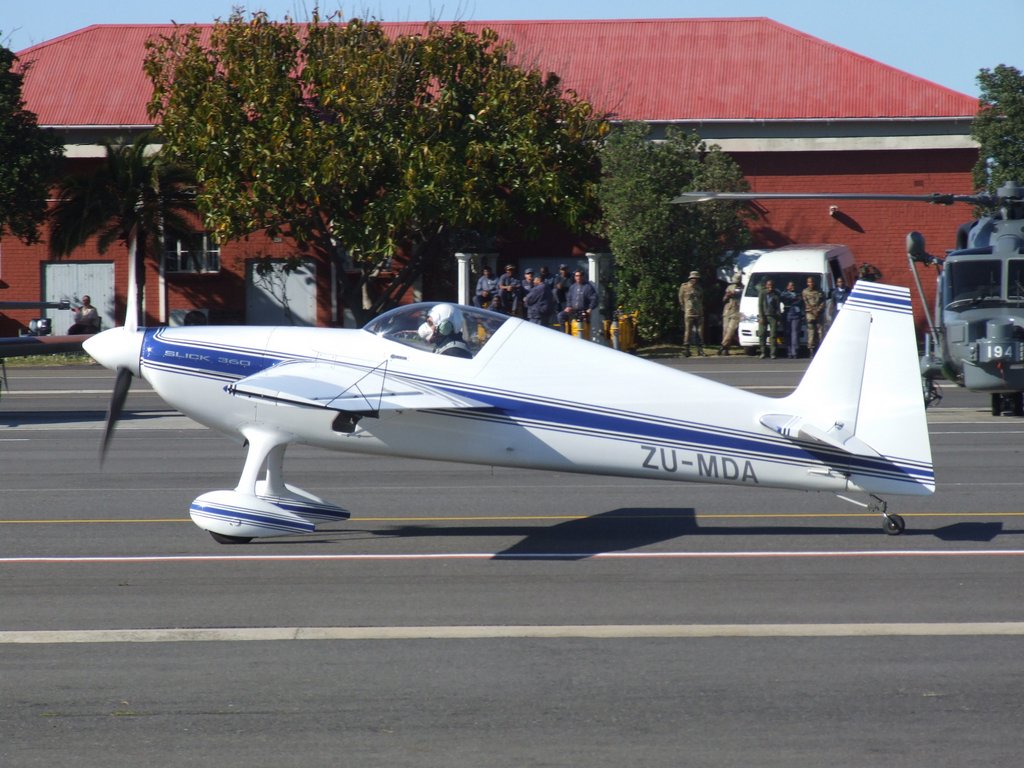
Competition Success
The Slick 360 achieved immediate competitive success when prototype pilot Glen Dell won the South African National Aerobatics Championships in June 2004, just one year after the aircraft's first flight. Dell, who became the Advanced World Aerobatic Champion in 2004, had driven the project's development due to weight disadvantages he experienced with aluminum competition aircraft. The prototype's victory demonstrated the effectiveness of the composite design approach in real competition conditions.
Design Innovation
South African aerobatic champion Glen Dell led the aircraft's development, working alongside aeronautical engineer François Jordaan, who designed the wings. Jordaan brought significant experience from his previous work on the Celstar GA-1 glider wings and the Ravin 500 aircraft. The design team had previously achieved success with the Celstar GA-1, which won gold and silver medals at the 1989 World Championships.
The Slick 360's carbon-fiber composite construction provided crucial weight savings over traditional aluminum designs. The wings incorporated advanced aileron systems enabling roll rates of approximately 400 degrees per second, delivering Laser-like flick roll characteristics essential for competitive judging in Advanced World Aerobatics Championships events. The spacious, high-visibility cockpit accommodated larger pilots, addressing a common limitation in aerobatic aircraft design.
Manufacturing Evolution
Production began under Aerocam, the company that developed the 2003 prototype, but underwent significant changes in 2006 when Global Composite Solutions acquired Aerocam. Full composite production models, beginning with serial number 002, commenced manufacturing in 2006 at the Pretoria, South Africa facility. Slick Aircraft Company was established in 2005 specifically to promote and market the Slick 360 while continuing research and development efforts.
Aerocam's diverse background included military remotely piloted vehicle design, King Air 200 cargo pod development, oil spill treatment spray systems, and composite kit assembly for various aircraft including the Thunder Mustang and Sea Wind. This experience in composite manufacturing proved valuable for the Slick 360's development.
Engine and Performance
The aircraft utilized a specially modified Lycoming AEIO-360-A1B6 engine, a four-cylinder horizontally-opposed air-cooled piston engine producing 171.5 kW (230 horsepower). AeroSport Power of Canada modified the engine with lightweight parallel valves and cold air induction sump for improved aerobatic oil scavenging. The engine was fully aerobatic-qualified but limited to 10 seconds of vertical flight, steep dives, inverted flight, zero-g conditions, or knife-edge maneuvers due to oil system constraints.
The powerplant enabled the Slick 360 to achieve a maximum speed of 420 km/h (260 mph) with a range of 796.6 kilometers (495 miles). The aircraft's structural design accommodated loads of +10/-10g, meeting the demanding requirements of advanced aerobatic competition. The power-to-weight ratio of 0.33 kW/kg provided competitive performance in the restricted Advanced category for 4-cylinder engines producing approximately 230 horsepower.
Limited Production
Production remained extremely limited, with exactly 9 aircraft sold through available records up to 2013. The aircraft measured 6.83 meters (22 feet 5 inches) in length with a wingspan of 7.30 meters (23 feet 11 inches) and height of 2.16 meters (7 feet 1 inch). Wing area totaled 8.686 square meters (93.50 square feet). Empty weight was 465 kg (1,025 pounds) with maximum takeoff weight of 645 kg (1,422 pounds).
Current Status
At least one airframe remains airworthy as of recent records. Aircraft registration LN-SLK (manufacturer serial number 360-0605) was built in 2006 and registered in Norway under the experimental/amateur-built aerobatic category. The total number of airworthy examples remains unknown but is necessarily low given the limited production run.
The Slick 360's significance lies in its role as a modern composite alternative to discontinued aerobatic competition aircraft, demonstrating advanced materials and design techniques in specialized aviation applications. While production numbers remained minimal, the aircraft successfully bridged the gap in Advanced category competition aircraft during a period when traditional models were no longer available.