
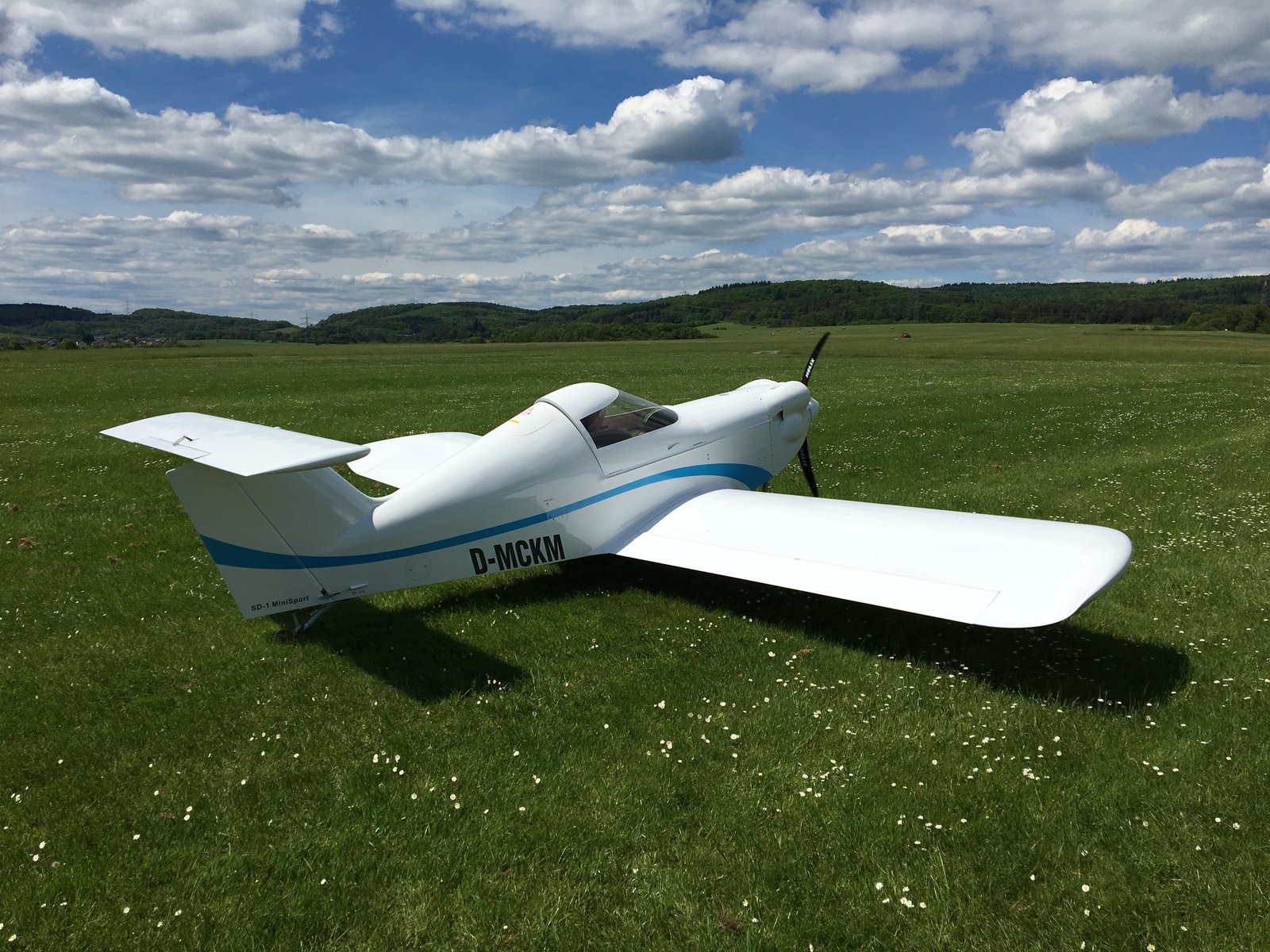
Design Philosophy and Innovation
Igor Špaček conceived the SD-1 Minisport with specific objectives: create a lightweight, easily assembled ultralight that could meet multiple international certification standards including FAI UL, LSA, German 120-kilogram empty weight regulations, and UK SSDR microlight rules. The aircraft's most notable feature is its wings, which can be removed and reinstalled in just 5-10 minutes using a simple pin system, making it exceptionally portable for amateur builders.
The Minisport employs an innovative mixed construction approach, combining a Sitka spruce truss fuselage with carbon fiber reinforcements and a composite main wing spar featuring carbon caps that weigh only 2 kilograms. The wing structure incorporates polystyrene ribs and 1-millimeter plywood skin, utilizing the GA 37U-A315 airfoil profile for optimal performance characteristics.
Manufacturing and Global Reach
Spacek s.r.o., established in 2007 by Igor Špaček in Hodonin, Czech Republic, began production of the SD-1 shortly after the company's founding. The first aircraft, serial number 15 registered as OK-KUI 22, was completed in 2010, initially built for Špaček's personal use before the design gained commercial traction in the ultralight market.
By 2023, more than 230 licenses had been issued worldwide, with over 100 aircraft flying in Europe alone as of the mid-2010s. At least 50 completed aircraft were operational globally by 2023, including notable examples such as serial number 100 (D-MTLC) in Germany, serial number 105 (ZK-DDM) in New Zealand, and serial number 107 (19-8441) in Australia.
The aircraft achieved international distribution through dealers in Australia, Canada, Germany, France, Italy, Poland, Spain, Portugal, the United Kingdom, and the United States. SkyCraft Airplanes in Orem, Utah, briefly manufactured the type as a light-sport aircraft until the company ceased operations by 2017.
Engine Options and Performance
The SD-1 accommodates various powerplants ranging from 24 to 50 horsepower, with popular choices including the Hirth F-33 (28 horsepower, single-cylinder, air-cooled, two-stroke) and the more powerful Hirth F-23 (50 horsepower, two-stroke). The Kohler CH-750 four-stroke engine is recommended for the XL variant designed for taller pilots.
This engine flexibility enables cruise speeds between 130-220 km/h, with a never-exceed speed of 131 mph and maneuvering speed of 156 km/h. The aircraft achieves a range of approximately 600 kilometers on 35 liters of fuel while supporting pilots weighing up to 105 kilograms.
Variant Configurations
Spacek offers four primary configurations to suit different operational requirements and pilot preferences. The TD variant features conventional taildragger landing gear, while the TG incorporates tricycle gear for easier ground handling. The TGC adds nose wheel steering to the tricycle configuration, and the XL variant provides additional cockpit space for pilots over 2 meters tall, expanding the standard 54-centimeter cockpit width.
Operational Characteristics
With maximum takeoff weight of 240 kilograms and empty weight up to 120 kilograms under German certification rules, the Minisport offers impressive performance for its size category. The aircraft measures 4.35 meters in length with a height of 1.23 meters, providing a compact yet capable platform for recreational flying.
The single-seat cockpit features a removable back panel that can accommodate baggage when passenger capacity isn't required. The T-tail configuration, combined with the high-wing design, provides stable flight characteristics while maintaining the structural simplicity essential for amateur construction.
Current Status and Legacy
Production continues as of 2025, with Spacek s.r.o. maintaining operations under Igor Špaček's leadership. The company has expanded its product line to include the two-seat SD-2 SportMaster while continuing to support the global SD-1 fleet through its international dealer network.
Notable examples include PH-4H6, which operates from Drachten EHDR and Hoogeveen EHHO airports in the Netherlands and Belgium, and OK-YUU 72 (serial number 241), which appeared at the Čáslav airbase open day in May 2023. The aircraft has gained recognition in aviation enthusiast communities and appears in flight demonstration videos and simulation software, cementing its place in the modern ultralight aviation landscape.
The SD-1's significance lies in its successful combination of innovative materials, practical design, and international regulatory compliance, making advanced ultralight aviation accessible to builders worldwide while maintaining the performance characteristics demanded by sport pilots.