
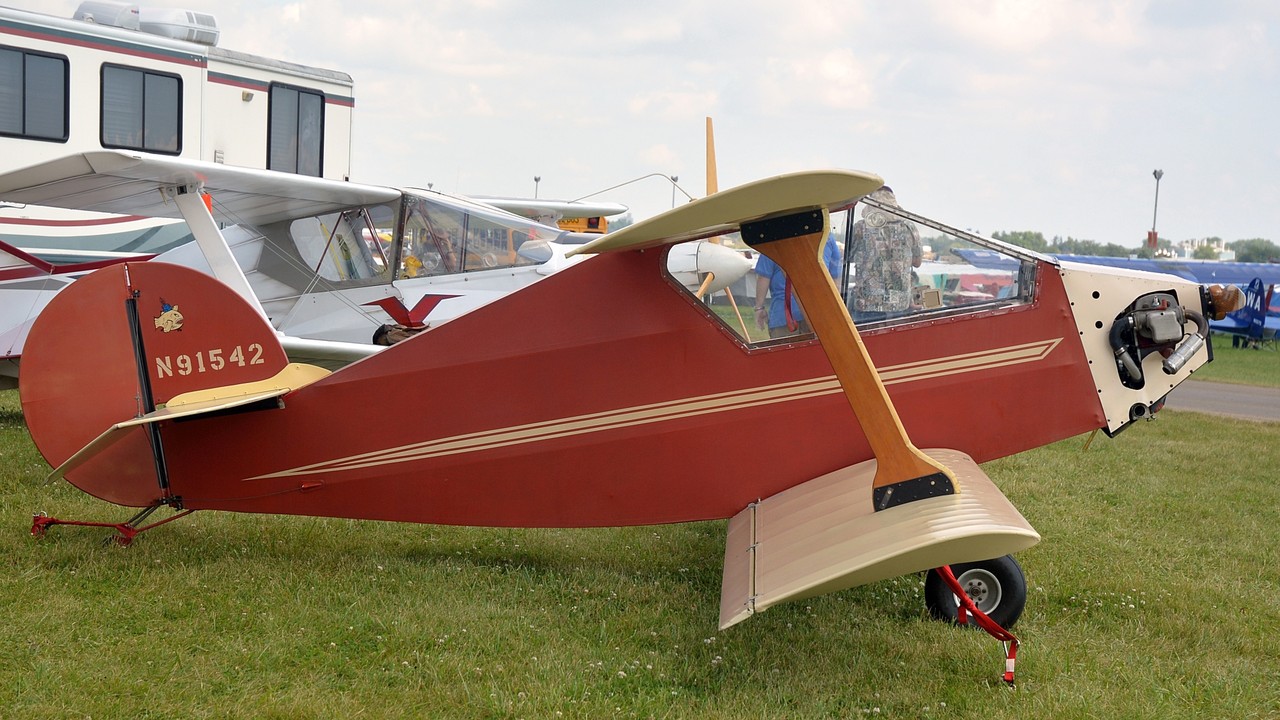
Design Innovation
The SNS-2 Guppy emerged from the creative minds of Hobie Sorrell and his sons John, Mark, and Tim at their Tenino, Washington facility. The aircraft's most distinctive feature was its negative-stagger wing arrangement, similar to the famous Beech Staggerwing, where the upper wing was positioned aft of the lower wing. This configuration provided the pilot with exceptional forward visibility while improving stall characteristics compared to conventional biplanes.
Unlike the open-cockpit ultralights that would dominate the market a decade later, the Guppy featured a fully enclosed cabin despite its ultralight weight category. The all-wood construction with fabric covering made it accessible to amateur builders, predating the formal ultralight regulations of the 1980s by more than a decade.
The Sorrell Aviation Story
Sorrell Aviation began operations in 1958, initially gaining attention with Hobie Sorrell's 1957 Dr.1, a three-quarter scale replica of the famous Fokker Dr.I triplane. The company specialized in negative-stagger biplanes, eventually producing between 50 and 100 Hiperbipe kits alongside the SNS-2 Guppy and Pitts S-1-11B parts.
The family-operated business continued through the 1980s before closing. However, their design legacy lived on as rights to later Sorrell designs were acquired by successive companies. Sunrise Aircraft of Sheridan, Oregon, took over some designs, followed by Thunderbird Aviation of Ray, Michigan, which acquired rights to the SNS-8 Hiperlight in 2002 and the SNS-7 in 2013.
Technical Specifications and Performance
The SNS-2's powerplant evolved during its development. Early prototypes used an 18-horsepower OMC Cushman 200 engine, but production kits featured the more robust 32-horsepower Rotax 377 two-stroke, two-cylinder engine. This Austrian-made powerplant provided enough thrust to push the 350-pound aircraft to a maximum speed of 90 mph and a comfortable cruising speed of 70 mph.
With a wingspan of 21 feet 3 inches and wing area of 129 square feet, the Guppy achieved its design objective of docile handling characteristics. The aircraft featured flaperons and fixed tailwheel landing gear, keeping complexity and weight to a minimum. At a maximum takeoff weight of just 600 pounds, the SNS-2 qualified as an ultralight by later standards while providing the structural protection of an enclosed cabin.
International Recognition
The Guppy found buyers beyond American shores, with documented exports to Australia and New Zealand. Australian registrations included aircraft 10-0136, registered on May 20, 1988, and 10-0291, registered on June 23, 1988. New Zealand received at least one example, the prototype registered as ZK-JGK with construction number Guppy-1.
One documented U.S. example, N5023C, was completed in 1983, demonstrating the design's longevity well into the 1980s. However, the exact total production number remains unknown, typical of many homebuilt aircraft where kit sales and completed aircraft numbers often diverge significantly.
Legacy and Current Status
The SNS-2 Guppy's influence extended beyond its own production numbers through its role in advancing the negative-stagger biplane concept. The design philosophy pioneered by the Guppy influenced later Sorrell aircraft, including the SNS-8 Hiperlight, which achieved significant success with 603 aircraft built by 2011.
Sorrell designs gained recognition at major aviation events, with the related Hiperbipe winning Outstanding New Design honors at Oshkosh in 1973. This recognition helped establish Sorrell Aviation's reputation in the homebuilt community during the post-World War II experimental aircraft boom.
While few SNS-2 Guppys remain active today, related Sorrell designs can be found in museums, including an unregistered Hiperlight at the Ultralight Aircraft Museum in Holbrook, New South Wales, Australia. The design's safety record included typical general aviation incidents, with documented accidents in Australia including a crash at Beechwood, NSW, on November 12, 1989, and another at Oxley Island, NSW, on February 25, 1987.
The SNS-2 Guppy represents an important chapter in homebuilt aviation history, bridging the gap between traditional aircraft and the ultralight revolution that would transform recreational flying in the following decades.