
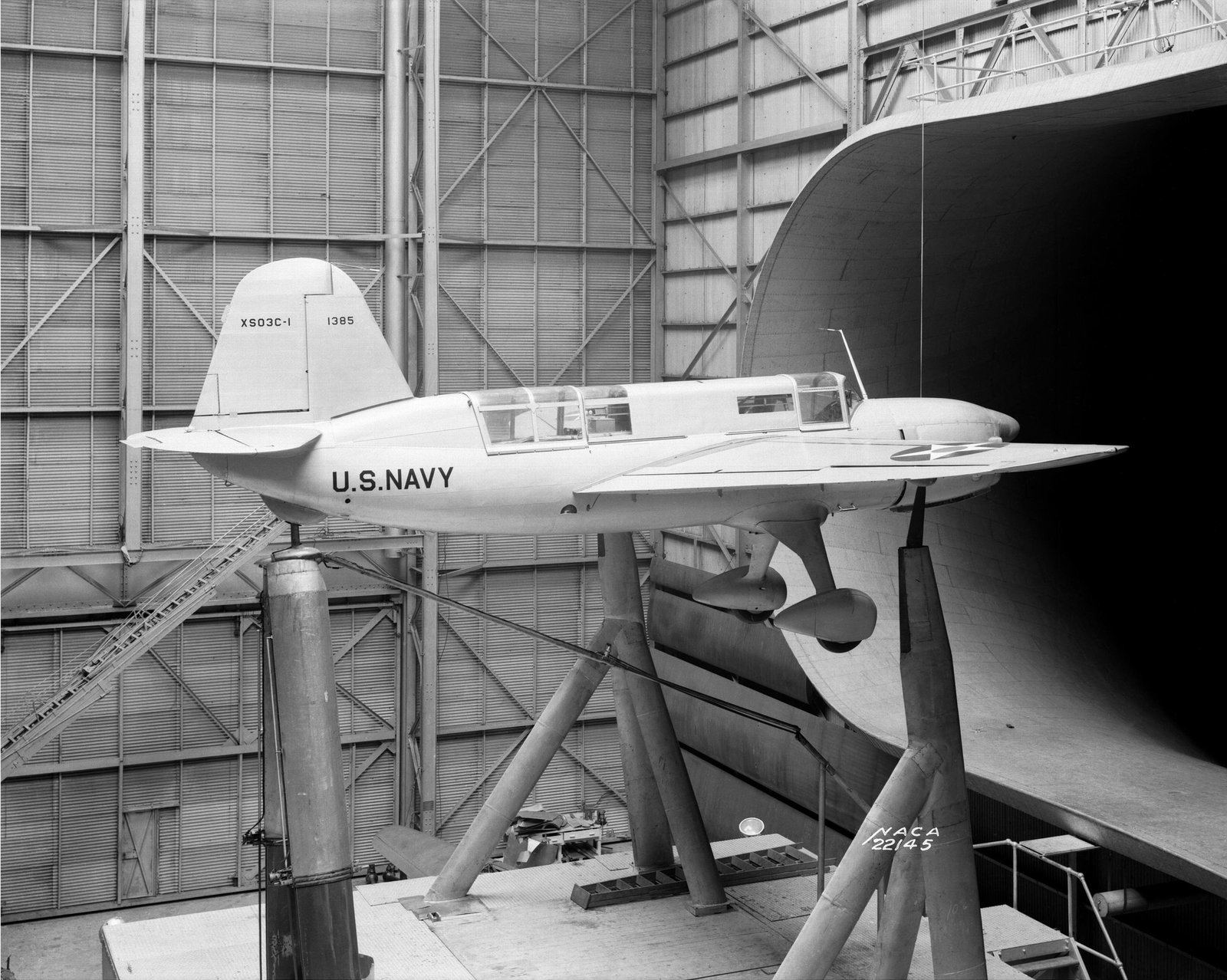
The Curtiss-Wright SO3C Seamew (Model 82) was developed by the Curtiss-Wright Corporation to modernize the U.S. Navy's scout-observation capabilities, specifically replacing the biplane Curtiss SOC Seagull. The aircraft first flew in 1939 and entered service in 1942. Designed as a two-seat, single-engine, low-wing monoplane, the Seamew was intended for catapult launch from cruisers, battleships, and auxiliary ships. While the prototype was initially a landplane with fixed wheeled undercarriage, production models were configured as floatplanes featuring a central main float and outrigger floats for water operations.
Technically, the SO3C was defined by its unusual powerplant: the Ranger XV-770 inverted V-12 air-cooled inline engine. Producing 600 hp, this engine proved to be a dismal failure, plagued by chronic unreliability and poor performance despite numerous modification attempts. This mechanical instability, combined with poor in-flight handling and aerodynamic stability issues, severely undermined the aircraft's effectiveness. The SO3C-2 variant, as a representative model, featured a wingspan of 41 feet, a length of 36 feet, and a maximum takeoff weight of 5,729 lb. It could reach a maximum speed of 172 mph and had a service ceiling of 15,800 feet.
During World War II, the SO3C served with the U.S. Navy, the U.S. Coast Guard, and the Royal Navy's Fleet Air Arm. The U.S. Coast Guard acquired between 27 and 48 aircraft, though all were returned to the Navy by June 1944 due to maintenance and performance failures. Under Lend-Lease, approximately 100 of the 250 allocated aircraft were delivered to the Royal Navy, where they were used by No. 744, 745, and 755 Naval Air Squadrons. British crews derisively nicknamed the aircraft the "Sea Cow."
Production occurred between 1942 and 1944, with approximately 795 aircraft built across several variants, including the SO3C-1, -2, and -3. However, the aircraft's failures were so pronounced that the U.S. Navy withdrew it from first-line service by 1944, which led to the unusual decision to bring the obsolete SOC Seagull biplanes back into front-line service. By 1945, the Seamew was completely removed from service. Its legacy remains that of an unsuccessful design hampered by an immature engine and unstable flight characteristics.