
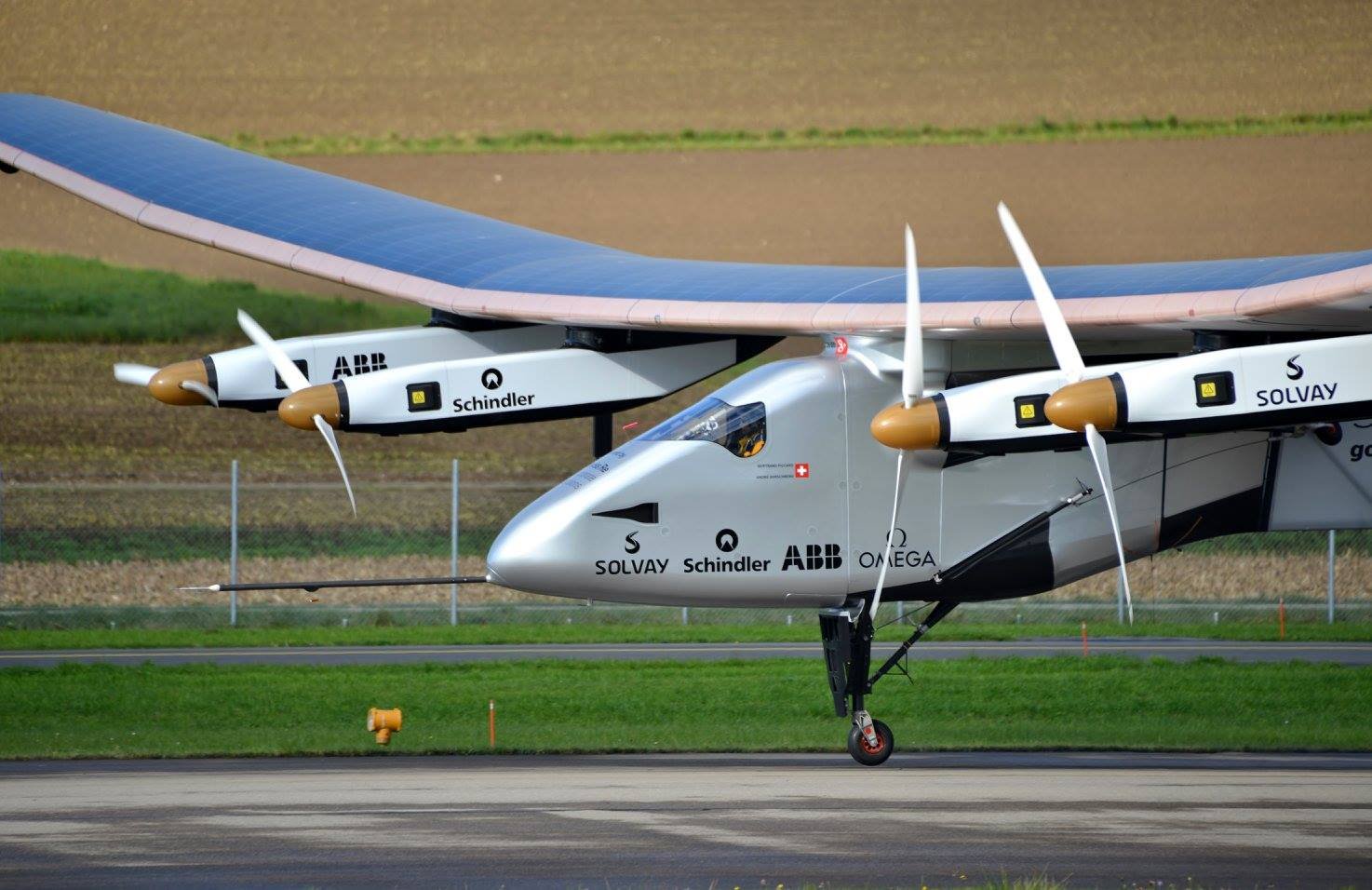
Historic Round-the-World Achievement
Solar Impulse 2's defining moment came during its 506-day circumnavigation from 9 March 2015 to 26 July 2016. Departing from Abu Dhabi, the aircraft completed 17 legs covering more than 43,000 kilometers across multiple continents and oceans. Pilots Piccard and Borschberg alternated flying duties throughout the journey, accumulating 550 total flight hours while the aircraft generated 11,000 kilowatt hours of energy entirely from solar power.
The most remarkable segment occurred when André Borschberg piloted the aircraft from Nagoya, Japan to Kalaeloa, Hawaii, between 28 June and 3 July 2015. His 117 hours and 52 minutes in the air, covering 8,924 kilometers, established records for both the longest non-stop solo flight and longest duration in a solar-powered aircraft. Bertrand Piccard later set another milestone flying from New York to Seville, Spain, covering 5,851.3 kilometers to claim the longest distance record in an electric aircraft.
Development and Design Innovation
Construction began in 2011 at Payerne Air Base in Switzerland, though the project faced significant challenges. A structural failure of the main spar during static tests in July 2012 delayed completion until 2014. The team overcame this setback by redesigning critical components and implementing enhanced safety systems.
The aircraft's design represented a dramatic advancement over its predecessor, Solar Impulse 1. Engineers installed 17,248 solar cells across the 72-meter wingspan, feeding power to four lithium-ion battery packs that drove the electric motors. A sophisticated battery cooling system managed thermal challenges during extended flights, while an advanced autopilot system and oxygen mask capability enabled high-altitude operations up to 12,000 meters.
The Visionary Team
Dr. Bertrand Piccard, grandson of stratosphere pioneer Auguste Piccard, conceived the Solar Impulse project following his own record-setting balloon circumnavigation in 1999. His partner André Borschberg brought essential aeronautical engineering expertise and pilot skills to the venture. The feasibility study began at École Polytechnique Fédérale de Lausanne in 2002, evolving from academic research into a full-scale demonstration program.
Rather than operating as a traditional aircraft manufacturer, the Solar Impulse organization functioned as an engineering research initiative focused on proving renewable energy concepts. The team's approach emphasized pushing technological boundaries while maintaining absolute safety standards for the pilots who would spend days alone at the controls.
Technical Specifications and Performance
Solar Impulse 2's four electric motors generated enough power to maintain cruising speeds between 50 and 100 kilometers per hour, with maximum velocity reaching 140 kilometers per hour. During nighttime operations, pilots typically flew at the lower end of the speed range to conserve battery power accumulated during daylight hours.
The aircraft's energy management system required precise coordination between solar collection, battery storage, and motor consumption. Pilots monitored power levels constantly, adjusting altitude and airspeed to optimize energy efficiency. Weather conditions played a critical role in flight planning, as cloud cover could dramatically reduce solar input and force extended battery-only operations.
Operational Challenges and Solutions
The Japan-to-Hawaii segment highlighted both the aircraft's capabilities and limitations. Extended flight duration in tropical conditions caused battery overheating, requiring a 10-month maintenance period in Hawaii while engineers developed and installed improved cooling systems. This setback demonstrated the project's commitment to safety over schedule, ensuring all technical issues were resolved before continuing.
Pilot endurance became as crucial as aircraft performance during multi-day flights. Both Piccard and Borschberg underwent extensive training in sleep management, nutrition planning, and emergency procedures. The cockpit's 3.8 cubic meter volume provided minimal space for essential survival equipment, requiring careful weight and space optimization.
Legacy and Impact
Solar Impulse 2 achieved its primary mission of demonstrating sustainable aviation technology while inspiring subsequent electric aircraft development. The project's success influenced manufacturers worldwide to invest in electric propulsion systems for both small aircraft and larger commercial applications.
On the fifth anniversary of their circumnavigation, Piccard and Borschberg flew together in a Bristell Energic two-seater trainer, highlighting the rapid advancement of electric aviation technology their pioneering flight had encouraged. While Solar Impulse 2 itself was never intended for mass production or continued operation, its engineering solutions and operational lessons continue influencing renewable energy aircraft development.
The aircraft's circumnavigation proved that careful energy management, advanced battery technology, and innovative solar collection systems could sustain long-distance flight without fossil fuels. This achievement challenged fundamental assumptions about aviation's energy requirements and established new possibilities for environmentally sustainable air transportation.