
Design Innovation and Contest Victory
Burt Rutan conceived the Solitaire in late 1980 as his entry for the 1982 Sailplane Homebuilders Association Design Contest, with Rutan Aircraft Factory formally announcing the project in April 1981. The design objectives focused on creating a homebuilt, single-place, self-launching sailplane that would be both easy to fly and quick to construct. When the prototype took to the skies on May 28, 1982, it showcased several revolutionary features that would earn it the contest victory.
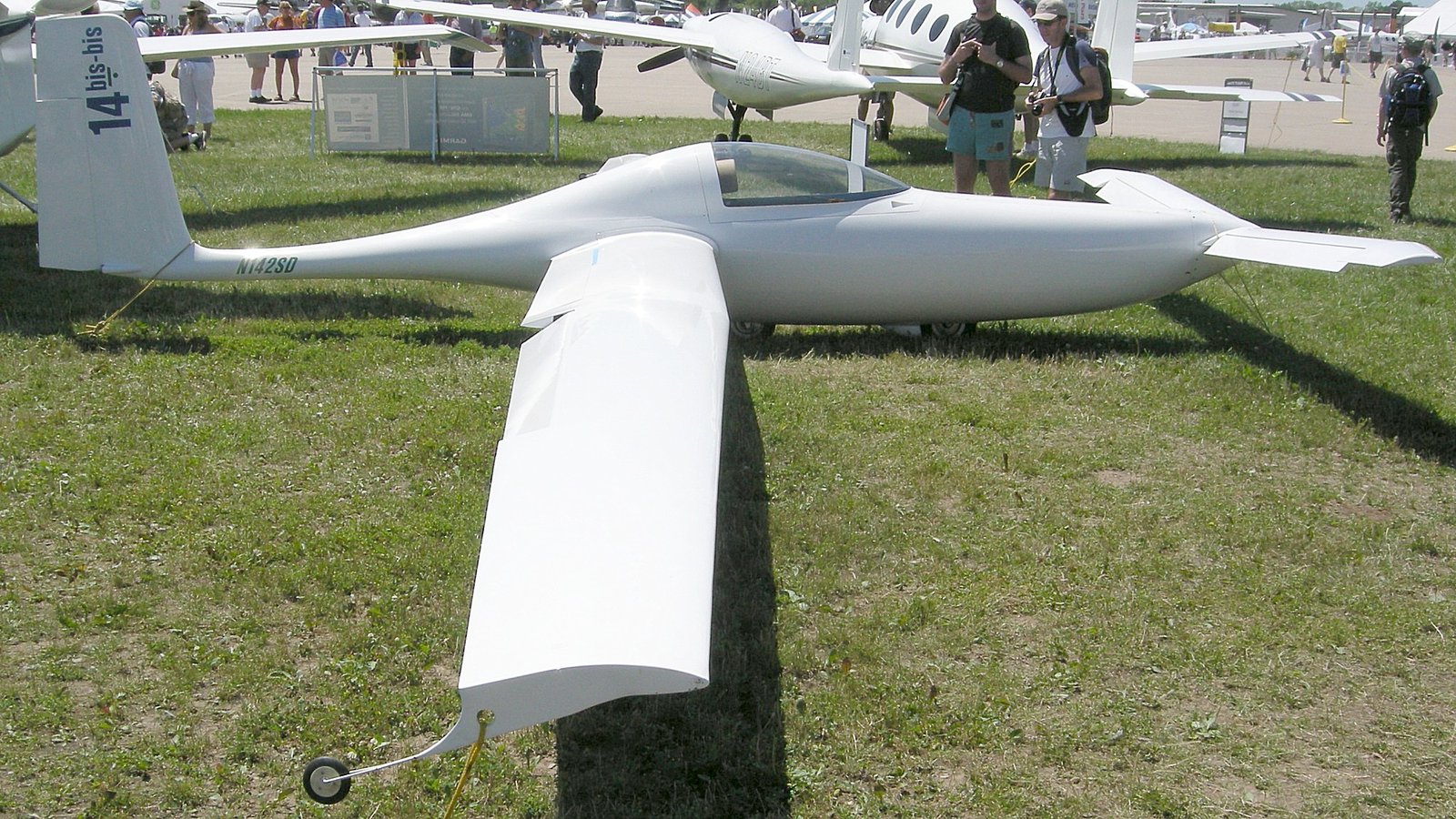
The aircraft's most distinctive characteristic was its canard configuration, featuring a small foreplane mounted at the nose ahead of the main wing. This tandem-wing arrangement made the Solitaire virtually stall-proof, as the canard would stall before the main wing, automatically pitching the aircraft nose-down and preventing a dangerous main wing stall. This safety feature represented a significant departure from conventional sailplane design philosophy.
Self-Launching Capability
The Solitaire's defining innovation was its retractable powerplant system. A single-cylinder, four-stroke Cuyuna engine producing 23 horsepower at 6,000 RPM could be deployed and retracted using electro-hydraulic power. The 215cc engine featured an electric starter that enabled air starting, allowing pilots to restart the engine during flight if needed. This self-launching capability eliminated the need for ground crews, tow planes, or winch launches that traditional sailplanes required.
Rutan experimented with several engine options during development, initially considering a Zenoah engine before briefly switching to a Robin engine, ultimately settling on the Cuyuna powerplant. With the engine folded into its forward fuselage bay, the aircraft achieved an impressive lift-to-drag ratio of 32:1, providing genuine soaring performance that rivaled purpose-built sailplanes.
Advanced Construction Methods
The Solitaire represented the most sophisticated kit aircraft that Rutan Aircraft Factory had ever offered. The construction utilized cutting-edge composite techniques, including prepreg fiberglass skins bonded to Nomex honeycomb cores with high-technology film adhesive. Wing spars featured S-glass roving spar caps molded in precision metal molds, while the entire assembly was vacuum-bagged and oven-cured for maximum strength and consistency.
Task Research manufactured and marketed the prefabricated fiberglass components, offering builders an unprecedented array of ready-made parts including fuselage halves, seat pan, canopy assembly, wing root fairings, and all metal components. This approach allowed amateur builders to access professional-grade composite construction without requiring extensive fabrication skills or specialized equipment.
The Rutan Aircraft Factory Legacy
Burt Rutan established Rutan Aircraft Factory in 1964, operating it for more than two decades before transitioning to Scaled Composites. RAF began selling Solitaire plans in June 1983, and within two months of the aircraft's 1982 introduction, between 50 and 60 plan sets had been purchased. However, in June 1985, RAF discontinued plan sales as Rutan shifted his focus to the newly established Scaled Composites, though the company continued supporting existing builders.
The factory's innovative approach to homebuilt aircraft design influenced an entire generation of amateur builders and designers. The Solitaire's advanced composite construction techniques demonstrated that sophisticated aerospace materials and methods could be adapted for homebuilt applications, paving the way for future composite aircraft designs.
Operational Characteristics
Pilots praised the Solitaire's handling qualities, particularly its spoilflap system that provided what evaluators described as "excellent" descent control. The system delivered precise, variable glide path control without causing trim upsets, a common problem with conventional spoilers. Unlike traditional sailplanes where pilot weight could cause center-of-gravity issues, the Solitaire's design positioned the pilot within the allowable center-of-gravity range regardless of pilot size.
The aircraft's 12.5-meter wingspan provided adequate performance for serious soaring while remaining manageable for individual owners. The canard configuration not only enhanced safety but also contributed to the aircraft's docile handling characteristics, making it accessible to pilots transitioning from powered aircraft to soaring.
Limited Production and Current Status
Despite initial enthusiasm, only approximately eight Solitaires were completed by builders worldwide. Registered examples include tail numbers N81RA, N142SD, N214RA, N691LP, OY-XRT, and PH-1312, among others. As of March 2011, seven examples remained registered in the United States, indicating that most completed aircraft continue flying.
One Solitaire is preserved at the EAA AirVenture Museum, where it serves as an example of 1980s composite aircraft innovation. The limited production numbers reflect the specialized nature of motor glider flying and the substantial commitment required to complete such an advanced homebuilt project.
The Solitaire's historical significance extends beyond its modest production numbers. It successfully demonstrated that practical, high-performance sailplanes could be both self-launching and homebuilt, expanding soaring accessibility beyond the traditional infrastructure-dependent sport it had been. The aircraft's influence on subsequent composite aircraft design and construction techniques continues to resonate in the experimental aircraft community today.