
Design Evolution and Development
Aeronautical engineer Marek Ivanov created the Song with ambitious goals: develop an ultralight that could meet LTF-L (120 kg), US FAR 103 Ultralight Vehicles, and English SSDR regulatory requirements while maximizing efficiency through advanced design. The original prototype, built between 2008 and 2009, featured an unconventional inverted V-tail configuration and cranked wings, representing Ivanov's initial approach to achieving optimal aerodynamic performance.
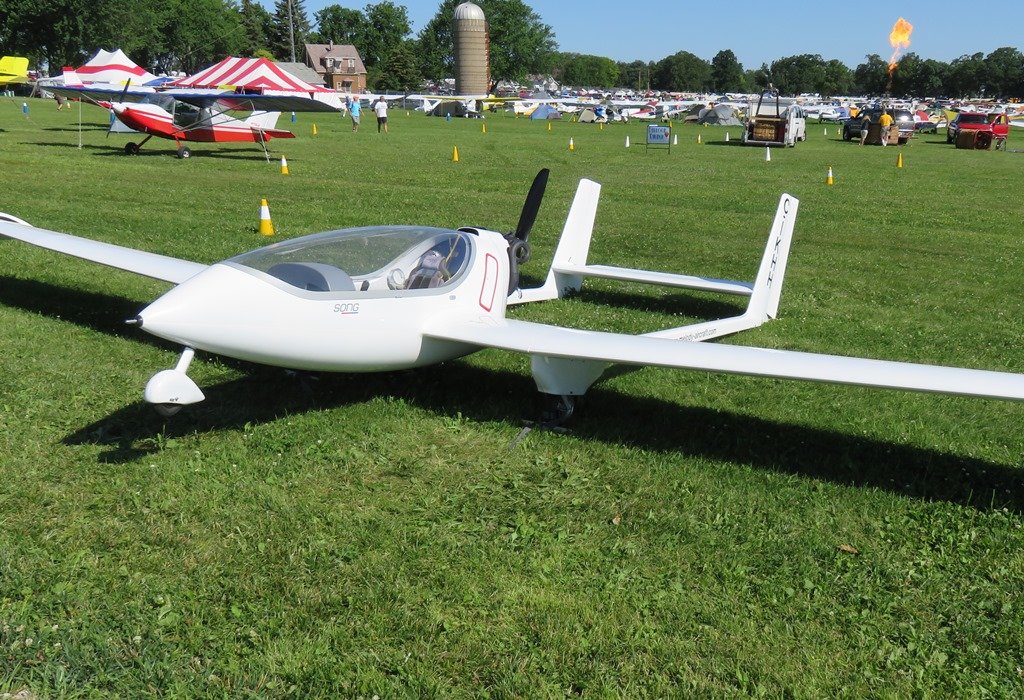
Recognizing opportunities for improvement, Ivanov completely redesigned the aircraft in 2010, transforming it into a twin-boom pusher configuration with straight elliptical wings. This redesign proved successful, leading to Czech UL2-1 Standard certification in 2013 and establishing the foundation for the current production version.
Manufacturing and Production
Airsport s.r.o., based in Zbraslavice, Czech Republic, manufactures the Song as a made-to-order aircraft with approximately four weeks required for each unit's construction. The company operates in association with Gramex spol. s.r.o., and production has continued steadily since the 2010 redesign. As of approximately 2015-2016, around 20 to 25 Song aircraft were flying worldwide, reflecting its status as a specialized design serving a niche market rather than mass production.
The Zbraslavice manufacturing facility represents part of the Czech Republic's growing reputation in advanced light aircraft development. For North American customers, Melody Aircraft handles distribution and shipping, with delivery typically requiring three to six weeks by container.
Technical Innovation
The Song's design philosophy centers on efficiency achieved through careful attention to aerodynamics and weight optimization. Its composite construction utilizes carbon fiber throughout the airframe, contributing to both structural strength and weight reduction. The elliptical wing planform, available in two configurations, allows operators to choose between a 7.5-meter span with flaperons or an 11.2-meter span with separate ailerons, spoilers, and flaps.
The twin-boom layout accommodates the pusher engine configuration while providing space for the fixed tricycle landing gear with steerable nose wheel. This arrangement also allows for an enclosed single-seat cockpit that enhances pilot comfort and aerodynamic efficiency compared to open-cockpit ultralights.
For enhanced safety, the Song offers an optional Galaxy GRS 3/270 ballistic parachute system, reflecting modern ultralight aviation's emphasis on emergency recovery capabilities.
Engine Options and Performance
Two four-stroke engine options power the Song, both mounted in pusher configuration. The Bailey V5 produces 20.5 horsepower (15 kW), while the Verner JCV 360 generates 35 horsepower (26 kW). Both engines are inline piston designs chosen specifically for their efficiency characteristics and compliance with ultralight weight restrictions.
The smaller engine options enable the Song to achieve exceptionally low fuel consumption while maintaining adequate performance for its intended role as a motor glider and recreational ultralight. This efficiency focus allows for extended range capabilities unusual in the ultralight category, making the aircraft suitable for cross-country flight despite its minimal fuel capacity.
Operational Role and Market Position
The Song operates exclusively in the civilian ultralight market, serving recreational pilots and motor glider enthusiasts who prioritize efficiency and range over speed or payload capacity. Its single-seat configuration and enclosed cockpit design appeal to pilots seeking a more refined ultralight experience compared to traditional open-cockpit designs.
The aircraft's ability to comply with multiple international ultralight regulations makes it particularly attractive to manufacturers and operators in global markets. This regulatory flexibility allows the same basic design to serve pilots in Europe, North America, and other regions without requiring significant modifications.
Legacy and Continuing Development
By 2015, the Song had undergone more than five years of continuous development and refinement since its 2010 redesign. While production numbers remain modest, the aircraft has established itself as one of the more sophisticated designs in the modern ultralight category.
The Song represents the Czech Republic's contribution to contemporary ultralight aviation, showcasing how modern materials and design techniques can create highly efficient aircraft within strict weight and performance limitations. Its emphasis on composite construction, aerodynamic refinement, and regulatory compliance reflects the evolution of ultralight aviation from simple recreational aircraft toward more capable and sophisticated designs.
Though no specific museum examples have been identified, the Song's ongoing production and operation continue to demonstrate the viability of specialized, efficiency-focused ultralight designs in the modern aviation market. Its development timeline from 2008 prototype through 2013 certification illustrates the extended development cycles typical of modern aircraft, even in the ultralight category.