
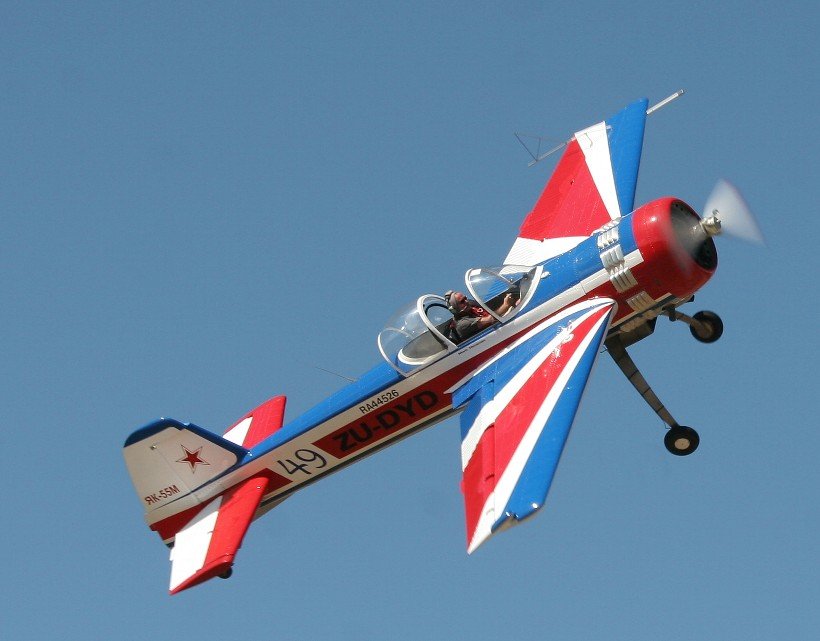
Development and Design
The SP-55M emerged from the vision of Vyacheslav Kondratiev, a veteran designer who had previously worked on both the original Yak-55 and the Sukhoi Su-26. After establishing Scientific Commercial Firm Technoavia in Moscow in 1991, Kondratiev set out to create an improved version of the Yak-55M that could better compete against Sukhoi's dominance in unlimited aerobatic competition.
Kondratiev's design incorporated significant improvements over its Yakovlev predecessor. The SP-55M featured a dramatically enlarged rudder with a swept trailing edge, completely redesigned ailerons for enhanced roll rates, and a built-up turtle-deck fuselage that provided enclosed luggage storage. The aircraft utilized a longer tubular spring steel undercarriage system instead of the Yak-55M's titanium gear, while composite-covered control surfaces and a deeper aft fuselage completed the aerodynamic refinements.
Production and Manufacturing
Production of the SP-55M began around 2000 at the Progress plant in Arsenyev, Eastern Russia—the same facility known for manufacturing Kamov helicopters. The manufacturing process involved building airframes at the Arsenyev factory, then shipping them to Technoavia's Moscow facility for engine installation and final assembly. An initial batch of ten airframes was constructed using this split-production method.
The prototype aircraft, carrying construction number 01-01 and initially registered as RA-44547, was completed in 2000. This first example would later find its way to Australia as VH-JCE, demonstrating the aircraft's international appeal among aerobatic pilots.
Powerplant and Performance
The heart of the SP-55M was the robust Vedeneyev M-14PF radial engine, a supercharged nine-cylinder powerplant producing 298 kW (400 horsepower)—a significant 40-horsepower increase over the standard M-14P that powered the original Yak-55. This power boost came through modifications to the supercharger gearing, providing the additional performance needed for competitive aerobatics.
The M-14PF drove an MT propeller with a diameter of 2.6 meters, optimized for the high-G environment of unlimited aerobatics. The engine's proven reliability and low maintenance requirements made it ideal for the demanding +9/-6 G loads that the SP-55M could sustain during competition routines.
With a maximum loaded weight of 997 kg and fuel capacity of 184 liters, the SP-55M achieved a range of 650 kilometers with 30 minutes of reserve fuel. The aircraft's landing roll of 450 meters demonstrated its suitability for operations from shorter airfields commonly used in aerobatic competitions.
International Success
The SP-55M found particular favor among aerobatic pilots in Western countries who appreciated its combination of high performance and lower acquisition costs compared to contemporary Sukhoi designs like the Su-31. The aircraft gained a foothold in Australia, New Zealand, the United Kingdom, and the United States, where pilots valued its competitive capabilities in unlimited category events.
Notable examples included the prototype VH-JCE, which was imported to Australia in 2005 and operated from Kyneton, Victoria. New Zealand received at least two examples: ZK-JPO, imported from Lithuania in 2005, and ZK-YKV, which had previously carried the American registration N5288N before arriving in 2008. These international sales demonstrated the SP-55M's appeal beyond its Russian origins.
Legacy and Current Status
The SP-55M represented the continuation of a distinguished lineage that began with the Yak-55, of which 108 examples were built between 1985 and 1991, followed by over 106 Yak-55M aircraft by 1993. While exact production numbers for the SP-55M remain unclear, the aircraft succeeded in extending high-performance aerobatic capabilities into the post-Soviet era with successful exports to Western markets.
Technoavia's current operational status remains uncertain, with no documented recent activity from the company that once promised to challenge Sukhoi's aerobatic aircraft dominance. However, the SP-55M's robust design and proven M-14PF powerplant have ensured that at least some examples continue flying today, maintaining the legacy of affordable, high-performance aerobatic aircraft that began with the original Yakovlev designs of the 1980s.