
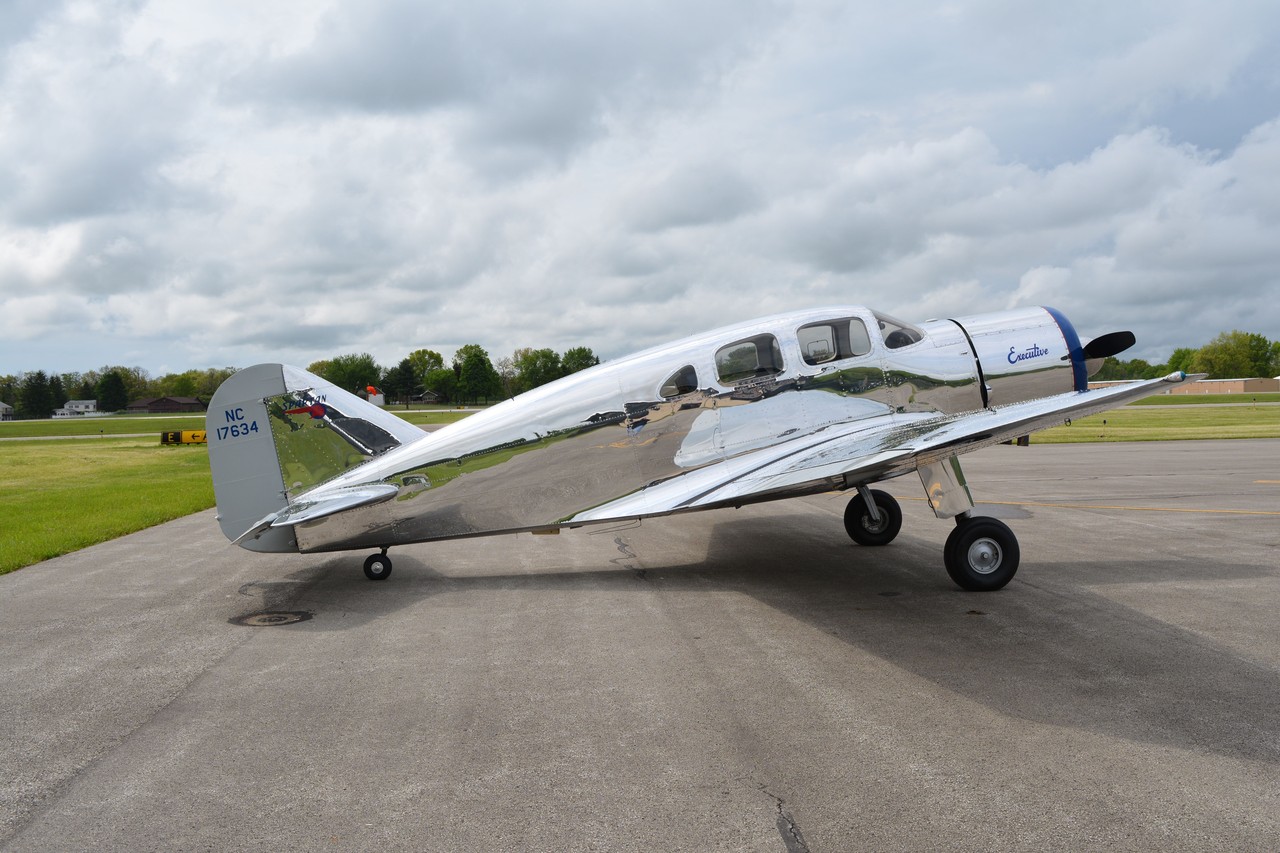
Service History
The Spartan 7W Executive carved out an exclusive niche in corporate aviation, serving as the ultimate executive transport for captains of industry willing to pay the premium $23,500 price tag in 1937 dollars. The aircraft attracted prominent owners including the Texaco corporation, Olsen Drilling Company, and Bodine Drilling. Serial number 2, registered NC13993, gained particular fame when owned by George Mennen of the advertising fortune, who used it for promotional flights before it was eventually nicknamed "Mrs. Mennen."
During World War II, the Executive proved its worth beyond civilian service when 14 aircraft were impressed into United States Army Air Forces service as UC-71 utility transports between 1942 and 1944. Remarkably, all but two survived military service and returned to civilian operations. The British government separately acquired six Executives for training American pilots destined for Atlantic ferry duty and RAF Eagle Squadron service.
International Operations
The Executive's reputation extended internationally, with notable service in both Mexico and Spain. Serial number 1, originally registered NX13992, was sold to Colonel Roberto Fierro in Mexico in 1937 before being transferred to LAPE airlines in Spain as EC-AGM. This aircraft met its end on February 5, 1939, destroyed during the Spanish Civil War. Another variant, the 7WP prototype, served briefly but significantly with the Chinese Air Force from summer 1937 until December 12, 1937, during the Second Sino-Japanese War.
The Manufacturer
Spartan Aircraft Company operated from 1928 through the early 1940s in Muskogee, Oklahoma, reaching its pinnacle under the ownership of oil magnate J. Paul Getty by 1935. The company produced a total of 38 executive-inspired aircraft during aviation's Golden Age from 1936 to 1946 before shifting focus to more profitable travel trailer manufacturing after World War II. Getty's investment enabled the company to attract veteran design engineer James B. Ford, whose leadership proved crucial to the Executive's development.
Engine & Technical Innovation
The production 7W was powered by the Pratt & Whitney Wasp Junior R-985-AN3, a supercharged 450-horsepower nine-cylinder radial engine that delivered exceptional high-altitude performance. This powerplant enabled the Executive to reach a service ceiling of 24,000 feet while maintaining a cruise speed of 215 mph. The original prototype began life with an underpowered 260-horsepower Jacobs radial in March 1936, but this was quickly upgraded to 285 horsepower by May 1936 before the decision to adopt the more powerful Pratt & Whitney engine for production models.
Design innovations included a tight-fitting engine cowling with distinctive rocker arm fairings on early models, a 250-square-foot wing area optimized for speed, and an enlarged vertical stabilizer that provided enhanced stability. The production aircraft featured a gross weight of 4,400 pounds and carried 112 gallons of fuel, compared to the lighter 3,500-pound prototype with its 75-gallon capacity.
Development Timeline
Development began in 1935 under James B. Ford's direction, with the 7X prototype taking its maiden flight on March 8, 1936. The first production 7W, serial number 1 registered NX13992, was completed and registered on November 9, 1936, followed quickly by serial number 2 on November 30, 1936. Type Certificate 628 was issued on February 15, 1937, to serial number 2, with a separate certificate 646 following on June 28, 1937, for the 7WP variant.
Production continued at a modest pace through September 9, 1940, when the final aircraft, serial number 34 registered NC17668, rolled out of the Muskogee facility. Spartan attempted a post-war revival with a tricycle-gear prototype designated 12W in 1946, but changing market conditions and the company's pivot to travel trailers ended any hopes of resumed production.
Legacy and Preservation
Approximately 20 complete airframes survive today, representing more than half of the original 36 aircraft built across all variants. At least three remain in flying condition as of 2008, including NC17633, known as "The Rocket," which found its way to British owner Nigel Pickard. The EAA Aviation Museum in Oshkosh, Wisconsin, displays NC13993 as a static exhibit, preserving the "Mrs. Mennen" legacy for future generations.
The Spartan Executive's influence extended far beyond its limited production numbers, establishing performance benchmarks that influenced luxury private aviation for decades. Its fighter-like speed combined with executive comfort represented a unique achievement in pre-war aviation, embodying the optimism and technological advancement of the Golden Age before world events redirected the industry toward military production.