
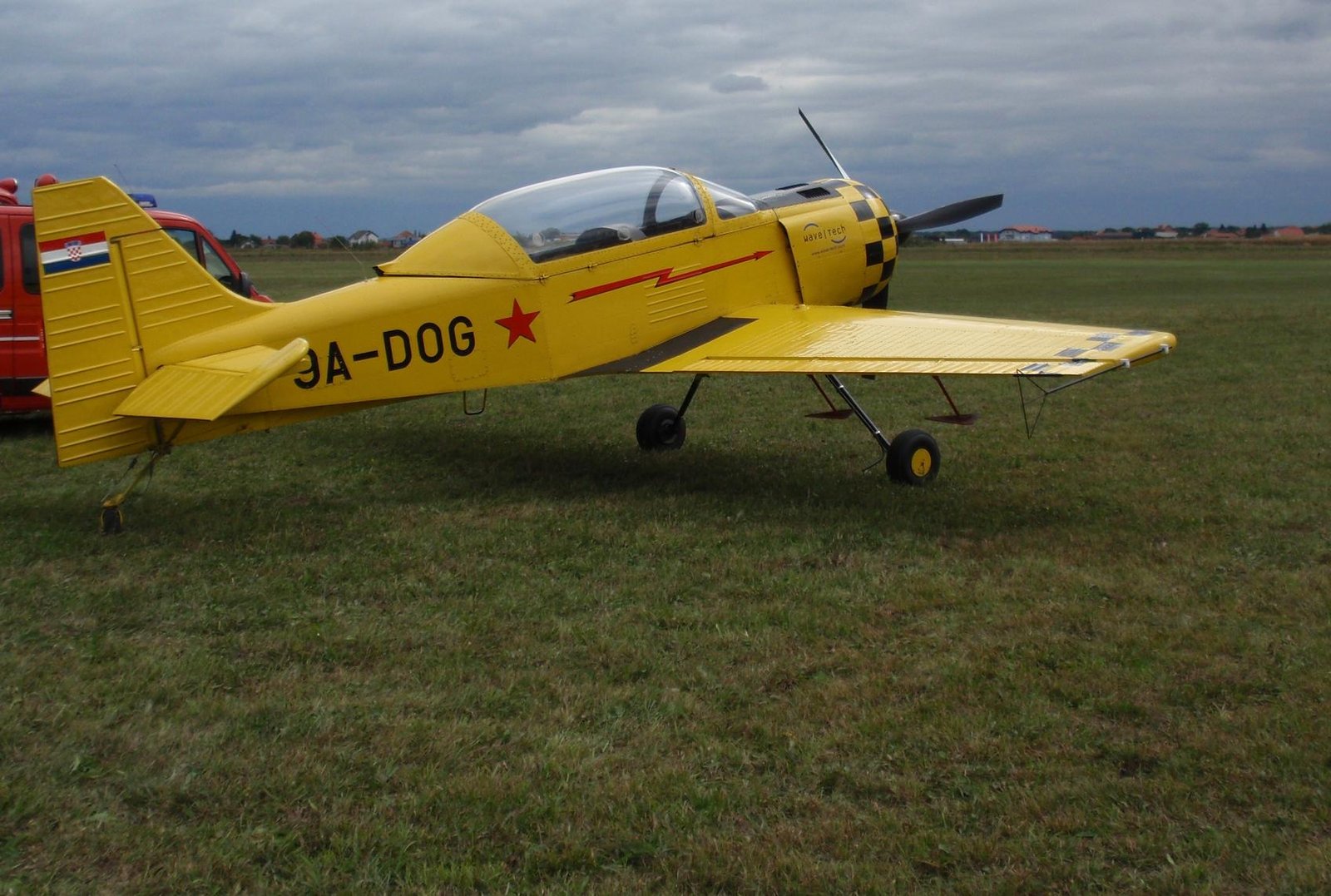
Design and Development
The SP-95 emerged from the design legacy of the Sukhoi Su-26 family, created by the same engineer who developed those renowned aerobatic champions. Technoavia conceived the SP-95 as the definitive production version of their SP-91 Slava prototype, targeting the demanding unlimited aerobatic competition market. The design philosophy centered on creating an aircraft capable of withstanding extreme G-forces while maintaining the precise control characteristics essential for world-class aerobatic performance.
The aircraft featured a metal low-wing cantilever monoplane configuration with conventional tailwheel landing gear. This robust construction method distinguished it from composite competitors like the Sukhoi Su-29, offering what many pilots considered superior durability for intensive aerobatic training and competition use. The SP-95's design incorporated innovations that enabled it to handle G-loads of +11/-9 in single-seat configuration or +12/-10 when operated as a two-seater.
The Manufacturer
Scientific Commercial Firm Technoavia was established in 1991 by Vyacheslav Kondratiev during the post-Soviet aviation industry transformation. The company operated from Russia and developed a diverse portfolio beyond the SP-95, including the SM-92 Finist, SM-94 modifications of the Yak-18T, SP-55M variants of the Yak-55, and the SM-2000 turboprop aircraft. Technoavia positioned itself as a specialized manufacturer serving the aerobatic and general aviation markets during Russia's economic transition period.
The company's approach focused on creating affordable alternatives to established Western aerobatic aircraft while leveraging proven Russian aviation technology and manufacturing capabilities. However, like many post-Soviet aerospace ventures, Technoavia faced significant challenges in establishing sustainable production and international market presence.
Engine and Performance
The SP-95's powerplant was the reliable Vedeneyev M14P, a nine-cylinder air-cooled radial engine producing 270 kilowatts (360 horsepower). This engine choice reflected practical considerations, as the M14P powered multiple Russian aerobatic aircraft types and offered commonality in electrical systems, pneumatic components, and MT propeller compatibility. The engine's proven reliability in unlimited aerobatic applications made it ideal for the SP-95's intended role.
Performance specifications reflected the aircraft's competition-focused design. Maximum speed reached 300 kilometers per hour (186 mph), while stall speed was a manageable 105 kilometers per hour (65 mph). The never-exceed speed of 450 kilometers per hour (280 mph) provided adequate margin for high-speed aerobatic maneuvers. With full fuel, the SP-95 achieved a range of 1,300 kilometers (810 miles), sufficient for cross-country competition travel.
The aircraft demonstrated impressive climb performance at 17 meters per second (3,350 feet per minute), essential for aerobatic sequences requiring rapid altitude changes. Empty weight of 800 kilograms (1,764 pounds) and maximum takeoff weight of 1,080 kilograms (2,381 pounds) resulted in favorable power-to-weight ratios.
Service History and Operations
Despite ambitious plans, SP-95 production remained extremely limited. Only five SP-91 prototypes were completed overall, and the full-scale SP-95 production variant failed to materialize as envisioned. This limited production reflected the challenging economic conditions facing Russian aviation manufacturers during the 1990s, as well as intense competition from established aerobatic aircraft producers.
The few examples that reached operational status found homes primarily with aerobatic pilots and airshow performers. Notable operators included Larry King, an Atlanta-based airshow pilot and mechanic who operated an SP-95 in the United States. Four SP-91 variants were exported to the USA, demonstrating some international interest despite production limitations.
The aircraft served effectively as a two-seat aerobatic trainer, with rear cockpit instrumentation enabling instruction in advanced aerobatic techniques. Pilots appreciated the aircraft's robust metal construction and handling characteristics, though many noted its rougher aesthetic finish compared to more polished Western competitors.
Legacy and Current Status
The SP-95 represents a fascinating chapter in post-Soviet aviation development, embodying both the technical capabilities and economic challenges of Russian aerospace companies during the 1990s transition period. While production numbers remained minimal, the aircraft demonstrated that Russian manufacturers could create competitive aerobatic designs despite limited resources.
At least one SP-95 continued flying in the United States through the early 2000s, though the exact number of remaining airworthy examples is unknown. The aircraft's legacy lies not in commercial success but in its representation of ambitious post-Soviet aviation entrepreneurship and its contribution to the limited-production aerobatic aircraft market.
The SP-95's story illustrates the broader challenges facing specialized aviation manufacturers attempting to establish new aircraft programs during periods of economic uncertainty, while also showcasing the enduring appeal of high-performance aerobatic aircraft among dedicated pilots and performers.