
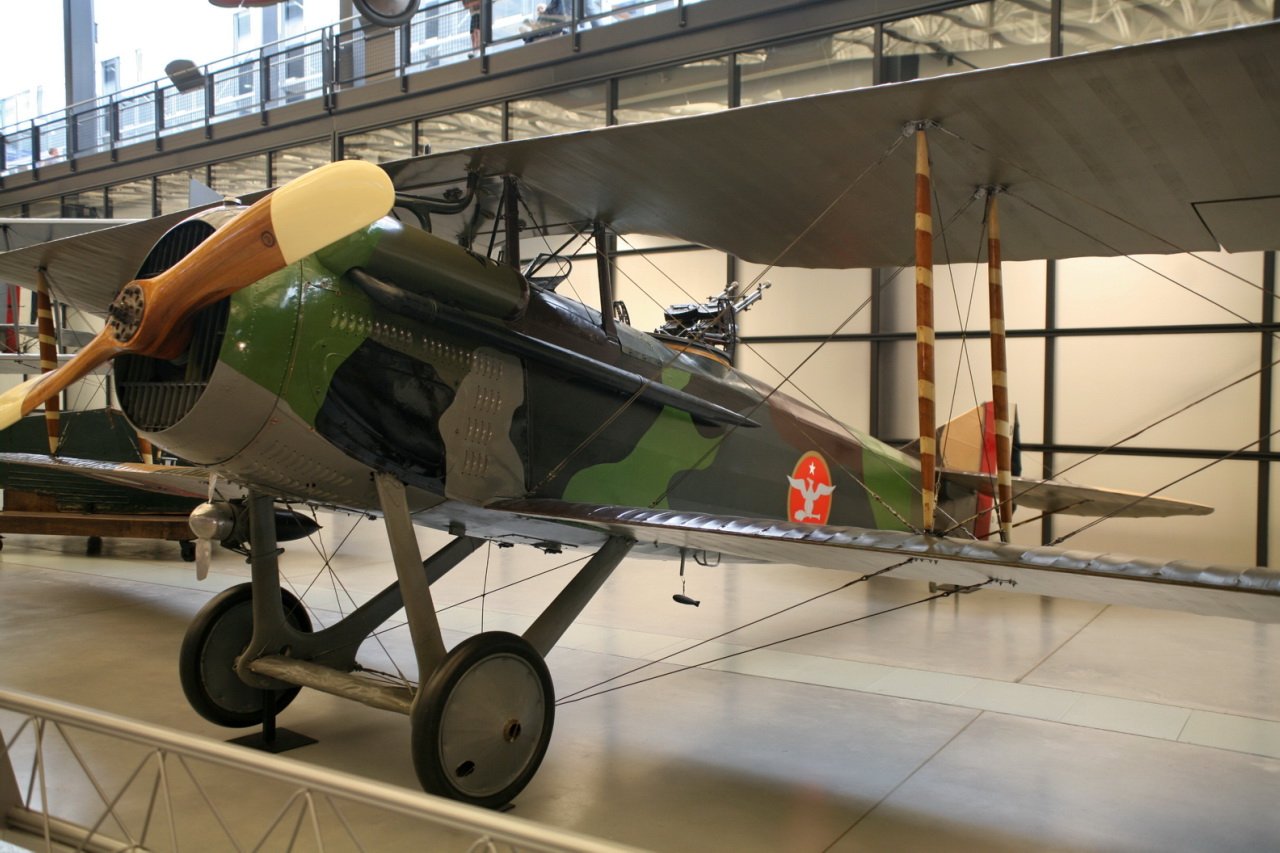
Production and Manufacturer History
The SPAD S.XI was produced by Société Pour L’Aviation et ses Dérivés (SPAD), a prominent French aircraft manufacturer. The company's origins date back to January 1911, when Armand Deperdussin founded the Société de production des aéroplanes Deperdussin. Following a financial scandal, Louis Blériot took over the presidency in 1914 and renamed the firm Société Pour L’Aviation et ses Dérivés, though the SPAD acronym was maintained. The company became a leader in combat aircraft production during World War I before ceasing activity around 1921. The S.XI was manufactured in France by SPAD and various subcontractors, with approximately 1,000 aircraft built.
Design and Technical Specifications
Designed in 1916 by Louis Béchereau, the chief designer who also created the SPAD VII and XIII, the S.XI was intended to bring the speed and structural strength of SPAD's fighters to a two-seat reconnaissance and observation role. The aircraft featured a biplane configuration with a wingspan of 11.76 meters and a total length of 7.72 meters. It was powered by a Hispano-Suiza 8B-series water-cooled V-8 piston engine, specifically the 8 Be model producing 220 ch (metric horsepower).
Technically, the aircraft had an empty weight of 910 kg and a loaded weight of 1,380 kg. Its performance included a maximum speed of 176 km/h at sea level and a service ceiling of 6,000 meters. For armament, the pilot operated a fixed 0.303 in (7.7 mm) Vickers machine gun, while the observer utilized a 0.303 in (7.7 mm) Lewis gun on a flexible ring mount. The aircraft was also capable of carrying small bomb loads for light bombing missions.
Service History and Legacy
Entering service in 1917, the SPAD S.XI served primarily with the French Aéronautique Militaire, where 12 escadrilles were fully equipped with the type. It was also operated by three Belgian squadrons and two American squadrons of the US Army Air Service. Post-war, small numbers of the aircraft were acquired by Uruguay, Japan, and Russia.
Despite being viewed as superior to the Dorand AR.1/AR.2 and certain Sopwith types, the S.XI was plagued by engine reliability issues and longitudinal stability problems, particularly when fully loaded. These shortcomings led to its progressive replacement by the improved SPAD S.XVI, and most S.XI aircraft were withdrawn from front-line use by autumn 1918. While one aircraft was modified as a night-fighter (Cn2 specification) with a forward-mounted searchlight, the type never achieved the fame of its single-seat fighter counterparts. No intact examples are currently documented in museum collections.