
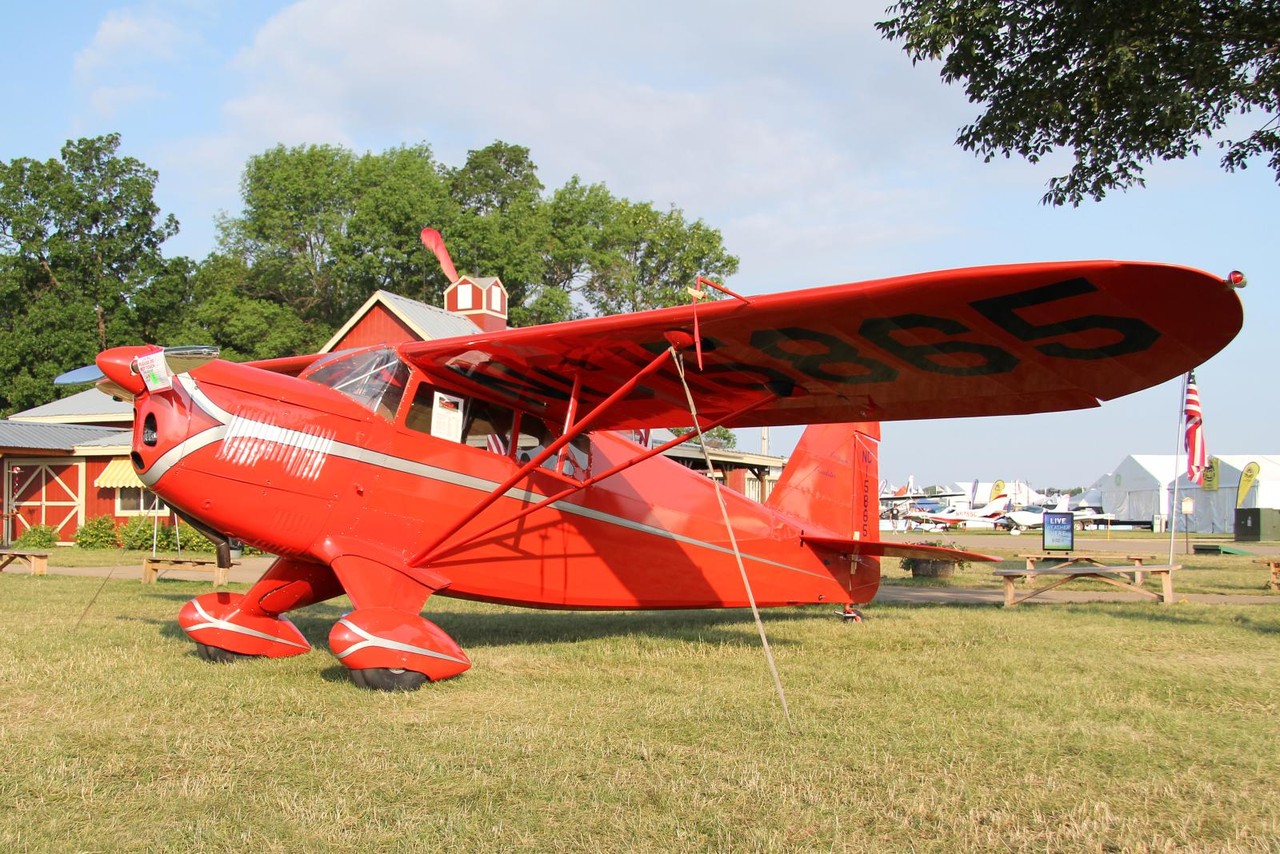
Development and Design
The Rearwin 6000 Speedster emerged from the vision of Rae Rearwin, who commissioned designers Noel Hockaday and Doug Webber in 1932 to create a high-performance sport aircraft that would revitalize his struggling company during the Great Depression. The design team focused on achieving maximum performance through a compact, low-drag airframe that minimized frontal area while providing enclosed comfort for pilot and passenger.
The prototype incorporated several innovative features for its era, including a welded steel tube fuselage faired with wood and fabric, laminated spruce wing spars with dural leading edges, and Pyralin transparencies. The wing-mounted fuel tanks held 17 gallons, providing the aircraft with a respectable 600-mile range. The distinctive tail profile became a hallmark of the design, though it would later require significant modification.
Certification Challenges
The Speedster's path to certification proved far more arduous than anticipated. After its successful first flight on July 11, 1934, the aircraft encountered serious obstacles during Civil Aeronautics Authority testing. The original design failed spin recovery requirements, grounding the certification process for nearly three years.
Engineers redesigned the empennage, enlarging the tail surfaces and improving flight control systems with better bearings and rudder-centering springs. They also adjusted aileron gaps to enhance control response. These modifications proved successful, and the aircraft finally received certification in late summer 1937, clearing the way for production.
Production and Powerplant Evolution
Rearwin Aircraft began production in late 1937, with manufacturing concentrated primarily between 1938 and 1940. The company initially designed the aircraft around the ACE Cirrus Hi-Drive inline engine, but when this powerplant was discontinued by 1937, engineers seamlessly integrated the 125-horsepower Menasco C-4 inline engine with only minor airframe modifications. This change led to the production designation Model 6000M.
Total production remained extremely limited, with only 10 to 12 aircraft completed. The breakdown included one prototype, six aircraft for the domestic American market, and between four to six units exported overseas. This small production run reflected both the specialized nature of the aircraft and the challenging economic conditions of the late 1930s.
Performance and Characteristics
The production Speedster delivered impressive performance for its era. The Menasco C-4 engine propelled the 1,668-pound aircraft to maximum speeds of 166 miles per hour, with a comfortable cruise speed of 140 miles per hour. The aircraft demonstrated a service ceiling of 17,000 feet and a climb rate of 750 feet per minute, making it genuinely competitive with contemporary sport aircraft.
Pilots appreciated the enclosed tandem cockpit arrangement, which provided weather protection while maintaining good visibility. The high-wing configuration offered stability and ground handling advantages, while the compact dimensions - 22 feet 2 inches in length with a 32-foot wingspan - made hangar storage practical for private owners.
Marketing and Demonstration
Rearwin Aircraft promoted the Speedster through high-profile demonstrations and air racing activities. The aircraft appeared at the Miami Air Races in 1937, showcasing its performance capabilities to potential customers and aviation enthusiasts. In May 1938, company demonstrator Ray Beebe embarked on a national tour, flying the Speedster to airports across the country to generate sales interest.
Despite these promotional efforts, sales remained disappointing. The specialized nature of the aircraft, combined with its relatively high cost and the limited sport flying market during the Depression, restricted commercial success. The company's efforts to export aircraft overseas provided some additional revenue but could not sustain profitable operations.
Company Decline and Wartime End
Rearwin Aircraft struggled financially throughout the late 1930s, operating with underutilized equipment acquired from previous ventures. The company, which had also produced models like the Ken-Royce and Junior, found the sport aircraft market insufficient to support continued operations.
World War II effectively ended civilian production when wartime restrictions prohibited non-military aircraft manufacturing. Rearwin Aircraft ceased operations during the early 1940s, joining many small aircraft manufacturers that could not transition to military contracts or survive the wartime economy.
Legacy and Survivors
The Rearwin 6000 Speedster's legacy rests in its representation of innovative 1930s design philosophy and the challenges faced by small manufacturers during economic hardship. The aircraft demonstrated advanced solutions to aerodynamic and structural challenges, particularly in its successful resolution of the spin recovery problems that initially prevented certification.
As of 2018, four Speedsters remained registered with the Federal Aviation Administration as active aircraft. The most notable survivor, a 1938 Model 6000M bearing registration N20741, resides at the EAA Aviation Museum's Pioneer Airport in Oshkosh, Wisconsin. Restored during the 1990s by Tom Bins and later acquired by R.O. Burns, this aircraft was donated to the museum in 2004, where it serves as a rare example of Depression-era sport aviation innovation.
The Speedster stands as a testament to the creativity and determination of small aircraft manufacturers who pursued advanced designs despite economic adversity, contributing to the evolution of light aircraft technology that would flourish in the post-war boom.