
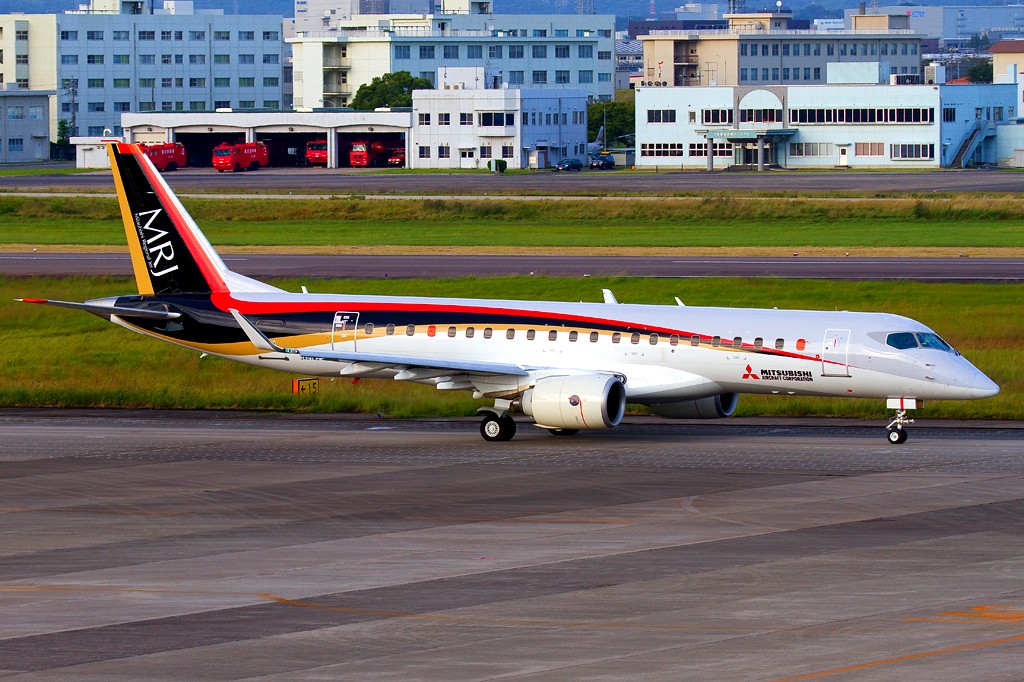
Development and Design Philosophy
The SpaceJet represented Japan's boldest commercial aviation venture since the NAMC YS-11 turboprop ended production in 1974. Mitsubishi Heavy Industries launched the program in 2007 under government backing, establishing the subsidiary Mitsubishi Aircraft Corporation (MITAC) to spearhead development. The company selected Komaki Airport in Nagoya as its primary manufacturing hub—the same facility where Mitsubishi had developed the legendary A6M Zero fighter during World War II.
Engineers designed the aircraft around modern efficiency standards, incorporating Pratt & Whitney's revolutionary PW1200G geared turbofan engines. These powerplants promised 20 percent better fuel economy than conventional turbofans through their innovative planetary gear reduction system. The cabin measured 2 meters high by 2.8 meters wide, accommodating passengers in a comfortable four-abreast seating arrangement.
Manufacturing and Prototypes
Mitsubishi commenced assembly operations in April 2011 at the purpose-built Komaki facility, with fuselage sections manufactured at the Tobishima plant in Aichi Prefecture. The company constructed exactly eight prototypes: seven MRJ90 variants capable of seating 88 passengers and one smaller MRJ70 model designed for 70 passengers. The maiden flight occurred on November 11, 2015, when the first MRJ90 prototype lifted off from Nagoya Airfield after years of anticipation.
Certification Struggles and Delays
What began as an optimistic 2012 delivery timeline quickly deteriorated into a series of devastating setbacks. Structural problems emerged during testing, requiring engineers to install reinforcement plates where the wings joined the fuselage. Avionics systems demanded complete redesign to meet international certification standards. The prototype fleet accumulated over 2,400 flight hours by 2018, focusing extensively on runway performance testing, yet certification remained elusive.
Delivery schedules shifted repeatedly: ANA Holdings, the launch customer, saw their delivery window move from 2012 to beyond 2021. SkyWest Airlines held orders for 100 firm aircraft plus 100 options targeting 2022 delivery. Japan Airlines subsidiary J-Air committed to 32 aircraft for 2023 entry into service. Mesa Airlines secured 50 firm orders with 50 additional options for 2024 delivery. Total firm orders reached 327 aircraft across multiple carriers.
The Manufacturer's Legacy
Mitsubishi Heavy Industries, founded in 1884 as a shipbuilder, had established formidable aviation credentials during the 20th century. Beyond the famous Zero fighter, MHI contributed to various aerospace projects and maintained significant defense manufacturing capabilities. The company invested heavily in MITAC's success, viewing the SpaceJet as validation of Japanese engineering prowess in the competitive airliner market.
However, external challenges compounded internal struggles. Bombardier filed a trade secrets lawsuit in October 2018, alleging improper acquisition of confidential information. Engine delivery delays from Pratt & Whitney disrupted testing schedules. Each setback pushed certification further into the future while development costs spiraled upward.
Technical Specifications and Performance
The MRJ90 variant achieved a maximum cruise speed of Mach 0.78 (931 kilometers per hour) during flight testing. Range specifications called for 2,043 nautical miles (3,778 kilometers), positioning the aircraft competitively within the regional jet segment. Standard crew complement included two pilots, with passenger capacity varying from 70 in the MRJ70 to 88 in the stretched MRJ90 configuration.
Pratt & Whitney's PW1200G engines, members of the successful PW1000G family powering Airbus A320neo aircraft, represented the SpaceJet's most advanced technological feature. The geared turbofan design reduced noise signatures while delivering substantial fuel savings compared to conventional regional jet powerplants.
Rebranding and Final Attempts
Mitsubishi rebranded the aircraft as SpaceJet in June 2019, hoping to revitalize market perception while introducing the M90 and proposed M100 designations. The M100 variant specifically targeted American scope clause restrictions limiting regional carrier aircraft size. Despite these marketing efforts, certification problems persisted.
By October 2020, Mitsubishi acknowledged reality and froze all SpaceJet development activities. The company had invested approximately one trillion yen over 13 years without achieving a single commercial delivery. On February 7, 2023, MHI officially terminated the program and began liquidating MITAC.
Legacy of Failure
Today, no SpaceJet aircraft operate commercially, and all customer orders were canceled following program termination. The eight prototypes likely remain in storage or have been scrapped, representing tangible reminders of aviation's most expensive recent development failure. While MHI executives claimed valuable engineering experience was gained, the SpaceJet's legacy serves primarily as a cautionary tale about underestimating modern aircraft certification complexity.
The program's demise left Japan without commercial airliner manufacturing capability, ending dreams of competing with Airbus, Boeing, and other established manufacturers in the lucrative regional jet market.