
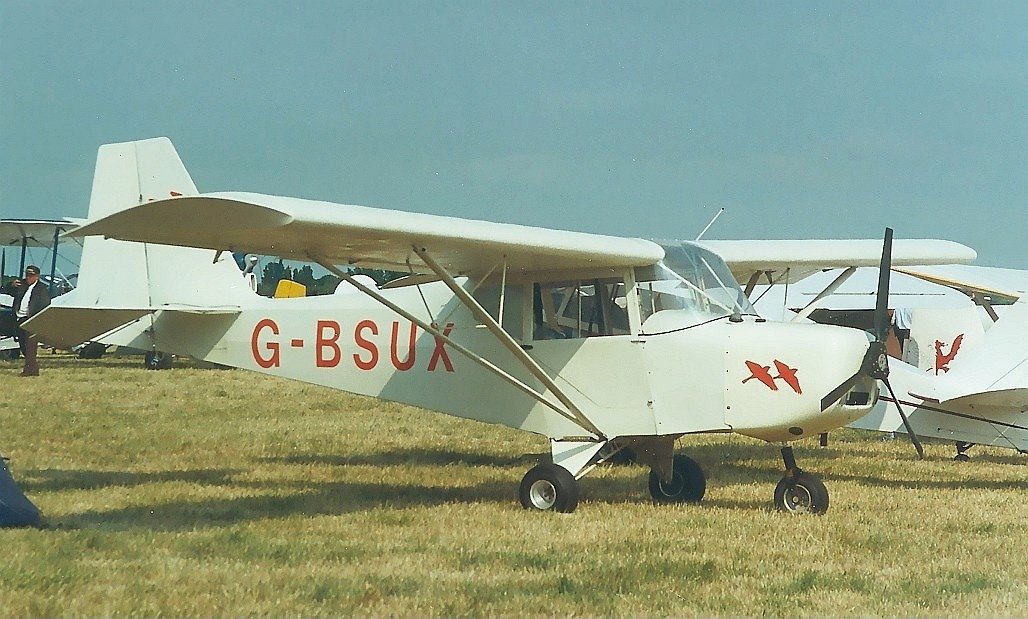
Development and Design Philosophy
Ernst W. Carlson conceived the Sparrow 2 as an enlarged derivative of his award-winning single-seat Sparrow Ultralight, which had captured Grand Champion honors at EAA AirVenture Oshkosh in 1987. The prototype took to the skies in 1990 equipped with a 52-horsepower Rotax 503 engine, though it later received the more powerful 66-horsepower Rotax 582LC that would become standard equipment. Carlson's design objectives centered on creating an accessible, affordable aircraft that amateur builders could complete in 400 to 500 hours while offering genuine two-seat capability with dual controls.
Manufacturing and Production
Carlson Aircraft Inc., based in East Palestine, Ohio, launched production of the Sparrow 2 in the early 1990s under Ernst W. Carlson's direction. The company had originally planned Australian production facilities at Warners Bay and later Maitland in New South Wales, though these international manufacturing centers never materialized as primary production sites. Throughout its production run, which extended into the mid-2000s, approximately 60 Sparrow 2 aircraft entered service, representing a modest but steady success in the competitive homebuilt market.
In the late 2000s, Carlson Aircraft sold the entire Sparrow line to Skyline Technologies of Salem, Ohio, though the new owner ceased production entirely. Carlson Aircraft continues operations today, focusing on manufacturing wings, wing components, and fuel tanks rather than complete aircraft.
Engine Options and Performance
The Sparrow 2 offered builders considerable flexibility in powerplant selection. The primary engine remained the Austrian-built Rotax 582, a 66-horsepower two-stroke unit featuring both liquid and air cooling. Alternative Rotax options included the 52-horsepower 503 and the 532LC, while builders seeking four-stroke reliability could specify the 80-horsepower Rotax 912.
For enhanced performance, Carlson developed the Sparrow 2 XTC variant, accommodating engines in the 80 to 85 horsepower range. These included the automotive-derived Subaru EA-81 producing 82 horsepower, the Continental C-85 at 85 horsepower, or the Rotax 912UL rated at 80 horsepower. The XTC variant achieved cruise speeds of 110 mph compared to the standard model's more modest performance.
Construction and Handling
The Sparrow 2 employed conventional construction methods familiar to homebuilders: a welded steel tube fuselage framework combined with aluminum wing spars, all covered in Dacron fabric. This approach balanced structural integrity with ease of construction, allowing amateur builders to complete the aircraft using basic tools and techniques. The side-by-side seating arrangement with dual controls made the aircraft suitable for training applications, while the high-wing configuration provided inherent stability.
Pilots praised the Sparrow 2's gentle handling characteristics and impressive short-field performance, with a stall speed around 26 mph enabling operations from grass strips and small airports. Optional folding wings enhanced the aircraft's practicality, allowing owners to store or transport their completed aircraft more easily.
Market Position and Legacy
The Sparrow 2 served the light training, sport, and touring aircraft market during a period of significant growth in experimental aviation. Its maximum speed of 130 mph and modest fuel consumption made it economical for weekend recreational flying, while the dual controls attracted flight schools and individual instructors seeking affordable training aircraft.
With standard empty weight of 510 pounds and gross weight of 1,050 pounds, the Sparrow 2 offered reasonable payload for two occupants and baggage. The XTC variant's higher gross weight of 1,250 pounds and larger fuel capacity extended cross-country capability, though at the cost of increased complexity and construction time.
Current Status
As of 2004, approximately 60 Sparrow 2 aircraft remained active, representing the majority of the total production run. The design's emphasis on straightforward construction, reliable Rotax powerplants, and forgiving flight characteristics contributed to a relatively high survival rate among homebuilt aircraft of its era. While no longer in production, the Sparrow 2 established Ernst W. Carlson's reputation as a designer capable of creating practical, affordable aircraft for the recreational flying community.
The broader Sparrow family, including the original ultralight with approximately 100 flying examples by 2001, demonstrated the appeal of Carlson's design philosophy emphasizing accessibility and ease of construction over cutting-edge performance or complex systems.