
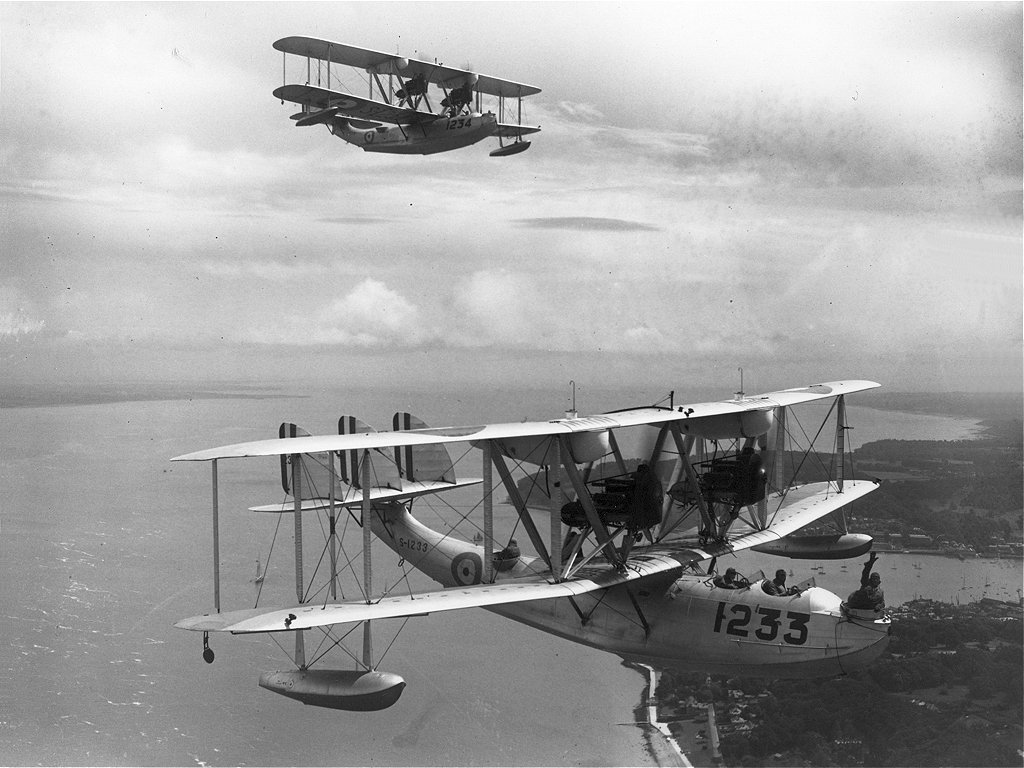
The Supermarine Southampton was a twin-engine biplane flying boat designed by Reginald Joseph Mitchell and manufactured by Supermarine Aviation Works. Produced between 1924 and 1934, the aircraft served as a pivotal early success in Mitchell's career, providing the credibility and publicity that would later support his work on the Schneider Trophy racers and the Spitfire. A total of 83 production aircraft were built at the Woolston works in Southampton, Hampshire, though an experimental three-engined derivative known as the Southampton Mk X was also developed separately.
The design evolved significantly during its production run. The first 18 Mk I aircraft, delivered starting in August 1925, featured all-wood hulls. The subsequent Mk II introduced all-metal hulls, and beginning in 1929, the earlier wooden Mk I airframes were progressively converted to metal. The first production aircraft, serial N9896, made its maiden flight on 10 March 1925, piloted by Henri Biard. The aircraft was powered by two liquid-cooled Napier Lion 12-cylinder piston engines, each producing approximately 465 hp, mounted in a tractor configuration on under-wing pylons.
In military service, the Southampton served primarily as a maritime reconnaissance and patrol aircraft. The Royal Air Force (RAF) was the primary operator, with No. 480 (Coastal Reconnaissance) Flight at RAF Calshot being the first unit to receive the type in August 1925. Other RAF units included No. 201, 203, 204, 205, 209, and 210 Squadrons. The aircraft's reliability was demonstrated during the 1927–1928 "Far East Flight," a 27,000-mile journey from Felixstowe to Singapore via the Mediterranean and India. Beyond the UK, the aircraft was exported to Argentina (eight aircraft), Turkey (six aircraft), Australia (two ex-RAF Mk I), Denmark, and Japan.
While primarily military, the Southampton saw limited civil application. Imperial Airways operated the type for a 10-passenger cross-Channel service between England and France. In Japan, an aircraft originally purchased by the Imperial Japanese Navy was converted by Japan Air Transport into an 18-passenger cabin airliner.
Technically, the aircraft featured a wingspan of 75 feet and a maximum takeoff weight of 18,000 lb. It reached a maximum speed of 95 mph and had a service ceiling of 5,950 feet. Military versions were armed with three 0.303 in Lewis machine guns (one in the bow and two amidships) and could carry up to 1,100 lb of bombs. Today, a single surviving Mk I example, serial N9899, is preserved at the Royal Air Force Museum in Hendon.