
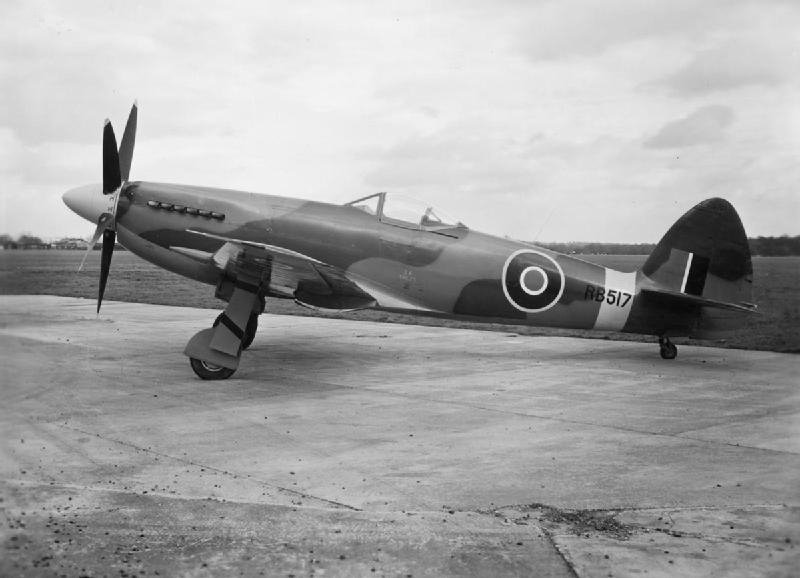
The Supermarine Spiteful was developed by Supermarine Aviation Works (Vickers) Ltd as a high-performance successor to the Spitfire. Designed to meet Air Ministry Specification F.1/43, the aircraft sought to push the limits of piston-engine fighter performance. The most significant design departure from the Spitfire was the introduction of a new laminar-flow wing, which featured a straight-tapered planform and different thickness distribution to reduce drag and increase speed. Other structural refinements included a new ventral radiator arrangement and modified undercarriage geometry.
Production began in March 1945, with the first production Spiteful F.14 taking flight on April 2, 1945. A total of 20 airframes were completed, consisting of three prototypes and 17 production aircraft. The final aircraft was delivered on January 17, 1947. While the Spiteful was built by Supermarine—a company that had become a subsidiary of Vickers-Armstrongs—the specific factory sites for these airframes are not definitively documented in the available records, although late-war production for the company was largely concentrated at South Marston.
Technical specifications for the F.14 variant centered on the Rolls-Royce Griffon 69, a liquid-cooled, 60-degree V-12 engine producing 2,375 hp. This powerplant, paired with an 11-foot five-blade Rotol propeller, allowed the Spiteful to reach a maximum speed of 483 mph (777 km/h) at 21,000 feet. The aircraft had a service ceiling of 42,000 feet and a range of 564 miles. For armament, it carried four 20 mm Hispano cannons and could be equipped with rocket projectiles or 2,000 lb bombs. A further evolution, the F.15, utilized Griffon 89 or 90 engines and featured six-blade contra-rotating propellers.
Despite its impressive performance, the Spiteful never entered operational squadron service with the Royal Air Force. By the time it reached production, World War II had ended and the aviation industry had shifted toward jet-powered fighters. The aircraft was used primarily for research and testing, including a public appearance at the 1945 RAE Farnborough "At Home" display. Its legacy, however, persisted through its design; the Spiteful's wing and undercarriage were later utilized for the Supermarine Attacker, the first frontline jet of the Fleet Air Arm. Most Spiteful airframes were sold for scrap by July 1948, and no complete examples are known to survive today.