
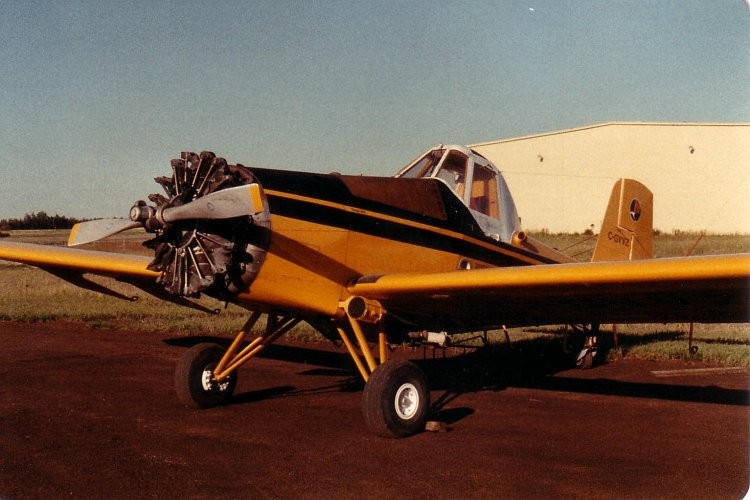
Agricultural Aviation Dominance
The Ayres Thrush established itself as the standard-bearer for agricultural aviation, capturing a dominant share of the crop-dusting market through nearly seven decades of continuous production. With nearly 2,000 aircraft sold worldwide, the Thrush became the workhorse of choice for aerial applicators, fertilizer spreaders, and firefighting operations. Its longevity in production—from 1956 to present—represents one of aviation's most successful specialized aircraft designs, outlasting numerous competitors and adapting to changing agricultural needs.
Designer and Early Development
Leland Snow conceived the original design in the mid-1950s, focusing on creating a robust agricultural platform that could withstand the demanding environment of low-level operations. Snow Aeronautical built the first examples as the S-2 series, incorporating innovative safety features including an energy-absorbing tubular fuselage structure designed to protect pilots during the inevitable hard landings common in agricultural flying. The aircraft's fiberglass hopper was strategically positioned at the center of gravity to minimize pitch changes as chemical loads were dispersed during flight.
Manufacturing Evolution
The Thrush changed hands multiple times while maintaining production continuity. In 1965, Aero Commander, a division of Rockwell International, acquired Snow Aeronautical and relocated production to Albany, Georgia. Rockwell rebranded the aircraft as the Ag Commander S-2D and later the Thrush Commander, operating the production line from 1965 to 1977. Frederick Ayres purchased the type certificate and Albany facility in 1977, forming Ayres Corporation after building his reputation retrofitting turboprop engines into existing Thrush Commanders. Thrush Aircraft acquired the program in 2003 and continues production today.
Engine Development and the Turboprop Revolution
Early Thrush variants relied on proven radial piston engines including the 450-horsepower Continental, 600-horsepower Pratt & Whitney R-1340, and 800-horsepower Wright Cyclone. These powerplants provided reliable service but became increasingly expensive to maintain as spare parts grew scarce. Ayres Corporation revolutionized the design in 1979 by introducing the Pratt & Whitney Canada PT6A turboprop, creating the "Turbo Thrush" variant. The PT6A-11AG initially produced 500 shaft horsepower, later upgraded to the 1,050-horsepower PT6A-60AG and ultimately the 1,230-horsepower PT6A-65AG option introduced in 2000.
The turboprop conversion solved multiple operational challenges simultaneously. Operators nicknamed it the "Hush Thrush" due to its significantly reduced noise signature compared to radial engines. The PT6A's fuel flexibility allowed operation on turbine fuel, aviation gasoline, or diesel fuel, providing operational advantages in remote agricultural areas. Operating costs decreased substantially while reliability improved, making the Turbo Thrush the preferred variant for most operators.
Operational Excellence
The Thrush's design prioritized practical agricultural operations over aesthetic considerations. Quick-release side panels allowed rapid cleaning of chemical residues, while the corrosion-resistant tubular fuselage construction withstood years of exposure to agricultural chemicals. The S-2R variant introduced a fully-enclosed cockpit with electric flaps, improving pilot comfort during long operational days. Hopper capacity grew from the original 480 gallons to 600 gallons in turboprop variants, with the S-2R-T660 model accommodating 1,514 liters of liquid chemicals.
Minimum runway requirements of 800 meters made the Thrush suitable for operations from short, unpaved agricultural strips. The conventional taildragger configuration provided ground stability when loading chemicals and excellent propeller ground clearance for rough-field operations. Modern variants offered optional air conditioning and entertainment systems, recognizing that agricultural pilots often flew multiple sorties daily during peak spraying seasons.
Current Production and Legacy
Thrush Aircraft continues building new examples at the historic Albany, Georgia facility, testament to sustained market demand for purpose-built agricultural aircraft. The basic design's adaptability enabled continuous updates incorporating modern avionics, improved engine options, and enhanced safety features while maintaining the fundamental characteristics that made the original successful.
A two-seat training variant addresses the agricultural aviation industry's pilot shortage by providing dedicated instruction capability. This configuration also serves ferry operations, transporting maintenance personnel and equipment to remote agricultural airstrips. The Thrush's 68-year production run represents remarkable longevity in aviation, exceeded by few aircraft types in any category.