
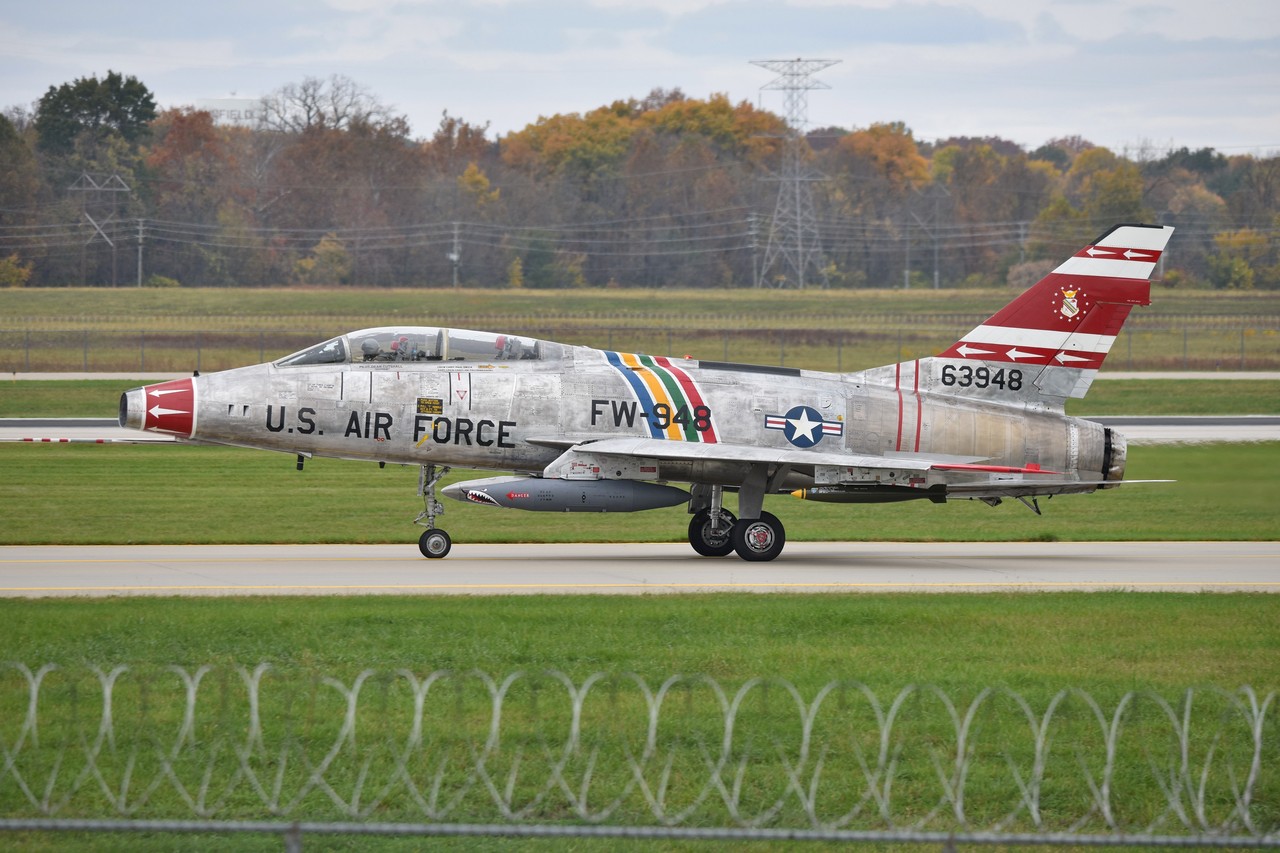
Breaking the Sound Barrier in Production Aircraft
The F-100 Super Sabre emerged as North American Aviation's answer to the Air Force's demand for a supersonic air superiority fighter. On May 25, 1953, test pilot George Welch pushed the first prototype to Mach 1.03, making aviation history as the pilot of the first production fighter to exceed the speed of sound in level flight. This achievement represented a quantum leap from its predecessor, the subsonic F-86 Sabre, and established the Super Sabre as the founding member of the "Century Series" of supersonic fighters.
Vietnam War Service and Combat Evolution
Originally conceived as an air superiority fighter, the F-100 found its true calling as a fighter-bomber during the Vietnam conflict. The aircraft's role transformation became complete when USAF units began deploying Super Sabres for close air support and interdiction missions in 1964. The Iowa Air National Guard's 185th Tactical Fighter Group exemplified this combat evolution, operating from Phu Cat Airbase under the 37th Tactical Fighter Wing and flying 6,539 combat missions totaling 11,399 hours.
During the peak period from May 1968 to April 1969, Air National Guard F-100 units alone accumulated 38,000 flying hours while delivering 20,807 tons of ordnance against enemy positions. The aircraft proved particularly effective in attacking bridges, supply barges, road networks, and troop concentrations throughout North and South Vietnam. Combat operations with the Super Sabre continued until July 31, 1971, by which time USAF and ANG units had flown a staggering 360,283 sorties.
North American Aviation's Legacy
North American Aviation, founded in 1929, had established itself as a premier military aircraft manufacturer through legendary designs like the P-51 Mustang and F-86 Sabre before undertaking the F-100 program. The company operated manufacturing facilities in Inglewood, California, and established a second production line in Columbus, Ohio, in September 1954 to meet accelerated delivery schedules. Following corporate acquisitions, North American merged into Rockwell International in 1967, which Boeing ultimately acquired in 1996, continuing the Super Sabre's technical legacy within modern aerospace programs.
Power and Performance Breakthrough
The Pratt & Whitney J57 turbojet engine provided the technological foundation for the F-100's supersonic capabilities. This axial-flow engine with afterburner generated 10,200 pounds of thrust in military power and 16,000 pounds with afterburner engaged, enabling the Super Sabre to reach 926.6 miles per hour at altitude. The J57's reliability proved exceptional for early jet technology, achieving a 99.5 percent ordnance delivery rate during Air National Guard operations in Vietnam.
The F-100D variant, which comprised 1,274 of the total 2,294 aircraft produced, incorporated significant aerodynamic improvements including a wingspan extended by 26 inches and enlarged tail surfaces to address stability issues encountered in earlier models. These modifications transformed the Super Sabre from a challenging aircraft into a stable gun and bombing platform capable of precise ordnance delivery.
Production Variants and Operational Challenges
North American delivered four main variants during the six-year production run from 1953 to 1959. The initial F-100A comprised 203 aircraft optimized for air-to-air combat, while the F-100C introduced fighter-bomber capabilities. The definitive F-100D incorporated the aerodynamic improvements that made the type truly combat-effective, and the two-seat F-100F served as an operational trainer.
Despite its groundbreaking performance, the Super Sabre earned a reputation for demanding respect from its pilots. The USAF recorded 889 accidents during the type's service life, resulting in 324 pilot fatalities, with the peak year of 1958 claiming 116 aircraft and 47 pilots. Combat losses in Vietnam totaled 242 aircraft, reflecting both the intensity of the conflict and the inherent risks of low-level attack missions.
Enduring Legacy
Today, only four F-100 Super Sabres remain airworthy worldwide, all based in the United States. The Collings Foundation operates F-100F serial number 56-3844, while museum displays preserve the type's historical significance at institutions including the National Air and Space Museum and the Iowa Air National Guard facility in Sioux City. These surviving examples represent the first generation of supersonic fighter aircraft that fundamentally transformed military aviation and established the technological foundation for all subsequent high-performance military jets.