
Development and Design Philosophy
Larry Neal's concept for the Super Sky Cycle emerged from decades of aviation experience and a specific vision for practical personal transportation. After conceiving the flying car idea in 1984, Neal spent ten years developing critical components before bringing the vehicle to market in 2009. His background included building a two-place gyroplane with a Porsche engine in 1978 on Tennessee's Cumberland Plateau, obtaining private pilot certification with Single Engine/Multi Engine Land ratings in 1983, and serving as chief test pilot for CarterCopters beginning in September 2001.
Neal deliberately chose the gyroplane configuration for its inherent safety characteristics. Unlike fixed-wing aircraft, gyroplanes cannot stall and descend more slowly than a parachute with engine failure, providing complete pilot control during emergency landings. This safety-first approach guided every aspect of the Super Sky Cycle's development.
Technical Innovation and Configuration
The Super Sky Cycle evolved from the Monarch single-place gyroplane kit, incorporating several groundbreaking features for dual-mode operation. An early prototype displayed at Sun 'n Fun 2006 featured a 66-horsepower two-stroke engine, but customer feedback demanding greater reliability for cross-country flights led to a complete powertrain redesign.
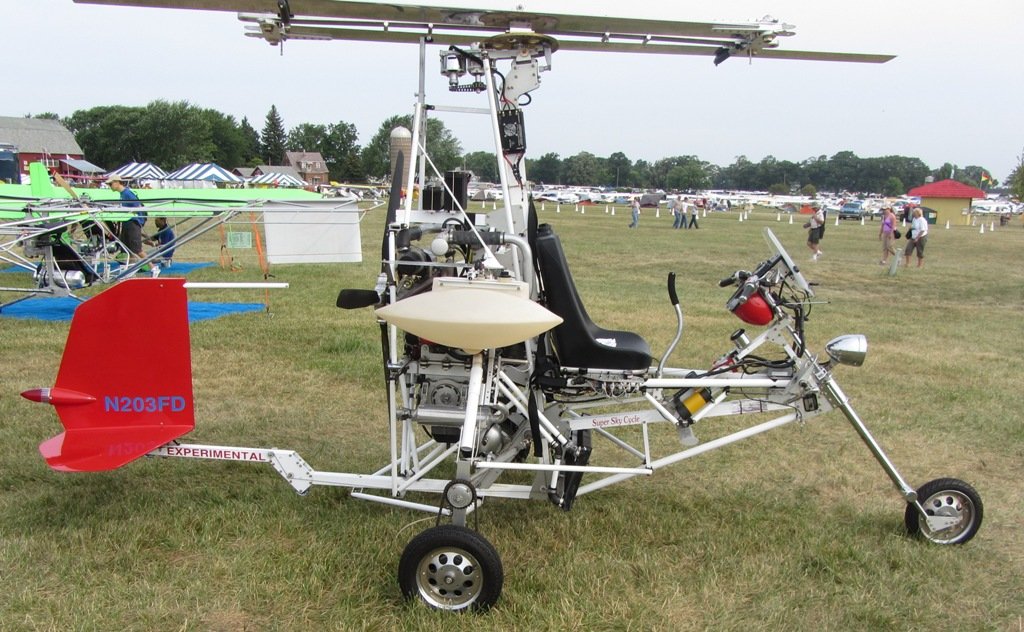
The production model employs a dual-engine system optimized for both flight and ground operations. The primary flight engine options include the 100-horsepower Rotax 912ULS four-cylinder four-stroke engine or the upgraded 115-horsepower turbocharged Rotax 914. Ground propulsion comes from a separate 27-horsepower Zanzottera MZ 34 two-stroke engine that drives the rear wheels through motorcycle-style handlebars.
The aircraft's most distinctive feature is its folding rotor system, enabling rapid transition from flight to ground configuration. A Kevlar tail provides directional control during flight operations, while the patented G-Force Landing Gear employs a parallelogram strut system with extended stroke capability. This landing gear system underwent testing to absorb vertical descent rates exceeding 700 feet per minute without vehicle damage or pilot injury.
Performance and Specifications
With an empty weight of 750 pounds and 7.5-gallon fuel capacity, the Super Sky Cycle achieves a cruise speed of 70 knots in flight mode while maintaining a minimum airspeed of just 20 mph. The aircraft requires only 20 feet for landing distance and can operate for five hours on a single fuel load. Ground operations match flight performance with a maximum road speed of 65 mph.
The vehicle's compact dimensions facilitate both aviation and automotive use. Overall length measures 14 feet 8 inches, with height adjustable from 8 feet 3 inches in flight configuration to 7 feet 10 inches for storage. The two-bladed propeller and pusher configuration provide efficient thrust while maintaining ground clearance for road operations.
Regulatory Status and Market Reception
The Super Sky Cycle achieved dual registration status as both a street-legal tricycle requiring a motorcycle license and an experimental gyroplane requiring pilot certification. By 2012, operators could legally drive the vehicle on public roads and refuel at standard gas stations, provided they maintained both motorcycle and pilot licenses.
Commercial interest emerged from various sectors, including orders from the Texas border patrol for surveillance and patrol operations in remote areas where traditional vehicles face limitations. The aircraft proved particularly valuable in regions with impassable roads or non-existent infrastructure where collision risks with other aircraft or buildings remained minimal.
Public Recognition and Industry Impact
The Super Sky Cycle garnered significant attention at major aviation and motorcycle events. At Airventure 09, Larry Neal drove the aircraft to the Road-able Aircraft Forum, making it the only fly-drive vehicle in attendance. The motorcycle community embraced the innovation, awarding second place in the Most Unusual Class at The Rat's Hole Custom Bike Show and generating substantial interest at the Sturgis 69th Annual Bike Rally, where it became possibly the most photographed vehicle at the event.
Manufacturing and Current Status
The Butterfly Aircraft LLC, operating under parent company Aerial Surveillance LLC, continues manufacturing kits for seven different gyroplane models ranging from ultralight configurations to a 300-horsepower Turbo Golden variant. The Super Sky Cycle kit includes all necessary components for customer assembly, requiring 100 to 300 hours of construction work to meet liability requirements.
This approach to the flying car concept demonstrates practical engineering solutions to long-standing transportation challenges, combining gyroplane safety advantages with motorcycle functionality in a single platform that achieved both regulatory approval and commercial viability.