
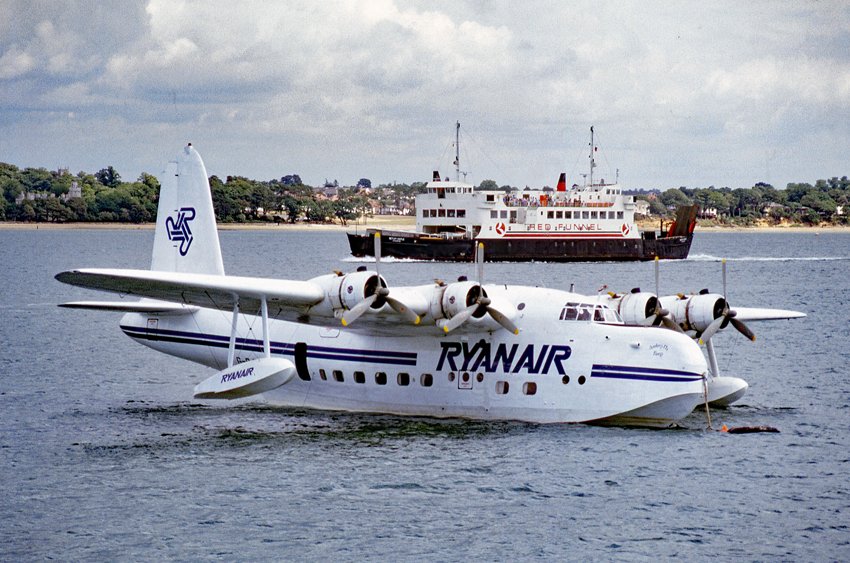
Production and Manufacturer History
The Short Sandringham was not a newly designed aircraft but a civilian conversion of surplus Short S.25 Sunderland military flying boats. These conversions were carried out by Short Brothers & Harland Ltd. in Belfast between 1945 and 1948. While the original military airframes had been produced at both the Rochester (Kent) and Belfast factories, the civil adaptation work was centered in Belfast. A total of 27 aircraft were converted during this period. The manufacturing entity, Short Brothers & Harland, was a joint venture between the original Short Brothers and the shipbuilder Harland & Wolff. Although the independent aircraft manufacturer Short Brothers no longer exists, its industrial lineage continues through the Belfast aerospace works, which later became part of Bombardier and subsequently Spirit AeroSystems.
Design and Technical Specifications
The airframe design of the Sandringham is derived from the Short S.25 Sunderland, which was designed by Arthur Gouge. The conversion process adapted the maritime patrol platform into a long-range airliner capable of transporting passengers, luggage, and freight. The design was particularly notable for its advanced hull, featuring a planing bottom and spray control for open-water operations. The interior was modified to provide luxurious accommodations, often utilizing a two-deck cabin arrangement with sleeping berths, recliner seating, and multiple lounges. One documented example was configured to seat 42 passengers and two stewards.
Engine and Performance
While various engines were used across different versions, the Sandringham 4 is well-documented as using four Pratt & Whitney R-1830-92D "Twin Wasp" 14-cylinder, two-row, air-cooled radial piston engines, each producing 895 kW (1,200 hp). Other conversions retained or upgraded from the original Bristol Pegasus radial engines. The Sandringham 4 reached a maximum speed of 383 km/h (238 mph) at 1,524 m (5,000 ft) and had a service ceiling of 6,492 m (21,300 ft). Depending on the payload, its range varied from 2,269 km (1,410 miles) with a 4,497 kg payload to 4,002 km (2,487 miles) with maximum fuel and a 1,261 kg payload.
Civil Service and Legacy
As a civilian aircraft, the Sandringham saw no military combat service, though its parent Sunderland type was a staple of RAF maritime patrols. Aeronaves Dodero of Argentina was the first operator, followed by Tasman Empire Airways Limited (TEAL) in New Zealand, which operated routes across the Tasman Sea. Other operators included BOAC and Antilles Air Boats, the latter of which flew a Sandringham named "Southern Cross" (VP-LVE) in the Caribbean into the early 1970s. This longevity made the Sandringham one of the final large WWII-era flying boats in commercial service. Today, a notable example is preserved in the Kermit Weeks / Fantasy of Flight collection in the United States.