
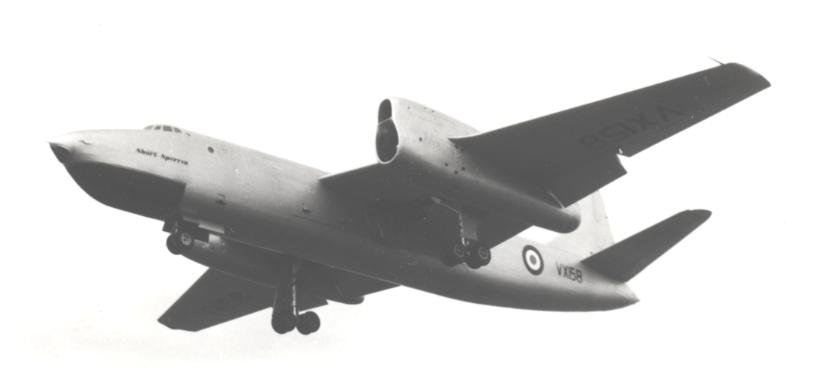
The Short SA.4 Sperrin was developed in the late 1940s to meet Air Ministry Specification B.14/46. It was designed as an interim or "fallback" strategic bomber, intended to provide the Royal Air Force with a reliable nuclear-capable aircraft should the more radical swept-wing V-bomber projects—the Vickers Valiant, Avro Vulcan, and Handley Page Victor—fail or suffer significant delays. Because the primary V-bombers successfully met the RAF's requirements, the Sperrin never entered series production.
Manufacturing was carried out by Short Brothers and Harland at their Belfast facility in Northern Ireland. The company, which had merged with Harland and Wolff in 1943, produced only two prototypes: VX158 and VX161. The first prototype took flight on August 10, 1951, followed by the second on August 12, 1952. The design was characterized by its conservative straight-wing configuration and a pressurized "drum" crew compartment in the forward fuselage, which housed a crew of five consisting of two pilots, a navigator, a radio operator, and a bomb-aimer/observer.
Technically, the Sperrin was designed to carry a 10,000 lb nuclear bomb or up to 20,000 lb of conventional ordnance over distances exceeding 3,800 miles. Its initial powerplant consisted of four Rolls-Royce Avon turbojets. Depending on the specific test phase, the aircraft utilized Avon RA.2 engines (6,000 lbf thrust) or Avon RA.3 engines (6,500 lbf thrust). The Sperrin's most significant contribution was as a flying laboratory. It was used between 1953 and 1956 to conduct bomb-release trials using inert casings of the Blue Danube, the UK's first deployable nuclear weapon, as well as Blue Boar television-guided bomb mock-ups. Specifically, VX161 was the only prototype equipped with a fully operational bomb bay for these trials.
Later in its career, the Sperrin served as a high-power engine testbed for the de Havilland Gyron turbojet. Experimental configurations included a mix of three Avon RA.2 engines and one Gyron Gy.1, or two Avon RA.2 engines paired with two Gyron Gy.2 engines, the latter producing approximately 20,000 lbf each. The aircraft reached maximum speeds of approximately 564–567 mph at 15,000 feet and a service ceiling of 45,000 feet. Following the conclusion of the Gyron project in 1956, VX161 was scrapped in 1957, and VX158 was scrapped in 1958. No airframes survive today.