
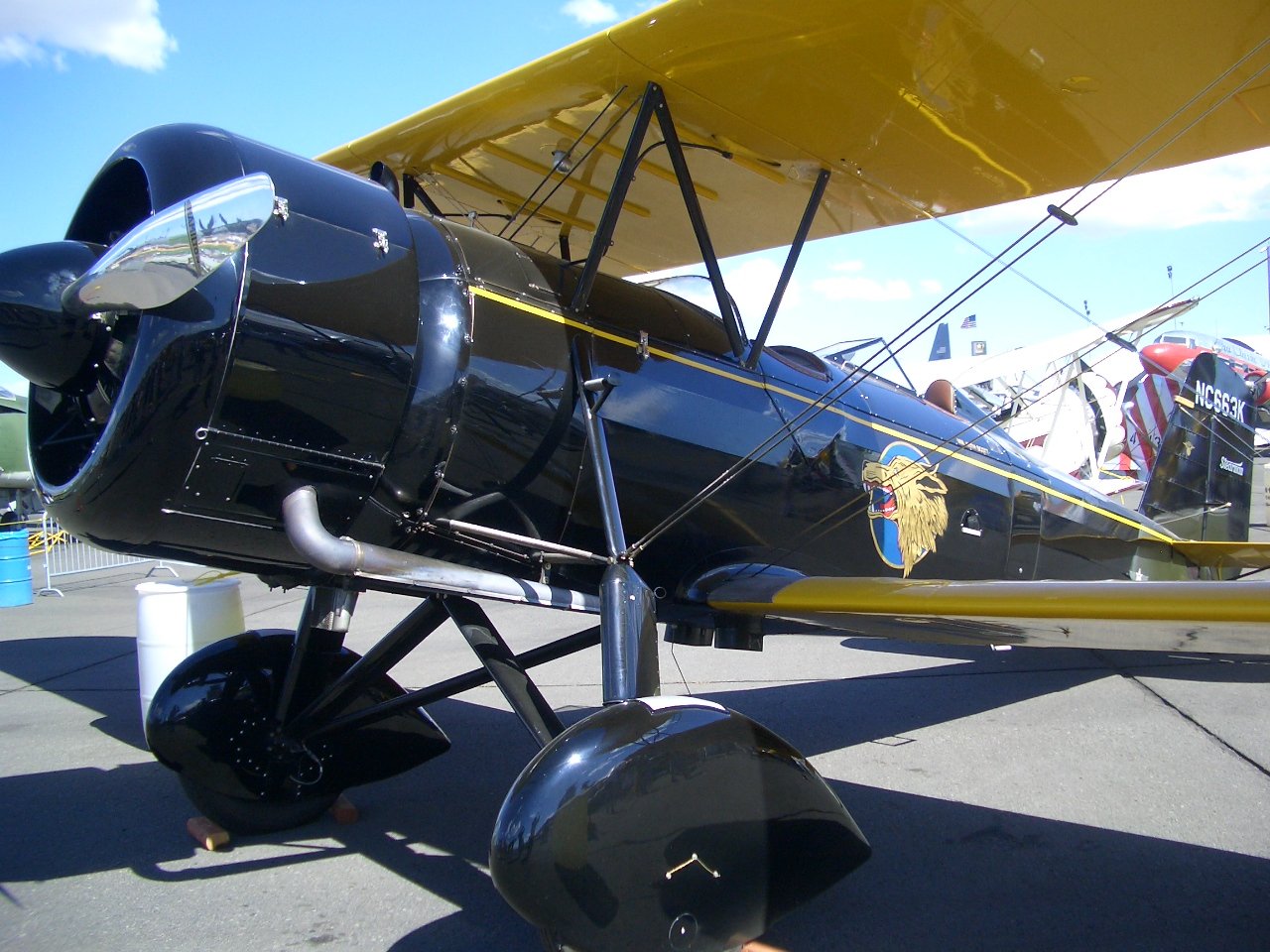
Commercial Aviation Pioneer
The Stearman 4 Junior Speedmail emerged during a critical period in American commercial aviation, when airlines desperately needed aircraft that could carry heavier loads than existing mail planes while maintaining the speed and reliability demanded by expanding route networks. Major operators including Varney Air Lines, which later became United Airlines, and American Airways, the predecessor to American Airlines, recognized the type's capabilities and incorporated it into their fleets. The aircraft proved particularly valuable for mail service, with specialized single-seat variants like the 4-CM and 4-DM featuring cargo holds in place of passenger accommodations.
The Stearman Legacy
Lloyd Stearman founded Stearman Aircraft Corporation in 1927 after departing Travel Air Manufacturing Company, which he had co-founded with Walter Beech and Clyde Cessna in 1925. Working from Wichita, Kansas, Stearman developed the Model 4 as an evolution of his earlier C-3 design, incorporating a deeper fuselage for increased cargo capacity and offering more powerful engine options. The company's independence was short-lived, however, as Boeing acquired Stearman Aircraft through a holding company in 1929, transforming it into a Boeing division by 1938 and eventually the Boeing Wichita Division by 1941.
Engine Options and Performance
Stearman offered the Model 4 with three different powerplant families, reflecting the rapidly evolving engine technology of the late 1920s. The 4-C variant utilized the 300-horsepower Wright J6-9 radial engine, while the 4-D series employed the equally powerful Pratt & Whitney Wasp Junior. The most potent variants, including the 4-E and the unique 4-DX, featured Pratt & Whitney Wasp engines producing between 400 and 450 horsepower. This power enabled the aircraft to achieve a maximum speed of 158 mph, cruise at 128 mph, and climb at 1,400 feet per minute to a service ceiling of 18,000 feet.
Variant Specialization
The Model 4's versatility became evident through its numerous variants, each optimized for specific commercial roles. The Junior Speedmail variants could accommodate passengers in luxury, featuring heaters in both cockpits and marketing prices around $16,000. Mail-focused versions like the Senior Speedmail eliminated passenger seating entirely, maximizing cargo capacity for postal contracts that formed the backbone of early airline revenue. The most unusual variant, the 4-RM Special, converted a single 4-CM into a four-seat passenger aircraft powered by a 450-horsepower Ranger inline engine, demonstrating the design's adaptability.
Corporate and Promotional Service
Beyond airline operations, the Stearman 4 found favor with major oil companies for executive transport and promotional activities. Standard Oil operated three Junior Speedmails in distinctive "Stanavo" colors, while Richfield Oil's NC667K became the flagship of the "Jimmie Allen Flying Club" from 1929 to 1937. Texaco operated a 4-D variant as Texaco 11/14 until February 1936, after which it transitioned to agricultural duties including crop dusting and mosquito control operations.
Production and Certification
Stearman's production run of exactly 41 aircraft across all variants reflected the economic pressures of the Great Depression and the specialized nature of high-performance commercial aircraft. The company secured multiple Approved Type Certificates from the Department of Commerce, including ATC 304 for the 4-C, ATC 305 for the 4-D, and ATC 292 for the 4-E variants. The final aircraft in the series, the Model 80 Sportster, emerged in 1933 as a one-off two-seater with a 420-horsepower Pratt & Whitney Wasp Junior T3A engine under ATC 504.
Surviving Legacy
At least six Stearman 4 aircraft remain airworthy today, representing one of the highest survival rates among 1920s commercial aircraft. NC667K, the former Richfield Oil flagship, achieved particular recognition after its 2007 restoration by Jim Kimball Enterprises, earning Grand Champion honors at Sun 'n Fun in 2013. The Kansas Aviation Museum displays a restored 4-D with Texaco heritage, while the Yanks Air Museum maintains another 4-D example that was originally delivered on July 16, 1931. These survivors serve as flying reminders of the ambitious engineering and commercial aviation pioneering that characterized American aviation's golden age.