
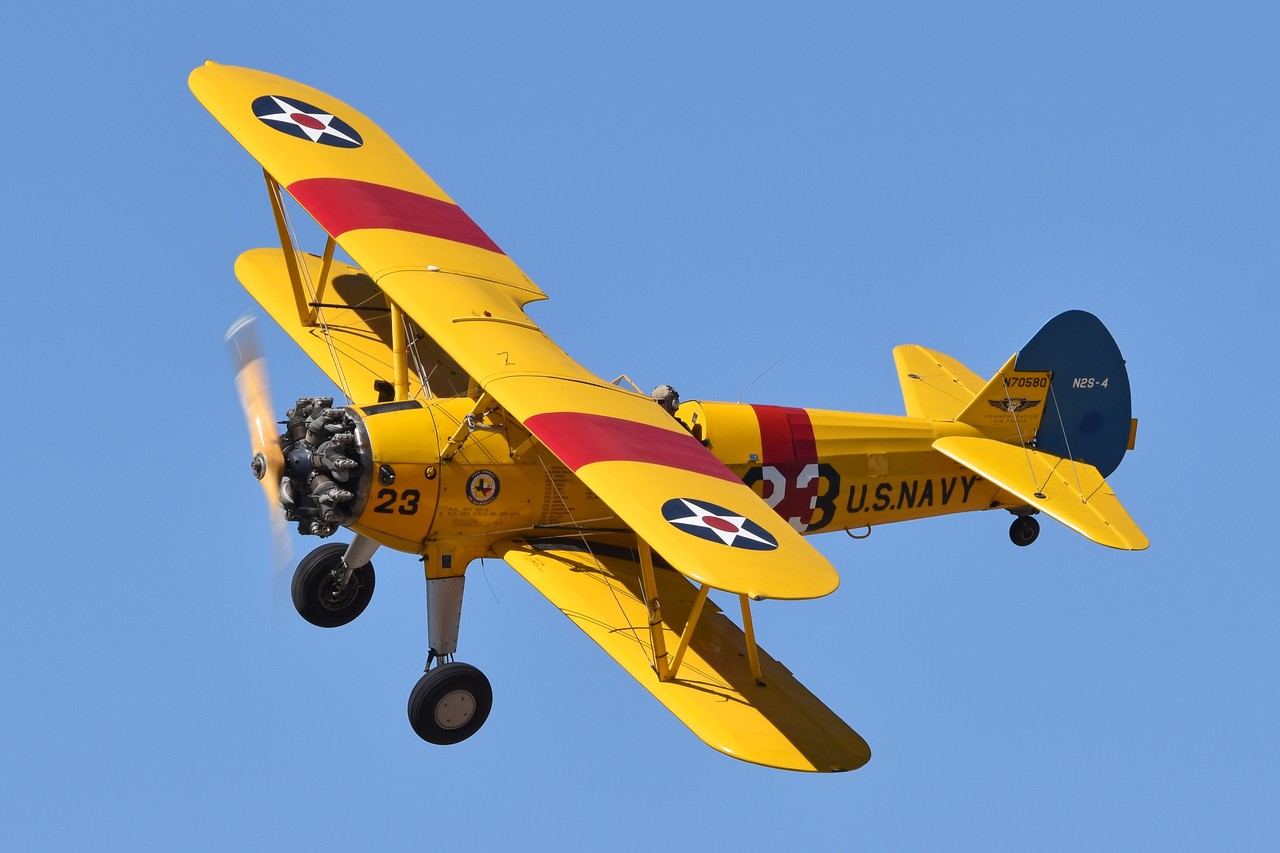
Wartime Dominance
The Stearman Model 75 achieved unprecedented success as the backbone of Allied pilot training during World War II. By the war's end, nearly every American military pilot had learned to fly in a Stearman trainer. The aircraft served across multiple branches and nations, with the United States Army Air Forces operating PT-13 and PT-17 variants, the U.S. Navy flying NS-1 and N2S designations, and the Royal Canadian Air Force utilizing aircraft designated as Kaydets.
Production milestones demonstrate the aircraft's critical wartime role. On March 15, 1941, Stearman delivered its 1,000th trainer to the Army and 1,001st to the Navy on the same day. The 2,000th Army trainer followed on August 27, 1941, and the company reached 10,000 primary trainers delivered on July 27, 1944. The PT-17 variant dominated production with 3,519 aircraft built, making it the most popular single version.
Engineering Innovation
Stearman engineers Mac Short, Harold W. Zipp, and J. Jack Clark created the Model 75's predecessor in remarkable time, designing and building the prototype Model 70 in just 60 days during late 1933. Test pilot David "Deed" Levy conducted the maiden flight on January 1, 1934. The Army Air Corps had specifically requested a more challenging trainer than existing aircraft, leading to the distinctive tall, narrow landing gear configuration that made the aircraft deliberately difficult to handle during ground operations.
Engineers incorporated spin strips—small triangular wooden pieces on the wing leading edges—after initial evaluations revealed the aircraft's stall characteristics were too benign for military training requirements. These modifications ensured the aircraft met Navy spin and recovery training standards while maintaining its exceptional structural strength.
The Stearman Company
Stearman Aircraft Company operated from Wichita, Kansas, during the 1930s and 1940s before becoming the Stearman Division of the Boeing Company following acquisition. The company's location in Kansas positioned it strategically for wartime production, with the entire manufacturing operation concentrated in Wichita facilities. Boeing's acquisition brought additional resources and manufacturing capability that enabled the massive wartime production surge.
Engine Variants and Performance
Multiple radial engines powered different Model 75 variants throughout production. PT-13 variants utilized various Lycoming R-680 configurations, including the R-680-B4B, R-680-7, R-680-11, and R-680-17 engines. The most numerous PT-17 variant featured the 170-horsepower Continental R-670 seven-cylinder air-cooled radial engine. Navy NS-1 aircraft operated Wright J-5 Whirlwind engines producing 200 horsepower, while experimental variants tested 225-horsepower Wright R-760 and Lycoming R-680 engines.
With a maximum takeoff weight of 2,635 pounds, the typical Model 75 achieved a cruising speed suitable for primary training operations. The aircraft's 13,200-foot service ceiling provided adequate altitude for advanced training maneuvers, while the 505-mile range allowed extended cross-country training flights without frequent fuel stops.
Pilot Training Experience
The Model 75's demanding ground handling characteristics served the intended training purpose perfectly. Student pilots struggled with the narrow, tall landing gear during taxi operations, teaching essential aircraft control skills before progressing to more complex aircraft. The tandem seating arrangement placed instructors in the rear cockpit with students forward, providing optimal communication and emergency control access.
Aerobatic capability remained exceptional throughout the aircraft's service life. The airframe's ability to withstand 12 positive and 9 negative Gs allowed comprehensive aerobatic training including loops, rolls, and spin recovery exercises essential for combat pilot preparation.
Civilian Legacy
Following World War II, thousands of surplus Stearman trainers entered civilian service across diverse applications. Agricultural operators extensively modified aircraft for crop dusting, relocating engines, installing chemical tanks in forward cockpits, and upgrading to 450-horsepower Pratt & Whitney R-985 Wasp Jr. engines. The U.S. government issued Approved Type Certificate No. 743 on June 6, 1941, for civilian Model A75L3 and A75N1 variants, with approximately 60 aircraft sold to civilian flight schools including Parks College of Engineering, Aviation and Technology.
Today, many of the original 10,000 aircraft remain airworthy, participating in air shows, aerobatic demonstrations, and agricultural operations. Museums worldwide preserve examples, including a PT-13D at the National Museum of the U.S. Air Force in Dayton, Ohio, donated by Boeing in September 1958. The aircraft's enduring popularity stems from its reputation as one of history's finest biplanes and its role training the greatest generation of military aviators.