
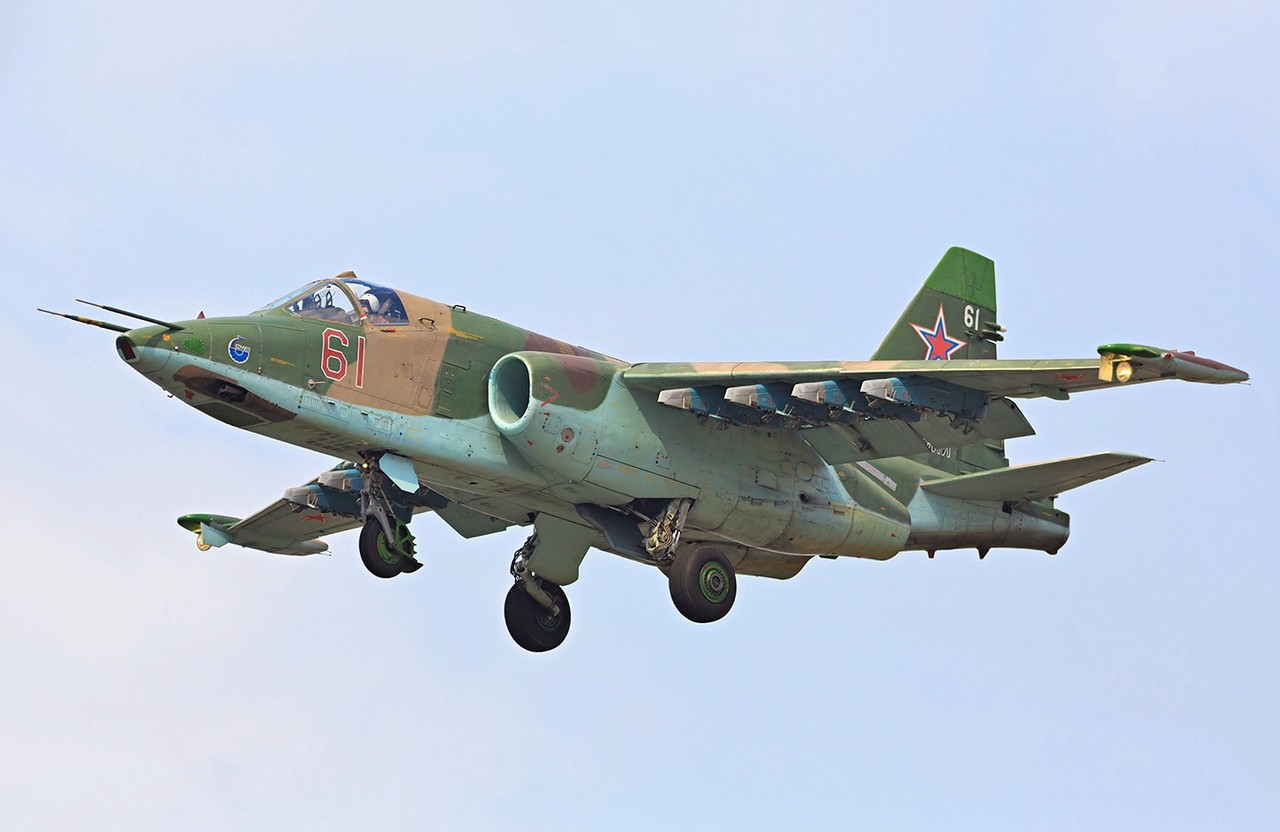
Combat Legacy
The Su-25 earned its reputation as an exceptionally durable ground-attack aircraft through extensive combat operations spanning four decades. During the Soviet-Afghan War from 1981 to 1989, nearly 50 Su-25s flew more than 60,000 sorties, including 5,300 strike missions that launched 139 guided missiles. Despite the hostile environment, only 21 to 23 aircraft were lost to enemy action, with an additional nine destroyed on the ground. This remarkable survival rate validated the aircraft's heavily armored design philosophy.
Russian forces continued deploying the Su-25 in subsequent conflicts, flying approximately 9,000 sorties during the First Chechen War from 1994 to 1996. The aircraft has remained operationally significant in the ongoing Russo-Ukrainian War that began in 2022, where both Russian and Ukrainian forces operate the type in active combat roles.
Design Innovation
The Sukhoi Design Bureau's approach to the Su-25 emphasized survivability over speed, creating one of only two armored fixed-wing jets in production by 2007 alongside the Su-34. The aircraft's titanium armor plating protected critical systems and the pilot compartment, while its twin-engine configuration provided redundancy for low-altitude operations over contested airspace.
Vladimir Ilyushin piloted the first prototype T8-1 on its maiden flight, culminating years of development that began with the completed airframe on May 9, 1974. The design successfully competed against the rival Ilyushin Il-102, leading to official service entry on July 19, 1981.
Production History
Series production commenced in 1978 at Factory No. 31 in Tbilisi, Georgian Soviet Socialist Republic, with additional manufacturing at facilities in Novosibirsk and Ulan-Ude. Between 1978 and 1989, Tbilisi produced 582 basic Su-25 variants for domestic use, while export Su-25K models added another 180 units from 1984 to 1989.
Total Su-25 production reached 1,024 aircraft across all variants by 2017, though manufacturing officially concluded in 2010 in Georgia with no new deliveries reported by June 2022. The production run included numerous specialized variants: the Su-25UB two-seat trainer first flew on August 12, 1985, with 130 to 180 units built, while the export Su-25UBK trainer variant saw approximately 20 aircraft completed.
Engine and Performance
Two Tumansky R-95Sh (R-195) low-bypass turbofan engines, manufactured by the Soyuz/Rybinsk Engine Company, power the Su-25. These engines were specifically optimized for the aircraft's close air support mission, emphasizing reliability in combat conditions and consistent performance during extended operations. Soviet forces in Afghanistan achieved sortie rates of 360 missions per aircraft annually, demonstrating the powerplant's durability.
The subsonic design reaches maximum speeds of approximately 975 km/h, with a tactical combat range of about 750 km and a service ceiling near 10,000 meters. The aircraft's rough-field capability allows operations from unprepared airstrips, extending its tactical flexibility in forward deployment scenarios.
Sukhoi Design Bureau
Pavel Sukhoi established his design bureau in the 1930s, evolving through various Soviet aviation ministries before becoming part of the modern United Aircraft Corporation (UAC) in 2006. Today operating as the Public Joint Stock Company United Aircraft Corporation - Sukhoi Division, the organization continues producing advanced military aircraft including the fifth-generation Su-57 fighter.
While Factory No. 31 in Tbilisi (now TAM - Tbilisi Aircraft Manufacturing) handled the majority of Su-25 production through 2010, it operates independently from the primary Sukhoi entity, which maintains its headquarters and primary design activities in Russia.
Current Operations
As of 2021, the Russian Aerospace Forces operated approximately 192 Su-25s, with an additional four serving in Naval Aviation roles. Modernization programs have extended the aircraft's service life, with the Su-25SM upgrade first delivered in August 2001. More than 60 upgraded aircraft were in service by 2013, expanding to over 80 units by 2015, with the modernization program continuing through 2020.
International operators have maintained smaller fleets, with notable deliveries including four factory-fresh Su-25s to the Democratic Republic of Congo between 1999 and 2000. The aircraft's continued combat employment in current conflicts demonstrates its enduring relevance as a specialized close air support platform, nearly five decades after its initial design.