
Competition Dominance
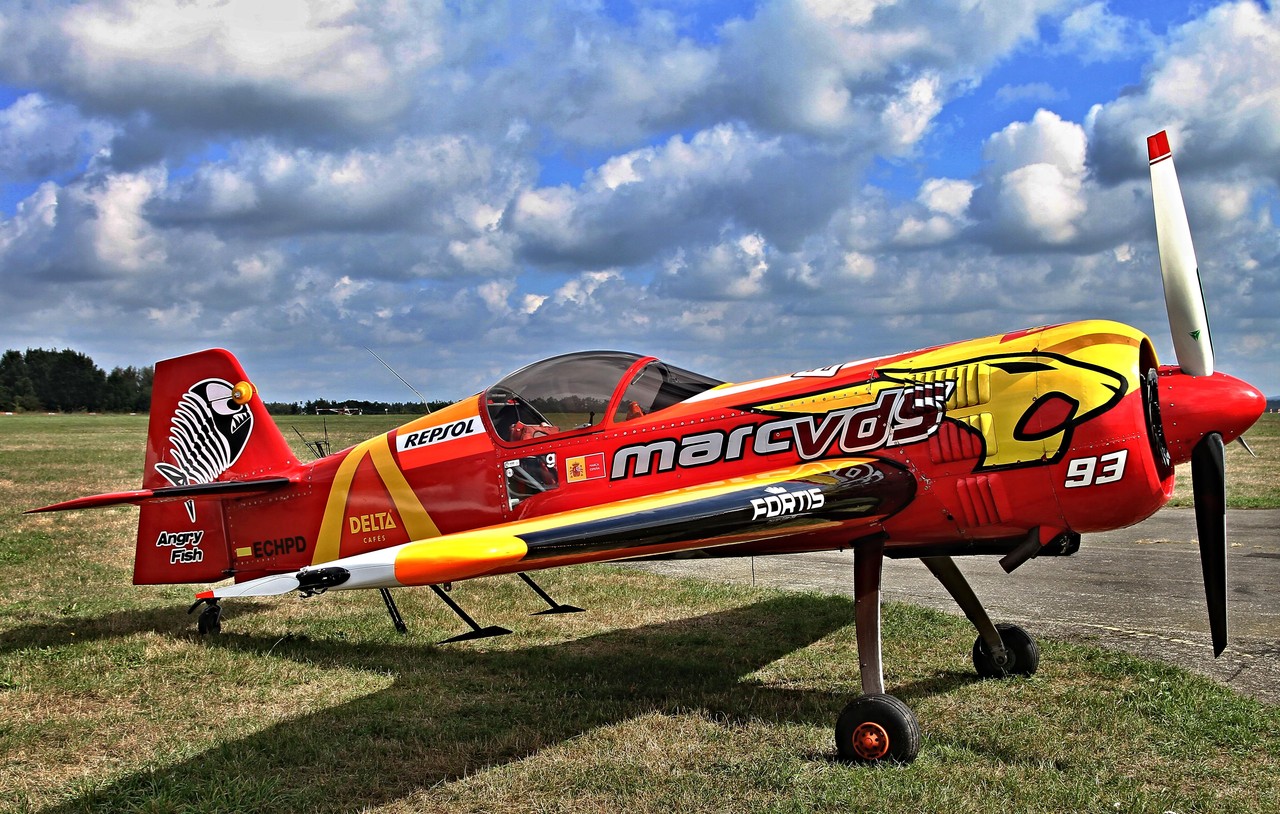
The Su-26 immediately established Soviet superiority in international aerobatic competition when it debuted at the World Aerobatics Championship in Hungary in August 1984, just two months after its first flight. By 1986, the refined Su-26M variant captured both men's and women's team prizes at the World Aerobatics Championships, with Soviet pilots continuing to dominate aerobatic titles throughout the late 1980s and 1990s. The modified Su-26M3, equipped with a more powerful 430-horsepower M9F engine, swept the 2003 and 2005 Aerobatic World Championships as well as the 2004 European Championships.
Design Innovation
The Su-26 represented a dramatic departure from traditional aerobatic aircraft design through its extensive use of composite materials and advanced engineering. The aircraft featured a special symmetrical wing section optimized for aerobatic performance and arched cantilever titanium landing gear that could withstand the tremendous stresses of competition flying. Initial prototypes S42-1 through S42-4 used two-bladed propellers, but production quickly shifted to the Su-26M configuration with refined tail surfaces and a German-made MTV-9 three-blade composite propeller that significantly improved performance.
The Manufacturer
The Sukhoi Design Bureau, established by Pavel Osipovich Sukhoi and renowned primarily for military fighter aircraft including the Su-27 and Su-35, demonstrated remarkable versatility in creating this specialized sports aircraft. Operating from their Moscow facility, Sukhoi engineers reduced the production Su-26M's weight by 30 kilograms compared to the prototype while simultaneously improving aerodynamics and engine cooling systems. The company, which continues today as Sukhoi Company JSC, remains a major Russian aerospace manufacturer producing both military and civilian aircraft.
Engine and Technical Specifications
The Su-26's heart was the reliable Vedeneyev M14P nine-cylinder air-cooled radial engine producing 270 kilowatts. This powerplant featured a speed governor, dual magnetos, mechanical fuel pump, generator, and oil pump, with pneumatic starting and the crucial ability to operate inverted during aerobatic maneuvers. The engine's robust design allowed the aircraft to perform spectacular gyroscopic maneuvers, rapid multiple snap rolls, and nearly hover using propeller thrust alone. The aircraft's 22-foot 5-inch length and 11.83 square meter wing area provided exceptional maneuverability within a compact, lightweight package.
Pilot Experience
Flying the Su-26 required exceptional skill due to its extreme performance capabilities and structural limits that exceeded those of virtually any other aerobatic aircraft. The machine could sustain positive 12 G forces and negative 10 G loads, stresses that pushed both aircraft and pilot to absolute limits. American aerobatic pilot Gerry Molidor, who purchased Soviet National Aerobatic team aircraft serial number 02-05 in 1998, flew it in advanced and unlimited competition until 2001, demonstrating the aircraft's continued competitiveness years after its initial design. The Su-26's landing speed of 71 mph and climb rate of 3,500 feet per minute made it both demanding and rewarding to operate.
Production and Export Success
Sukhoi produced the first three Su-26M aircraft (S42-6, S42-7, and S42-8) during the initial three months of 1986 to prepare for the 13th World Aerobatics Championship. Production aircraft began rolling out in winter 1989, with the first four machines incorporating weight reductions and performance improvements. In May 1989, Aviaexport secured the USSR's first aircraft delivery contract to the United States, delivering Su-26M aircraft in 1990 followed by an order for 25 additional machines. The export variant Su-26MKh, which first flew March 28, 1990, featured additional wing fuel tanks to extend ferry range, with eleven examples delivered to customers in the United States, Switzerland, and other nations.
Legacy and Museum Preservation
Today, the Su-26 remains highly sought after among serious aerobatic competitors, though flying examples are limited due to the small production run during the aircraft's 1984-1990s manufacturing period. The National Air and Space Museum houses Su-26M serial number 02-05, built in 1990 and originally painted in distinctive "Russian purple," which logged 222 flights with the Soviet National Aerobatic team during 1990 and 1991. Examples remain registered and flying in multiple countries including the United States, Australia, Switzerland, and Spain, testament to the aircraft's enduring performance capabilities and the skill of its Soviet designers who created a world-class competition aircraft during the height of the Cold War.