
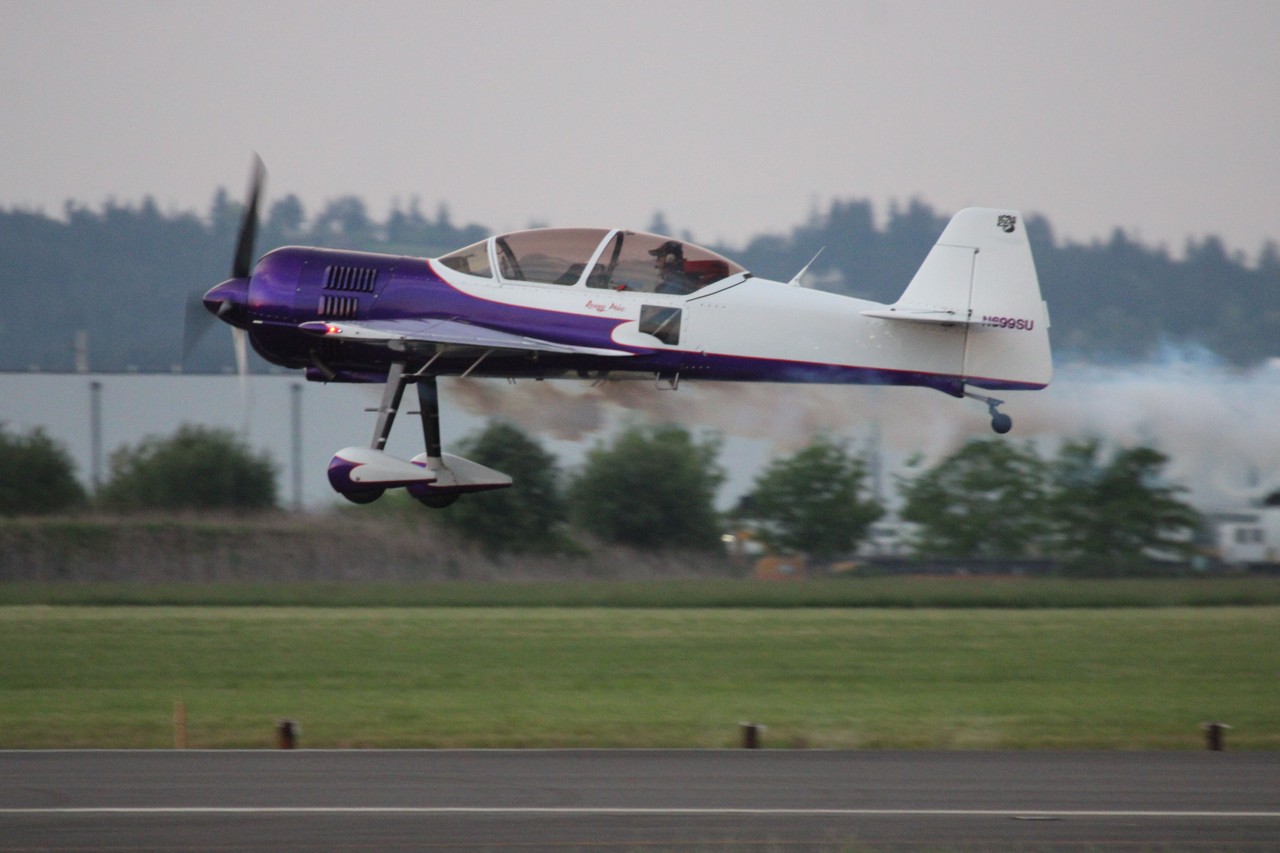
Development and Design Innovation
The Su-29 emerged from Sukhoi's desire to create an advanced two-seat trainer building upon their successful Su-26 aerobatic aircraft. Test pilot Ye.I. Frolov lifted the first prototype Su-29-1 off the runway at Zhukovsky's Flight Research Institute airfield on August 9, 1991, marking the beginning of a new chapter in Russian aerobatic aircraft development.
Sukhoi's engineers faced the challenge of adding a second seat while maintaining the exceptional performance characteristics of the single-seat Su-26. Their solution proved revolutionary for its time: extensive use of composite materials comprising 60 percent of the aircraft's structure. This innovative approach limited the weight penalty to just 50 kilograms over the Su-26, while providing the structural strength needed for extreme aerobatic maneuvers.
The aircraft featured a distinctive continuous one-piece canopy stretching over both cockpits, replacing the Su-26's smaller single-seat configuration. Dual flight controls allowed the Su-29 to serve effectively as both a trainer and demonstration aircraft, expanding its operational versatility beyond pure aerobatic competition.
Engine and Performance
Powering the Su-29 is a single Vedeneyev M14P or M14PF nine-cylinder radial engine, producing 360 to 400 horsepower respectively. The geared and supercharged powerplant provides exceptional climb performance of 3,545 feet per minute, enabling rapid altitude changes essential for complex aerobatic sequences.
The combination of lightweight composite construction and robust engine performance yields impressive specifications: a maximum speed of 280 mph, operational range of 600 miles, and service ceiling reaching 43,061 feet. These capabilities place the Su-29 among the highest-performing aerobatic aircraft of its generation.
Despite automated features like air-fuel mixture adjustment, the Su-29 demands considerable pilot skill. The air-pressure-powered starter system requires precise coordination to introduce oxygen into the synchronized cylinders during engine start procedures. Pilots describe the aircraft as "tricky to handle," reflecting its uncompromising design prioritizing performance over ease of operation.
Production and Certification
Sukhoi commenced Su-29 production in 1990, with manufacturing continuing for nearly two decades in Moscow facilities. The first twelve aircraft found buyers in the United States market during early 1992, establishing an international customer base from the program's early stages.
A significant milestone occurred on July 7, 1994, when the Su-29 became the first Russian aircraft to achieve full certification under the AR-23 standard. This certification opened additional export opportunities and validated the aircraft's design integrity for international operators.
Total production exceeded 50 aircraft during the program's run, with many examples featuring high-quality Western components for export customers. These included Cleveland brakes, advanced Western avionics, and specialized fuel computers, demonstrating Sukhoi's willingness to adapt their design for international markets.
The Sukhoi Design Bureau
The Pavel Osipovich Sukhoi Design Bureau traces its origins to 1939, establishing itself as one of the Soviet Union's premier aircraft manufacturers. While famous primarily for military fighters like the Su-27 and Su-35, the bureau's aerobatic aircraft program demonstrated their versatility in specialized civilian applications.
Sukhoi's approach to the Su-29 reflected their military heritage: no expense spared in development and production to achieve maximum performance. This philosophy, while increasing costs, resulted in an aircraft capable of competing with the world's best aerobatic machines.
International Service and Legacy
The Su-29 found homes with prestigious aerobatic teams and organizations worldwide. Argentina's Southern Cross aerobatic team, Austria's Flying Bulls, the Czech Aerobatic Team, and Russia's DOSAAF all operated the type, showcasing its capabilities at airshows and competitions globally.
The Flying Bulls' example, manufactured in 2002, exemplifies the aircraft's build quality. Purchased with only 130 flight hours, it came with complete documentation for every component, reflecting Sukhoi's meticulous production standards. Individual inspection and approval of each part provided operators with unprecedented maintenance traceability.
Current Status
Today, the Su-29 remains active in aerobatic training and demonstration roles worldwide. Its advanced composite construction techniques influenced subsequent aerobatic aircraft development, while its performance capabilities continue to challenge pilots decades after its first flight. The aircraft represents a unique bridge between Soviet-era engineering traditions and modern composite manufacturing methods, securing its place in aviation history as an innovative and capable aerobatic machine.