
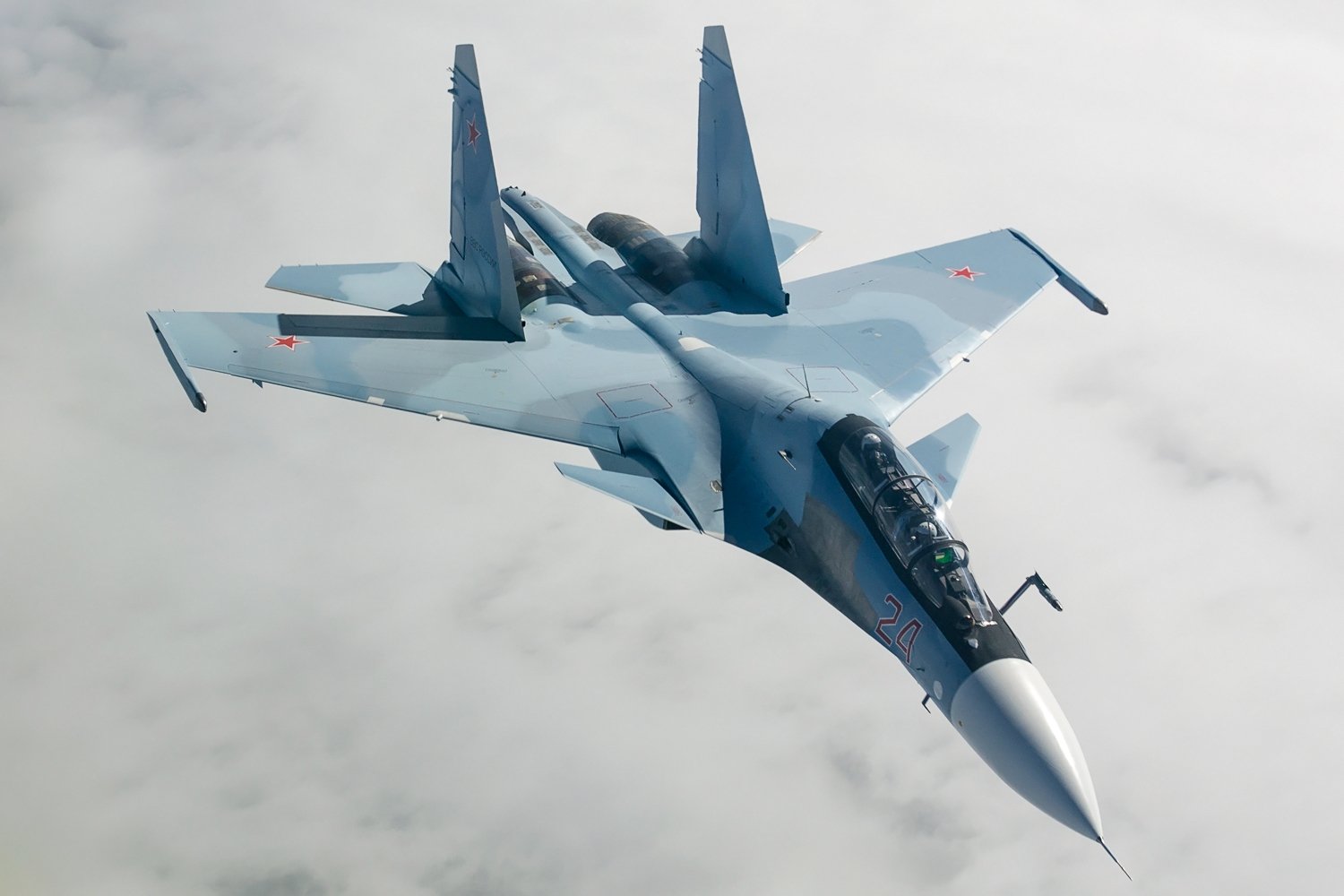
The Sukhoi Su-30 is a twin-engine, two-seat multirole fighter developed by the Sukhoi design bureau. Designed as an advanced evolution of the Su-27 family, the aircraft was intended to expand combat flexibility and operational range. The Su-30 prototype completed its first flight on December 31, 1989, marking the beginning of a versatile family of aircraft that would eventually be produced in substantial numbers for both domestic use and international export markets.
Production of the Su-30 was centered at several key facilities. A primary manufacturing hub was the Komsomolsk-on-Amur Aircraft Plant, also known as KnAAPO or KnAAZ, located at 1 Sovetskaya Street in Komsomolsk-on-Amur, Russia. This facility has a long industrial history, having been established in 1927. In addition to the Komsomolsk-on-Amur plant, Irkut was also responsible for the production of major variants of the aircraft. While the total number of units produced across all sub-variants is not definitively listed in the available records, the aircraft is recognized as one of the most successful export fighter families produced by Sukhoi.
The organizational structure of the manufacturing entities has evolved significantly over time. The Komsomolsk-on-Amur plant eventually became part of the Yakovlev / United Aircraft Corporation framework. Records indicate that on February 1, 2005, a manufacturing branch of Sukhoi Civil Aircraft was established in Komsomolsk-on-Amur, which is linked to the current Yakovlev Aircraft Production Center. Despite these corporate transitions, the legacy name Komsomolsk-on-Amur Aircraft Production Association continues to appear in various official and sanctions-related documentation.
In terms of operational role, the Su-30 serves as a multirole fighter capable of performing a wide array of combat missions. While the specific engine models and performance specifications vary across its numerous sub-variants, the aircraft is consistently characterized by its twin-engine configuration and two-seat cockpit, which supports its multirole mission profile. The aircraft's legacy is defined by its role as a cornerstone of Russian fighter exports and its association with the prolific Komsomolsk-on-Amur production center.