
Development and First Flight
The Superjet 100 emerged from Sukhoi's strategic shift toward civilian aviation under Mikhail Pogosyan's leadership in the late 1990s. Originally founded in 1939 as a military aircraft manufacturer, Sukhoi launched the Russian Regional Jet program in June 2001 with government backing and international partnerships including Boeing, Ilyushin, and Rosaviakosmos. The program evolved from an initial 60-95 seat concept to focus on the larger 95-100 seat market after 2004 market research revealed stronger demand for higher-capacity regional jets.
Test pilot Leonid Chikunov and development leader Alexander Dolotovsky guided the aircraft through its design phase at the Sukhoi Design Bureau. The first prototype, designated 95001 with serial number 97001, rolled out on September 26, 2007, at the Komsomolsk-on-Amur Aircraft Plant in Siberia. After extensive ground testing, the aircraft achieved first flight on May 19, 2008, marking a milestone in Russian aviation history.
Production and Manufacturing
Manufacturing takes place at the Komsomolsk-on-Amur Aircraft Plant, Russia's largest aircraft facility in the Far East. Serial production commenced in spring 2011 following certification in November 2010. By January 2020, 175 aircraft had been completed from 302 total orders, with production initially targeting 70 units annually by 2012.
The program faced significant challenges during development, particularly with engine supply. Early aircraft utilized Franco-Russian SaM146 turbofan engines manufactured by PowerJet, a joint venture between Safran Aircraft Engines and NPO Saturn. Quality issues at NPO Saturn caused production delays from 2009, forcing prototype engine swaps and postponing deliveries until certification was achieved.
Commercial Service
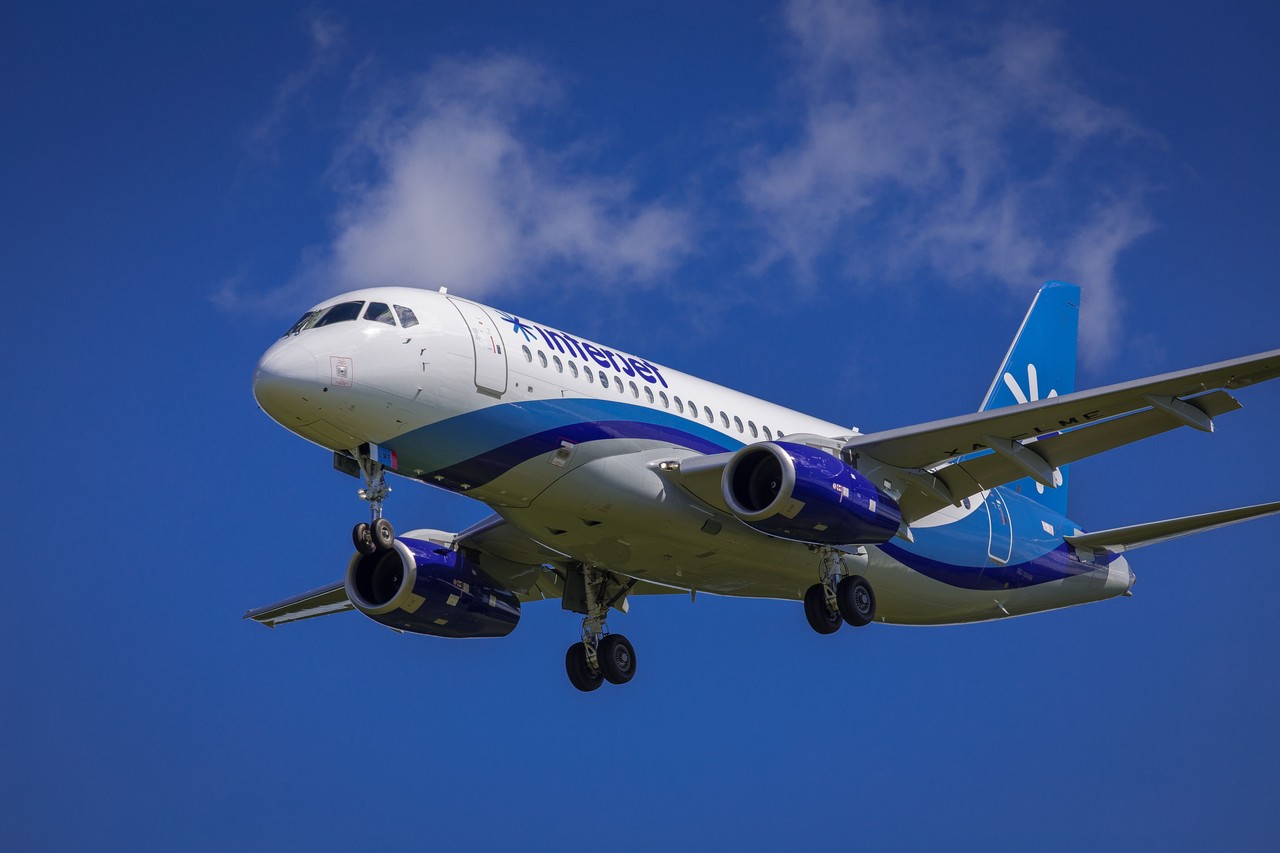
Armavia operated the first commercial flight on April 21, 2011, following a prototype demonstration flight for the carrier on November 4, 2010. Aeroflot became the launch customer with an initial order of 30 aircraft placed in 2005. The operator roster expanded internationally to include Interjet serving Western Europe and the Americas, CityJet in Europe, and Kartika Airlines in Indonesia.
By September 2017, the fleet of 105 aircraft had completed more than 220,000 flights accumulating 330,000 flight hours. These numbers grew to 127 aircraft logging 275,000 flights and 420,000 hours by May 2018, demonstrating the type's operational reliability once engine issues were resolved. The aircraft achieved 300,000 revenue flights and 460,000 total hours by September 2018.
The Manufacturer Today
Sukhoi Civil Aircraft originally developed the SSJ100 as a division of Sukhoi Holding before merging into United Aircraft Corporation's Regional Aircraft branch. In August 2023, the program transferred to Yakovlev, also part of UAC, and was renamed the Yakovlev SJ-100. This transition reflected Russia's broader strategy of import substitution following international sanctions.
UAC continues production under the Yakovlev designation, targeting serial output beginning in 2024. The company estimates demand for more than 2,300 aircraft in the 100-seat category through 2036, positioning the SJ-100 to capture significant market share in regional aviation.
Engine Evolution and Performance
The aircraft's powerplant evolution reflects Russia's pursuit of technological independence. Original SaM146 engines, while reliable post-certification, created supply vulnerabilities due to Western component dependencies. The current SJ-100 variant utilizes domestically-produced PD-8 turbofan engines, with the first PD-8-powered prototype (97023) flying on April 23, 2025.
Certification of the PD-8 engine is expected by end-2025, with production ramping from four engines initially to 30 annually. The first serial-produced PD-8-powered aircraft, bearing serial number 97024, completed its maiden flight on September 5, 2025, marking full Russian self-sufficiency in regional jet production.
Technical Specifications and Performance
The Superjet 100-95 operates with a two-person flight crew and incorporates modern fly-by-wire flight controls. Maximum operating speed reaches Mach 0.78 (470 knots) with a service ceiling of 41,000 feet. Range capabilities allow 2,480 nautical miles with a full passenger load of 98 travelers, making it suitable for most regional routes.
Seating configurations vary from 75 passengers in three-class layouts to 100 in high-density arrangements. The aircraft's aerodynamic design matched 80 percent of pre-flight computational models during initial testing, demonstrating advanced engineering capabilities that positioned it competitively against established Western regional jets.
Legacy and Current Status
As of April 2023, approximately 160 Superjet 100s remain in active service worldwide. Twenty-four SJ-100 variants were in various completion stages by September 2025, with serial production scheduled to resume fully between 2024 and 2026. Engine deliveries are planned to commence by spring 2026 to support expanded production rates.
The aircraft represents Russia's successful re-entry into commercial aviation after the Soviet era, achieving more than 420,000 flight hours despite early production challenges. Its evolution from the Western-component dependent SSJ100 to the fully domestic SJ-100 illustrates the broader geopolitical shifts affecting modern aviation manufacturing and the resilience of established aerospace programs.