
Service History
The Super Universal dominated bush flying operations throughout the 1930s, particularly in Canada and Alaska where its rugged construction and reliable performance made it the aircraft of choice for exploring remote territories. Japan Air Transport became the largest operator of American-built Super Universals, expanding their initial order from six aircraft to 21 by the early 1930s. Northern Airways deployed the type extensively during the fierce "Rate War" competition of the 1930s, while Canadian operators favored the aircraft on floats and skis for accessing previously unreachable wilderness areas.
Richard E. Byrd selected the first production Super Universal, named Virginia, for his 1928 South Pole expedition, though the aircraft met a dramatic end when Antarctic winds exceeding 150 mph tore it from its moorings and hurled it over one kilometer backward across the ice.
Military Evaluation and International Service
Despite its commercial success, American military services showed little interest in the Super Universal. The U.S. Navy evaluated one aircraft as the XJA-1 but declined to purchase the type, while the U.S. Air Corps tested a production model for photoreconnaissance and transport duties without placing orders. Only one late-production American aircraft found military service with the Argentine Navy.
Japanese and Manchurian variants told a different story entirely. Nakajima's licensed production created the Ki-6 military variant, with at least 46 Super Universals built and approximately 40 configured for military use. Production in the puppet state of Manchukuo ran from October 1933 through 1943, with aircraft designated M-118 through M-198 serving the Manchu Air Transport Company and, after 1937, the newly established Manchurian air force during extensive operations in occupied China.
The Manufacturer
Anthony Fokker established Fokker Aircraft Corporation of America in Hasbrouck Heights, New Jersey, after splitting from General Motors while retaining licensing rights to his designs. Fokker personally supervised construction at multiple facilities, including a new factory in Moundsville, West Virginia, that began operations in April 1928. The American subsidiary represented Fokker's attempt to compete directly with domestic manufacturers in the rapidly expanding U.S. aviation market.
The company's Dutch parent had gained fame producing fighter aircraft during World War I, but the American operation focused entirely on civil transport aircraft. Despite the Super Universal's commercial success, structural problems would ultimately doom Fokker's American ambitions and reshape the entire transport aircraft industry.
Technical Innovation
Anthony Fokker designed the Super Universal as Model 8, incorporating significant improvements over the earlier Universal. The cantilever wing eliminated external struts, while the fully enclosed cockpit and cabin provided weather protection that open-cockpit predecessors lacked. Steel-tube construction with plywood-covered wooden ribs created a robust airframe capable of withstanding harsh operating conditions.
American-built aircraft used the reliable Pratt & Whitney Wasp radial engine, while Canadian Vickers substituted Bristol Jupiter powerplants in their 15 aircraft produced during 1929. Japanese variants initially employed Bristol Jupiters before switching to the domestically-produced Nakajima Kotobuki, itself developed from the British design.
Production and Licensing
Fokker America manufactured 80 Super Universals between 1928 and the early 1930s, assigned serial numbers 801 through 880. International licensing expanded production significantly, with Canadian Vickers contributing 15 aircraft in 1929 and Nakajima building approximately 100 in Japan. The extensive Manchurian production added dozens more aircraft, bringing total worldwide production to well over 200 examples.
This distributed manufacturing approach reflected Fokker's strategy of establishing local production to serve regional markets, though it also complicated parts supply and maintenance standardization.
Legacy and Downfall
The discovery of cracks in multiple Super Universal airframes during the early 1930s triggered a crisis that extended far beyond Fokker. Authorities grounded the entire fleet pending investigation, and the subsequent findings revolutionized transport aircraft construction standards. The incident accelerated the industry's transition from mixed wood-and-metal construction to all-metal designs, directly influencing the development of the Boeing 247 and Douglas DC-2.
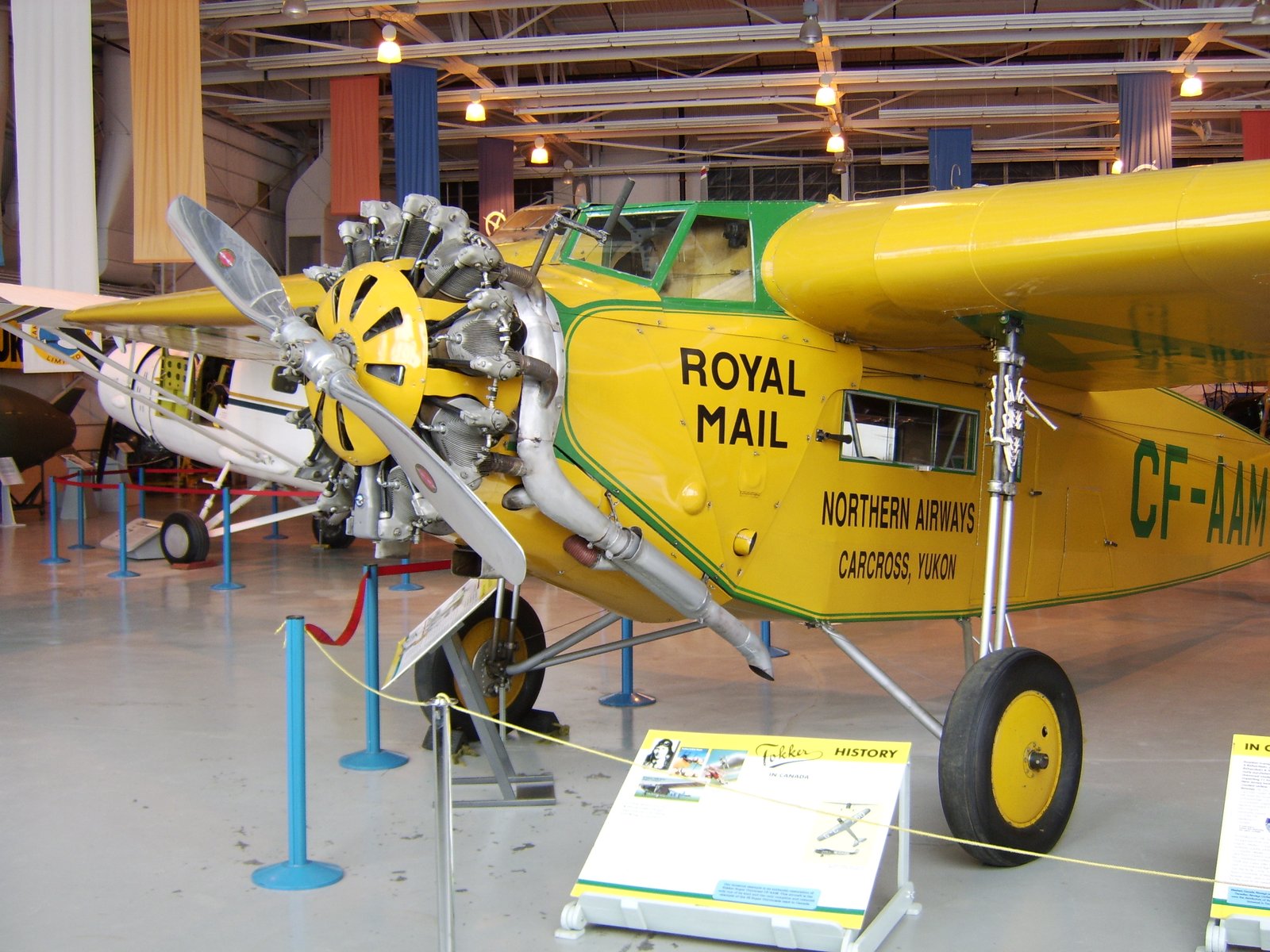
One remarkable survivor, Canadian registration CF-AAM, returned to flight on July 24, 1998, after 61 years on the ground and 18 years of restoration involving 10,000 volunteer hours. Now displayed at the Royal Aviation Museum, this aircraft represents the painstaking reconstruction of two crashed Yukon examples supplemented with American components, complete with original wood paneling and mohair cabin appointments.
The Super Universal's legacy extends beyond its technical contributions to encompass the pioneering spirit of 1930s aviation, when pilots pushed fabric-and-wood aircraft into Earth's most challenging environments with only mechanical instruments and dead reckoning navigation.