
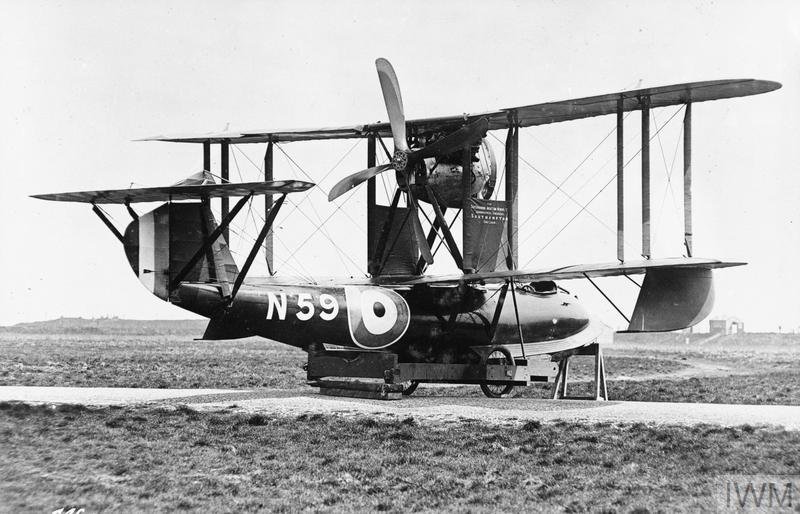
The Supermarine N.1B Baby was a single-seat fighter flying boat prototype developed in Britain during the final stages of World War I. The aircraft was designed to meet Admiralty Specification N.1B, which called for a dedicated fighter capable of operating from water bases to protect coastal areas and naval forces. The design was led by F. J. Hargreaves, who was assisted by R. J. Mitchell, the designer who would later achieve global fame for the Supermarine Spitfire.
Constructed by Supermarine Aviation Works Ltd at their facility in Woolston, Southampton, the Baby featured a biplane wing configuration and a hydrodynamic hull. Hargreaves' hull design was inspired by the work of Bolas, specifically the forms developed by John Cyril Porte and Linton Hope. While three airframes were initiated, the project remained strictly experimental. Only one aircraft successfully flew, while a second airframe (designated N60) was used for spare parts, and a third was abandoned before completion. The prototype's first flight occurred in 1918, though a precise calendar date is not documented.
Technically, the Baby was powered by a single piston engine driving a propeller. Although specific engine models and horsepower for the N.1B are not explicitly recorded in the primary Baby references, the aircraft's basic airframe served as the foundation for the Supermarine Sea Lion I. Because the Sea Lion I used a Napier Lion engine, it is highly probable the Baby utilized a similar water-cooled inline piston engine from the Napier Lion series.
Despite its innovative approach, the Baby never entered series production. Trials conducted between 1918 and 1919 revealed that the aircraft did not provide a sufficient performance advantage over existing land-based fighters or floatplanes to justify a full production run. Consequently, the aircraft never saw operational combat service or civil use. Its primary legacy is technical; the experience gained in hull design and hydrodynamics directly informed the development of the Schneider Trophy racers and established the engineering expertise that defined Supermarine's future success.