
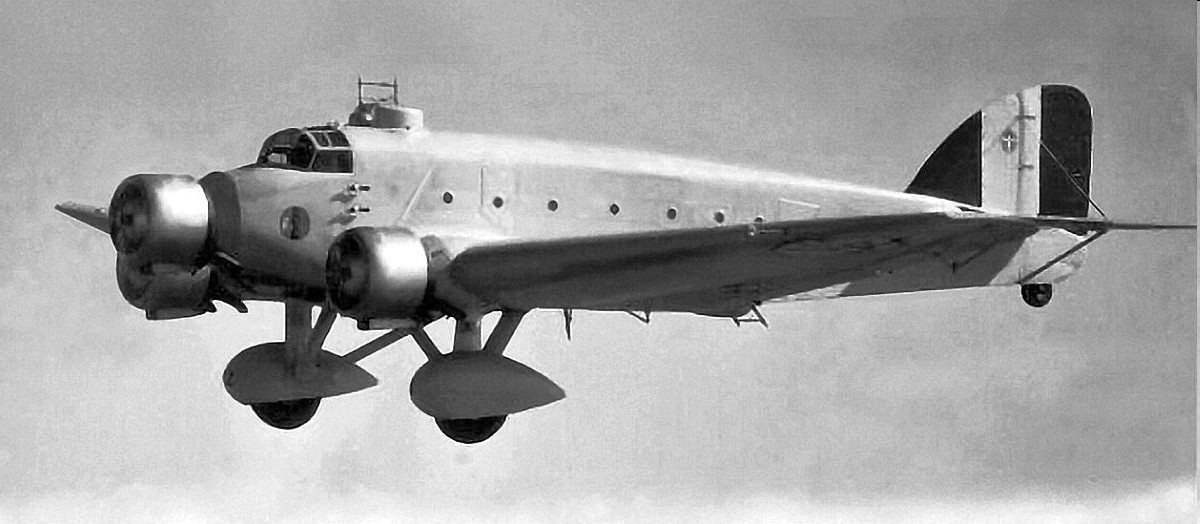
The Savoia-Marchetti SM.81 Pipistrello was developed as a militarized version of the S.73 airliner, designed to serve as a three-engine transport and bomber. The prototype first took to the skies on 8 February 1934 at Vergiate, with the maiden flight conducted by Adriano Bacula. Upon its introduction, the aircraft was considered a significant advancement for the Regia Aeronautica, offering a combination of long-range capabilities, speed, and heavy armament that was competitive for the era.
Production of the SM.81 took place at the Savoia-Marchetti facility in Vergiate, near Varese, Italy. The manufacturing run began in 1934 and continued until March 1938, resulting in a total of 534 aircraft. The aircraft was powered by piston radial engines, with various models utilizing powerplants from Piaggio, Alfa Romeo, and Gnome-Rhône. Depending on the specific variant and engine installation, power output ranged from approximately 580 hp to 1,000 hp.
In terms of performance, the SM.81 was capable of reaching speeds exceeding 200 mph when new, with a service ceiling of roughly 23,000 feet and an operational range of approximately 1,200 miles. For defense, the aircraft featured a complex arrangement of turrets: two fuselage turrets each equipped with a single 7.7 mm Lewis machine gun, and two additional turrets—one located behind the cockpit and one ventral—each armed with two 7.7 mm Breda-SAFAT machine guns.
The SM.81 saw extensive combat service across several conflicts. It was deployed during the Second Italo-Abyssinian War, where it operated in reconnaissance, transport, and bombing roles. It also served in the Spanish Civil War as part of the Aviazione Legionaria supporting Nationalist forces. Additionally, China operated the aircraft, though these were reportedly lost to training accidents by early 1938. By the outbreak of World War II, the Regia Aeronautica maintained roughly 300 SM.81s. While obsolete as a daytime bomber by this stage, the aircraft remained useful as a night bomber and a daytime transport, particularly in the North African theater. Following the 1943 Italian armistice, the aircraft continued to fly with the Italian Co-Belligerent Air Force and the Italian Social Republic. The SM.81 remained in active service until its final retirement in 1950.