
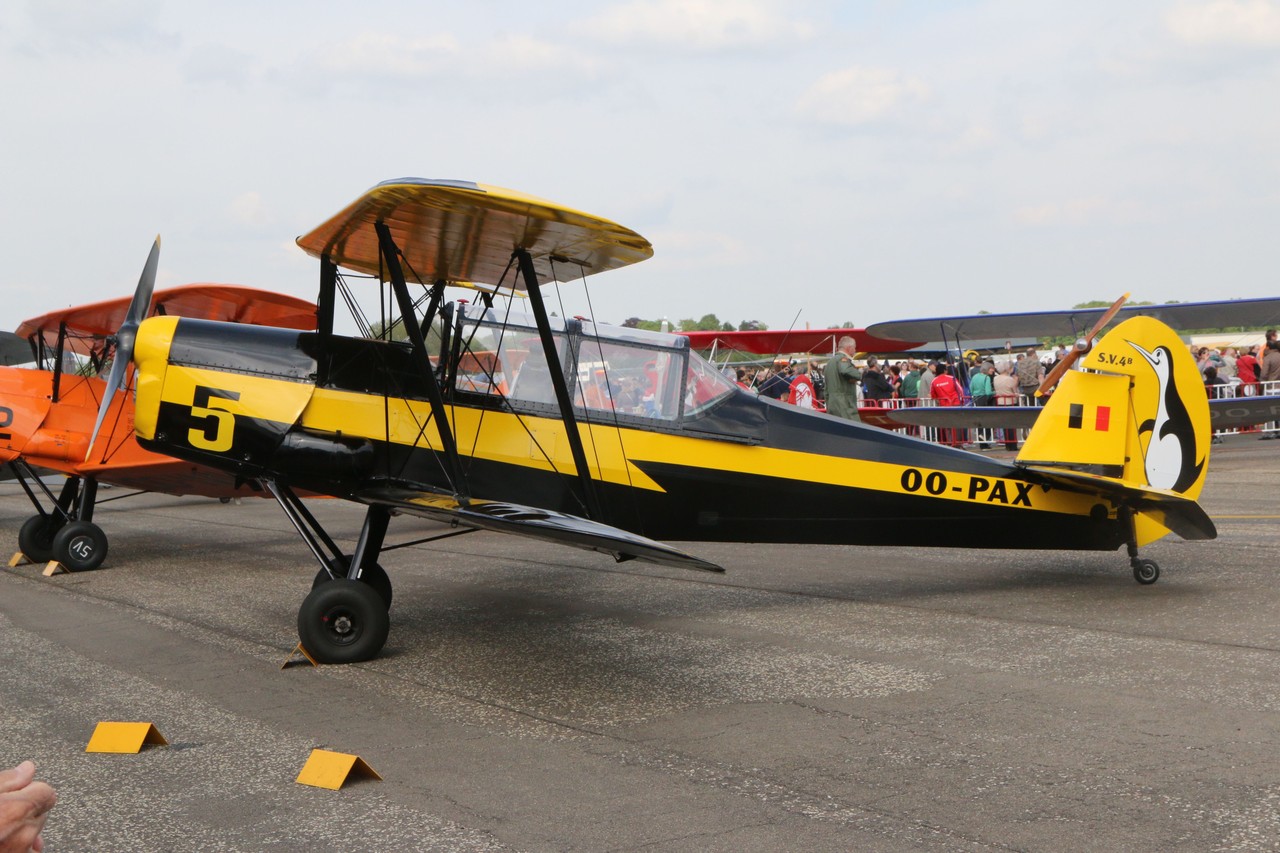
Design and Development
The SV-4's creation began when Jean Stampe, co-founder of Société Stampe & Vertongen, commissioned Georges Ivanoff to improve upon the company's earlier SV-3 design. Ivanoff's innovative solution involved moving the upper wing's center section forward and adding a distinctive swept-back configuration, inspired by the de Havilland DH.82 Tiger Moth. This design change solved a critical problem: it allowed easy access to the front cockpit while maintaining proper center-of-gravity balance during aerobatic maneuvers.
The prototype took flight on May 17, 1933, from Antwerp with Jean Stampe himself at the controls. Registered as OO-ANI and powered by a 130-horsepower de Havilland Gipsy Major 2 engine, the aircraft immediately demonstrated the gentle flying characteristics that would make it ideal for training novice pilots.
Production History
Initial production remained modest, with Stampe & Vertongen building only 35 aircraft between 1933 and 1940. The company constructed six SV-4s for their own flying school in 1933, followed by two more in 1937 and another pair in 1939. However, tragedy struck in 1935 when both Georges Ivanoff and Leon Stampe (Jean's son) died in separate aircraft accidents, severely disrupting the company's operations.
World War II transformed the SV-4's prospects dramatically. In 1939, the Belgian government ordered 300 aircraft, though only the first 30 were completed before the German invasion halted production. More significantly, a French delegation placed an order for 600 SV-4s, recognizing the design's potential as a military trainer.
Post-war production exceeded all pre-war totals combined. France's state-run SNCAN (Société Nationale de Constructions Aéronautiques du Nord) manufactured 701 SV-4C variants between 1945 and 1949, powered by French Renault 4P engines producing 130 horsepower. Algeria's Atelier Industriel de l'Aéronautique d'Alger contributed another 150 aircraft in 1947, serialized from 1001 to 1150.
Military Service
While the SV-4 saw limited wartime action, one aircraft achieved legendary status during World War II. On July 4, 1941, Belgian pilots Michael Donnet and Leon Divoy used SV-4 OO-ATD to escape German-occupied Belgium, flying from Chateau Ter-Block to England. Donnet later chronicled this daring escape in his book "Flight to Freedom."
The Belgian Air Force operated approximately 65 SV-4B aircraft from 1948 through the 1960s as basic trainers. Built by the reformed company Stampe et Renard (Jean Stampe's post-war partnership with former engineer Alfred Renard), these aircraft featured the reliable Gipsy Major 10 engine producing 130-145 horsepower. The first 20 Belgian military aircraft, designated V1 through V20, were painted in distinctive bright orange livery.
French military aviation made extensive use of the type, with French Air Force pilots training on the 701 SNCAN-built SV-4C variants. After military service, many of these aircraft transferred to French aero clubs, where they continued training civilian pilots well into the 1960s.
Aerobatic Excellence
The SV-4's forgiving flight characteristics and structural strength made it the dominant aerobatic competition aircraft throughout Europe for nearly three decades. Its wooden construction, necessitated by post-war aluminum shortages, proved surprisingly advantageous—the aircraft could withstand the stresses of repeated aerobatic maneuvers while remaining affordable to operate.
The type's aerobatic supremacy lasted until the early 1960s, when more specialized designs like the Pitts Special began displacing it in international competition. However, the SV-4's role in developing generations of aerobatic pilots cannot be overstated—it served as the training mount for countless pilots who would later achieve fame in more advanced aircraft.
Technical Characteristics
Measuring 10.6 meters in length with a 2.8-meter height, the SV-4 achieved a maximum speed of 188 km/h and cruised efficiently at 140 km/h. Its 420-kilometer range made it suitable for cross-country training flights, while its 770-kilogram maximum takeoff weight allowed for two occupants plus necessary fuel and equipment.
The aircraft's primary powerplant, the de Havilland Gipsy Major series, proved exceptionally reliable throughout decades of service. This inverted inline four-cylinder engine provided excellent pilot visibility while delivering consistent performance across thousands of flight hours.
Legacy and Preservation
Today, dozens of SV-4s remain airworthy worldwide, testament to their robust construction and enduring appeal. Many survive in private hands, particularly in the United Kingdom, where surplus French military aircraft found new homes with civilian owners. Museums across Europe display preserved examples, including notable specimens at Belgian Wings and various Flying Legends events.
The SV-4 represents more than mere aviation history—it embodies the democratization of flight training in post-war Europe. Its affordable construction costs and gentle handling characteristics enabled the reconstruction of European aviation after World War II's devastation, training thousands of pilots who would populate airlines, air forces, and flying clubs throughout the continent.