
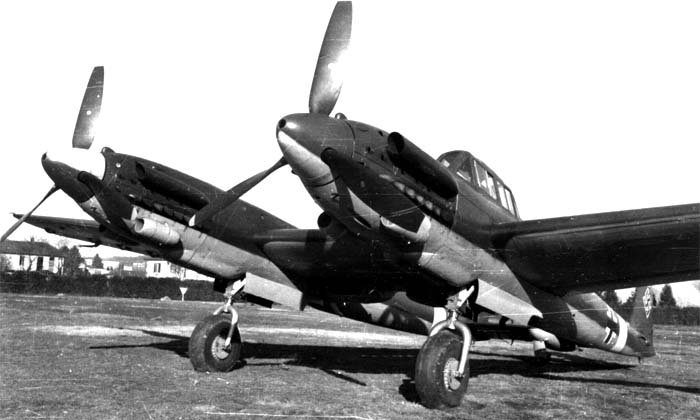
The Savoia-Marchetti SM.92 was a specialized heavy fighter and fighter-bomber developed in Italy to meet a specific Air Force requirement for a twin-seat, long-range multirole aircraft. Designed as an evolution of the SM.88, the SM.92 was characterized by its unconventional twin-fuselage layout. In a departure from traditional designs, the crew—consisting of a pilot and a rear gunner—were situated entirely within the left fuselage.
Technically, the aircraft was powered by two Daimler-Benz DB 605A-1 inverted V-12 liquid-cooled piston engines. Depending on the rating convention used, these engines produced either 1,290 hp or 1,475 PS each. The aircraft's armament was substantial for its class, featuring three 20 mm MG 151 cannons and five 12.7 mm machine guns. It was also capable of carrying a significant bomb load, with provisions for up to 2,000 kg (approximately 4,400 lb) internally or under the inner wings, supplemented by 160 kg (approximately 350 lb) bombs under each outboard wing.
Only one prototype, designated MM.531, was ever completed, as the aircraft never entered series production. The SM.92 first flew in October 1943 and accumulated more than 21 hours of total flight time. Its operational history was brief and marked by misfortune. In March 1944, the prototype was mistaken for an American P-38 Lightning by a Macchi C.205 fighter; the resulting attack left the SM.92 badly damaged and grounded for several months. The aircraft never recovered from these setbacks and was ultimately destroyed by Allied bombing in 1944.
In terms of performance, the SM.92 reached a maximum speed of 615 km/h at an altitude of 6,700 m, with a cruise speed of 539 km/h. It possessed a service ceiling of 12,000 m and a range of 2,000 km. Its climb rate allowed it to reach 6,000 m in 7 minutes and 10 seconds. Despite these advanced specifications, the aircraft remained a prototype and never saw combat or squadron service. Today, no examples of the SM.92 survive, as the sole prototype was lost during the war.