
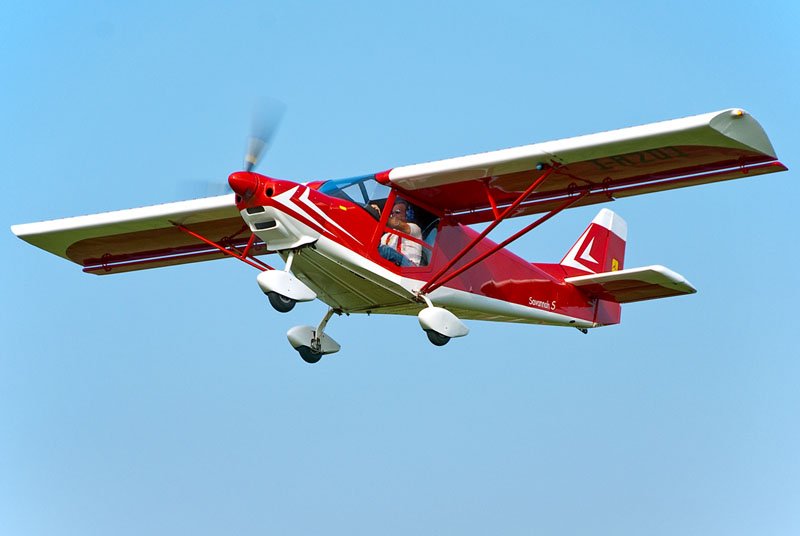
Design Innovation and Development
The Savannah emerged from ICP Srl's pursuit of creating an ultralight aircraft with unmatched short-field performance. The original MXP-740 "Classic" variant introduced in 1997 featured leading edge slats, though these were later abandoned due to inefficiency concerns. The design team instead focused on a sophisticated combination of vortex generators, slotted flaps, and slotted flaperons that allow the ailerons to droop in conjunction with the flaps, creating exceptional low-speed handling characteristics.
This aerodynamic package enables the Savannah to achieve a remarkable stall speed of just 48 kilometers per hour (30 mph) with full flaps deployed. The thick, low-speed wing design maximizes lift generation at minimum airspeeds, allowing the aircraft to become airborne in merely 35 meters (115 feet) and land within 50 to 70 meters (164 to 230 feet).
The Manufacturer
ICP Srl (Industria Costruzioni Prototipi), based in Italy, established itself as a specialist in ultralight aircraft manufacturing through the Savannah program. The company has maintained continuous production of multiple Savannah variants, demonstrating the design's enduring market appeal. As of December 2020, ICP continued manufacturing several variants simultaneously, indicating sustained demand for the aircraft's unique capabilities.
Variant Evolution
The Savannah family has expanded significantly since 1997, with each variant targeting specific market segments. The Bingo 4T, introduced in 2003, featured the 45-kilowatt HKS 700E engine, offering operators a lower-powered option. The Savannah ADV represents a major aerodynamic refinement, incorporating a redesigned tapered wing spanning 8.00 meters with full-span flaperons, enabling a top speed of 200 kilometers per hour (124 mph).
The Vimana variant, launched in 2006, optimized the design specifically for STOL operations while accommodating the more powerful 74-kilowatt Rotax 912 ULS engine. In North America, this variant gained recognition under the Rampage designation, broadening the aircraft's international market presence.
Engine Options and Performance
The Savannah's adaptability extends to its powerplant options, accommodating engines from multiple manufacturers. The Jabiru 2200, a 60-kilowatt air-cooled flat-four engine, provides reliable operation for standard missions. Rotax options include both the 80-horsepower 912 UL with two-blade adjustable-pitch propeller and the 100-horsepower 912 ULS paired with a three-blade adjustable-pitch propeller configuration.
With the Rotax 912 ULS installation, the Savannah achieves a maximum speed of 198 kilometers per hour (123 mph) and maintains a cruise speed of 179 kilometers per hour (111 mph) at 75 percent power. The aircraft demonstrates impressive climb performance with a rate of 6.1 meters per second (1,200 feet per minute) and reaches a service ceiling between 3,962 and 4,000 meters (13,000 to 13,123 feet).
Operational Characteristics
The Savannah's side-by-side seating configuration accommodates two occupants within a compact airframe measuring 6.60 meters (21 feet 8 inches) in length and 2.58 meters (8 feet 6 inches) in height. The aircraft's empty weight of 286 kilograms (631 pounds) allows for varying maximum takeoff weights depending on certification category: 450 kilograms (992 pounds) for European ultralight operations, 560 kilograms (1,234 pounds) in experimental category, and up to 600 kilograms (1,323 pounds) for Australian and New Zealand operations.
Standard fuel capacity of 78 liters (20.6 US gallons) provides a range of 800 kilometers (497 miles) with four hours endurance. Long-range tank options, particularly in Australian and New Zealand markets, expand capacity to 150 liters (39.6 US gallons), extending endurance to eight hours for extended cross-country flights.
Structural Engineering
Despite its ultralight classification, the Savannah incorporates robust structural design with load factors of +6/-3 g, exceeding typical ultralight requirements. The wing area of 12.87 square meters (138.5 square feet) provides excellent lift characteristics while maintaining structural efficiency. The never-exceed speed of 230 kilometers per hour (140 mph) offers pilots adequate margin above normal operating speeds.
Current Status and Legacy
The Savannah's continued production into 2020 and beyond demonstrates the enduring appeal of specialized STOL aircraft in the ultralight market. Multiple variants remaining in active production indicate ICP Srl's commitment to serving diverse operational requirements, from basic recreational flying to specialized short-field missions. The aircraft's combination of innovative aerodynamics, multiple engine options, and proven performance has established it as a significant contributor to the modern ultralight aviation segment.