
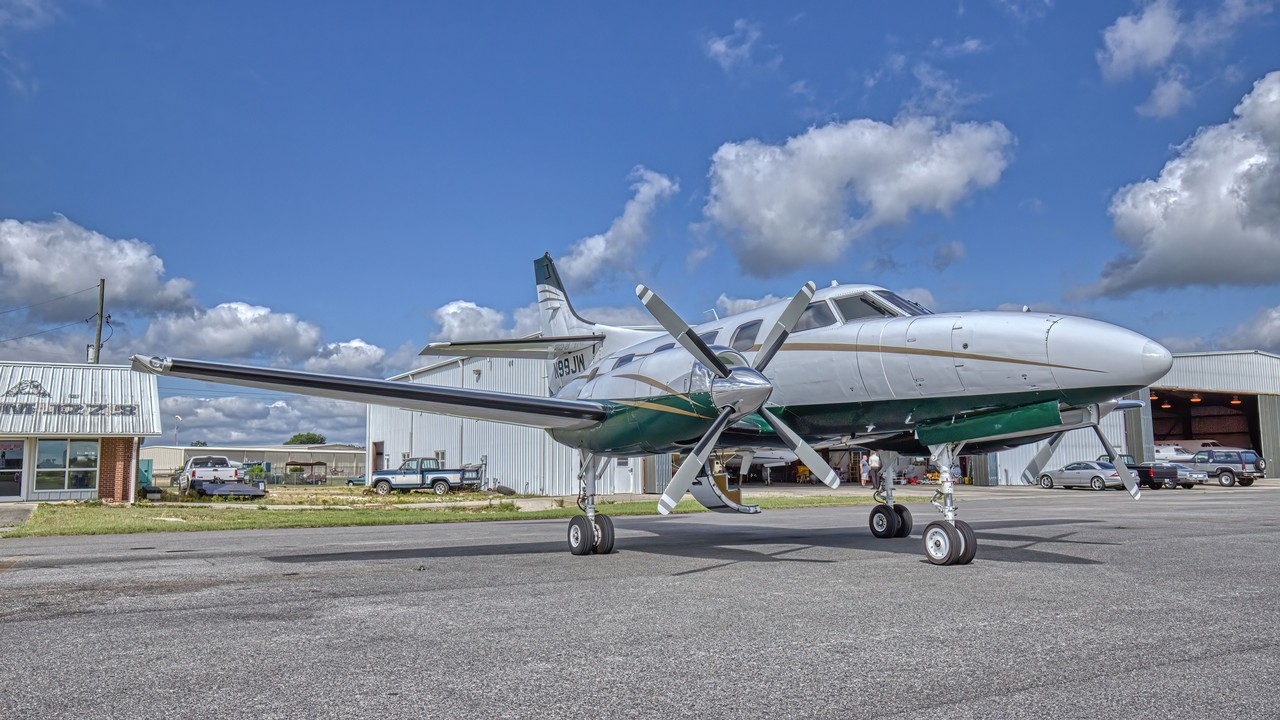
Service History
The Merlin III dominated the high-end business aviation market by offering unprecedented combination of speed, range, and efficiency. With its ability to cruise at 288 mph while consuming less than half the fuel of comparable jets, the aircraft changed executive transport expectations in the 1970s and early 1980s. The type's capabilities were dramatically demonstrated in 1971 when a Merlin III won the grueling 5,851-mile London-to-Victoria, British Columbia transatlantic and transcontinental air race, showcasing its long-range prowess against international competition.
The Manufacturer
Ed Swearingen founded Swearingen Aircraft in the early 1960s, initially gaining recognition through his "Excalibur" conversions of Beechcraft Twin Bonanza and Queen Air aircraft. His iterative approach to aircraft improvement led him from hybrid conversions to the clean-sheet Merlin III design by the late 1960s. Financial difficulties forced Swearingen to sell 90 percent of his company to Fairchild in late 1971, which renamed it Swearingen Aviation Corporation. Fairchild acquired majority ownership in 1980, continuing production as Fairchild Aerospace Merlin until the company ceased operations, with related Metro production ending in 1998.
Engine & Technical Innovation
The Merlin III was powered by twin 840-horsepower Garrett TPE331-10U-503G turboprops, each driving four-blade propellers with full beta reversing capability and deicing systems. Garrett AiResearch, later acquired by Honeywell, manufactured these single-shaft engines with negative torque sensing technology. The TPE331 series became standard across all subsequent Merlin and Metro variants after replacing Pratt & Whitney PT6 engines used in the earlier Merlin IIB. Later Merlin IIIB models, introduced in September 1978, featured uprated 900-horsepower engines with counter-rotating propellers and synchrophasers for reduced vibration.
Swearingen's design innovations included a distinctive cruciform horizontal tail configuration, inverted inlet engine mounting, and pressurized cabin with ovalized rectangular windows replacing traditional aircraft portholes. Optional equipment included winglets for improved fuel efficiency and rocket-assisted takeoff (RATO) provisions for operations from hot and high-altitude airfields where standard performance was marginal.
Performance & Pilot Perspective
The Merlin III achieved a maximum speed of 325 mph and service ceiling of 28,900 feet, with initial climb rates of 2,530 feet per minute. Its balanced field takeoff distance over a 50-foot obstacle was 2,150 feet, while landing distance was just 1,570 feet, enabling access to shorter airfields typically restricted to smaller aircraft. The aircraft's 648-gallon fuel capacity provided its impressive 2,860-mile range, while maintaining a relatively light empty weight of 7,400 pounds against a maximum gross weight of 12,500 pounds.
Pilots appreciated the aircraft's jet-like cruise speeds combined with turboprop reliability and fuel efficiency. The twin-engine configuration provided safety redundancy for over-water and remote area operations, while the pressurized cabin allowed comfortable high-altitude flight above most weather systems.
Production & Legacy
Swearingen produced exactly 92 Merlin III aircraft and 10 Merlin 300 variants (winglet-equipped SA227-TT models) as short-fuselage configurations. Production began in February 1972 and concluded in 1983 with the final Merlin IIIC bearing construction number TT-541. The design served as the foundation for the stretched Metroliner airliner series, with 703 total Metro, Merlin IV, and military C-26 variants eventually manufactured.
The Merlin III's influence extended beyond its direct production numbers, establishing Swearingen's reputation for efficient, long-range turboprop designs that bridged the gap between piston-powered aircraft and pure jets. While exact numbers of airworthy examples remain unknown, Merlin III aircraft continue active service today, with flight tracking services showing regular operations worldwide. The type's pioneering role in business aviation helped define the market segment that would later be served by modern turboprops like the King Air 350 and TBM series, proving Ed Swearingen's vision of efficient, fast business aircraft decades ahead of its time.