
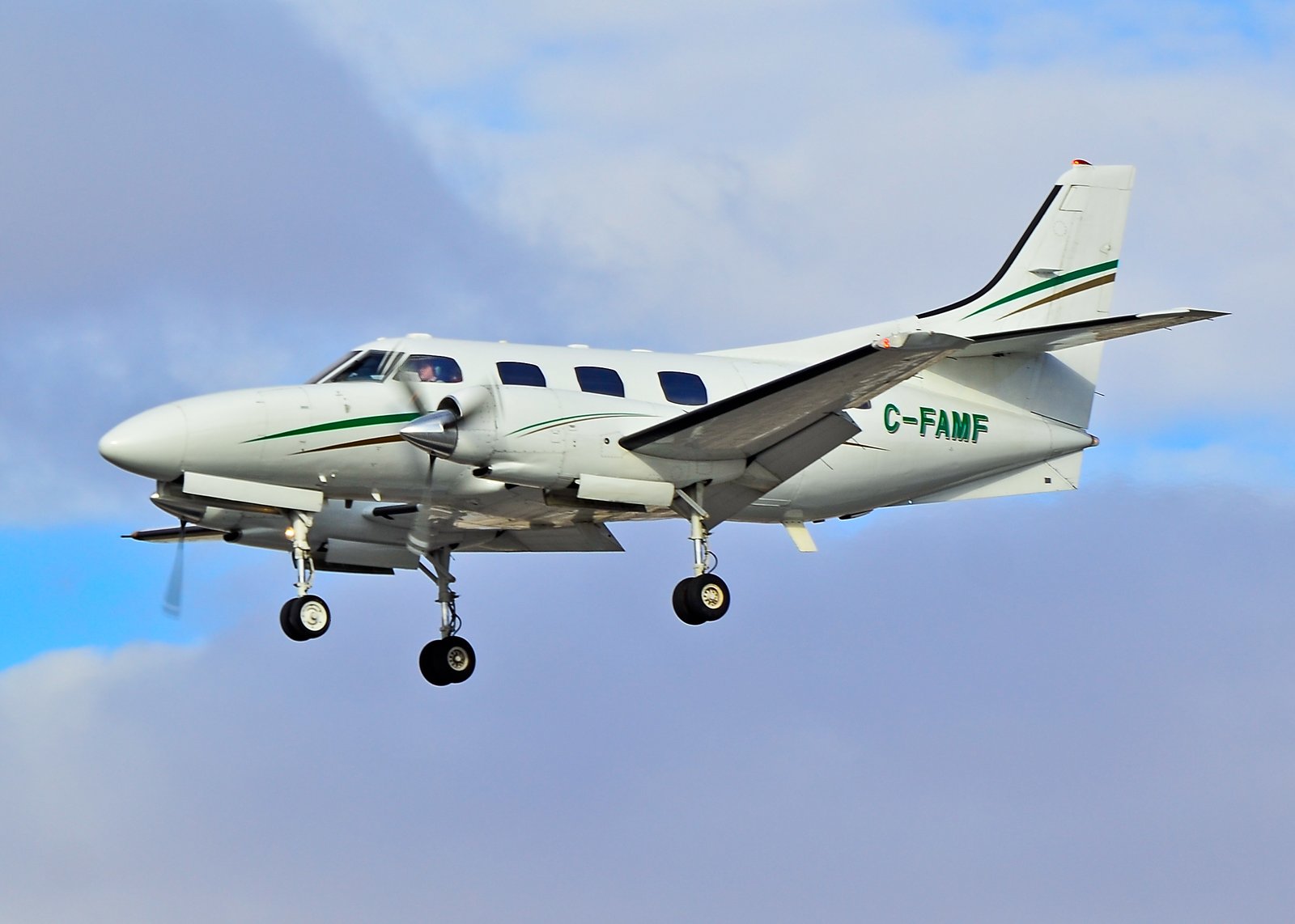
Corporate Aviation Pioneer
The Merlin IV represented Ed Swearingen's ambitious vision to compete directly with established manufacturers like Beechcraft in the executive transport market. By 1974, approximately 30 Merlin IVs had been delivered before production shifted to the improved Merlin IVA variant. The aircraft carved out a significant niche in corporate aviation, with initial sales of the Merlin IV running roughly double those of its airliner counterpart, the Metro, despite the company's early financial constraints.
The Merlin series gained international recognition when a Merlin III won the prestigious 9,414-kilometer London to Victoria, British Columbia Air Race in 1971, demonstrating the aircraft's long-range capabilities and reliability on a global stage.
The Swearingen Legacy
Ed Swearingen founded his aircraft company in 1959 after establishing his reputation modifying Beechcraft Twin Bonanza and Queen Air aircraft under the "Excalibur" brand. His innovative approach to the Merlin design combined engineering practicality with cost efficiency, utilizing a hybrid configuration that paired a new fuselage and vertical stabilizer with modified Queen Air wings and horizontal surfaces, plus Twin Bonanza landing gear.
Financial pressures during the Metro's development forced Swearingen to sell 90 percent of his company to Fairchild Hiller Corporation in late 1971. The acquisition transformed Swearingen Aircraft into Swearingen Aviation Corporation, a Fairchild subsidiary, with production continuing at the San Antonio facility until the company eventually ceased aircraft manufacturing operations.
Technical Innovation
The Merlin IV's most distinctive feature was its incorporation of a trimmable horizontal stabilizer, a sophisticated flight control system typically reserved for jet aircraft. This innovation made the Merlin one of only two turboprop aircraft types to feature this advanced technology, significantly enhancing pilot workload management during long corporate flights.
Power came from twin Garrett AiResearch TPE-331-1 turboprops, mounted in an inverted inlet configuration that became the signature appearance of all subsequent Merlin and Metro variants. Earlier Merlin prototypes had used Pratt & Whitney Canada PT6 engines, but the TPE-331 became the definitive powerplant for production aircraft. Later variants incorporated TPE331-11U engines with redesigned quick-access cowlings and four-bladed propellers for improved maintenance access and performance.
Performance and Capabilities
The pressurized cabin allowed the Merlin IV to operate efficiently at high altitudes, providing passengers with airline-like comfort in a smaller, more flexible aircraft. The twin-turboprop configuration offered excellent single-engine performance and operating economics that made it attractive to corporate flight departments seeking reliable, cost-effective transportation.
Later Merlin IVC variants featured a 10-foot wingspan increase through wing extensions, reducing drag and improving fuel efficiency. Toward the end of production, optional winglets became available on short-fuselage variants, with ten of the final 25 SA227-TT aircraft delivered as Merlin 300s equipped with these drag-reducing devices.
Military Service
While primarily designed for civilian use, the Merlin IV did see limited military service. The U.S. Army acquired a single second-hand Merlin IVC, operating it under the designation UC-26C as the sole military variant of this specific model, demonstrating the aircraft's versatility beyond its intended corporate role.
Production Legacy
The final Merlin IVC rolled off the San Antonio production line in 1987, marking the end of the short-fuselage Merlin series after more than two decades of production. Across all variants, Swearingen and Fairchild built 703 Metro, Expediter, Merlin IV series, and C-26 aircraft, with an additional 158 SA226 and SA227-series short-fuselage aircraft produced as Merlin IIIs, IIIAs, and IIIBs.
The Merlin IV's legacy lies in its successful bridging of the gap between smaller twin-engine aircraft and larger corporate jets, providing companies with a sophisticated, pressurized aircraft capable of operating from shorter runways while offering jet-like systems and performance. Ed Swearingen's innovative design philosophy, combining practical engineering with advanced features, influenced corporate aircraft development throughout the 1970s and 1980s, establishing benchmarks that competitors would strive to match.