
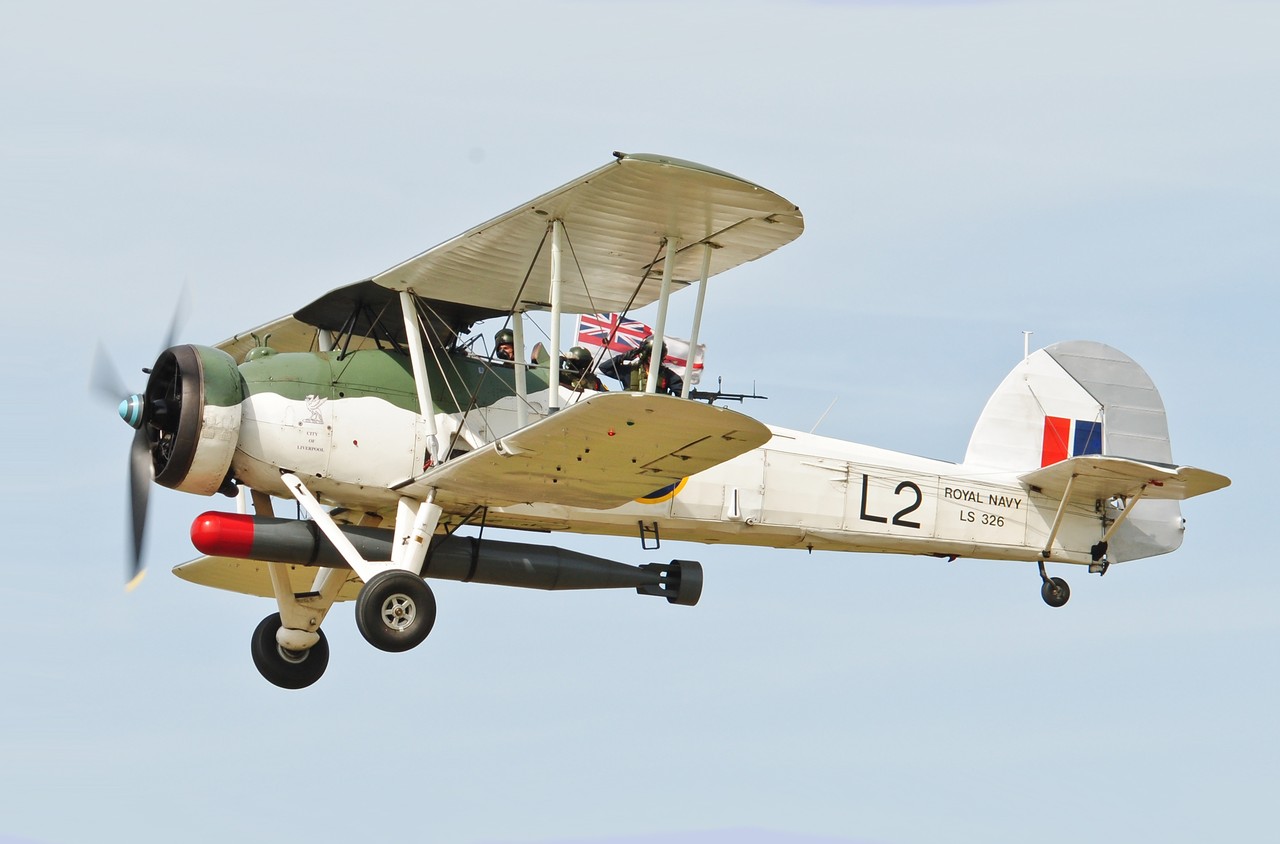
Combat Dominance Against All Odds
The Swordfish achieved legendary status by sinking approximately 50,000 tons of Axis shipping each month during World War II, despite looking obsolete before the conflict even began. From the first day of the European war to Germany's surrender on May 8, 1945, this humble biplane remained on the front lines when more advanced aircraft had been withdrawn from service. Between May 1943 and V-E Day alone, Swordfish aircraft flew 4,177 patrols, destroying 10 U-boats outright and sharing credit for five additional submarine kills.
The aircraft's most spectacular victory occurred on November 11, 1940, when Swordfish from HMS Illustrious attacked the Italian fleet at Taranto. At the cost of just two aircraft to enemy action, the Royal Navy eliminated Italian naval dominance in the Mediterranean in a single night operation that would later inspire the Japanese attack on Pearl Harbor.
Shared Production Success
Fairey Aviation Company designed the original aircraft, designated TSR II (Torpedo-Spotter-Reconnaissance), but shared production responsibilities with Blackburn Aircraft Company to meet wartime demands. Between 1935 and August 18, 1944, the two manufacturers completed approximately 2,391 aircraft, with Blackburn producing 1,699 examples and Fairey building 692. Blackburn-built aircraft earned the unofficial nickname "Blackfish" among Fleet Air Arm personnel.
The production run included 989 Mark I aircraft, 1,080 Mark II variants, and 320 Mark III models. The final Mark IV variant featured an enclosed cockpit and served primarily with the Royal Canadian Air Force, converted from existing Mark II airframes.
The Fairey Aviation Legacy
Fairey Aviation Company operated as a major British aircraft manufacturer throughout the early-to-mid 20th century before being absorbed into larger aviation conglomerates during industry consolidation. The company's design philosophy emphasized reliability and simplicity over cutting-edge technology, evident in the Swordfish's steel-spar construction, duralumin ribs, steel-tube fuselage, and fabric covering.
This deliberately uncomplicated approach simplified both production and field maintenance, crucial factors for naval aircraft operating from carriers in harsh maritime environments. The design philosophy proved so successful that the Swordfish outlived the Fairey Barracuda, the more advanced monoplane specifically designed to replace it.
Bristol Pegasus Powerplant
The reliable Bristol Pegasus radial engine powered all Swordfish variants, though Royal Navy test pilot Captain Eric Brown noted it appeared "to have been added as an afterthought" from external appearances. Early Mark I aircraft used the 690-horsepower Pegasus engine, while later Mark II and Mark III variants upgraded to the more powerful 820-horsepower Pegasus XXX series.
Despite the engine's modest appearance, its reliability proved invaluable for crews conducting night operations over water, where engine failure meant almost certain death. The air-cooled radial design required minimal maintenance compared to liquid-cooled alternatives, essential for sustained carrier operations.
Operational Versatility
The three-man crew operated from open cockpits in most variants, with the pilot, observer, and rear gunner exposed to weather and enemy fire. Mark II aircraft introduced metal reinforcement to the lower wing structure and could carry eight 60-pound RP-3 rockets in addition to the standard 18-inch torpedo. The Mark III variant added ASV radar mounted between the landing gear legs for improved anti-submarine warfare capability.
With a service ceiling of 19,249 feet and operational range of 546 miles, the Swordfish possessed sufficient performance for its intended missions despite appearing hopelessly outclassed by contemporary fighters. Its 1,220 feet-per-minute rate of climb, while modest, proved adequate for torpedo attacks that required low-level approaches.
Global Service Record
Seventeen Royal Navy squadrons operated Swordfish aircraft during World War II, with additional units serving in the Royal Air Force, Royal Canadian Air Force, and smaller numbers in the Netherlands, South Africa, and Spain. The aircraft's success in convoy escort duties was particularly remarkable—only one of 217 convoys protected by MAC (Merchant Aircraft Carrier) ships was successfully attacked by enemy submarines between May 1943 and V-E Day.
The Swordfish officially retired on May 21, 1945, just thirteen days after Germany's surrender, though training units continued operating the type into 1946. Its combination of rugged construction, operational flexibility, and proven combat effectiveness had sustained the Royal Navy's striking power throughout the war's darkest periods, earning lasting respect from the crews who flew this unlikely warrior.