
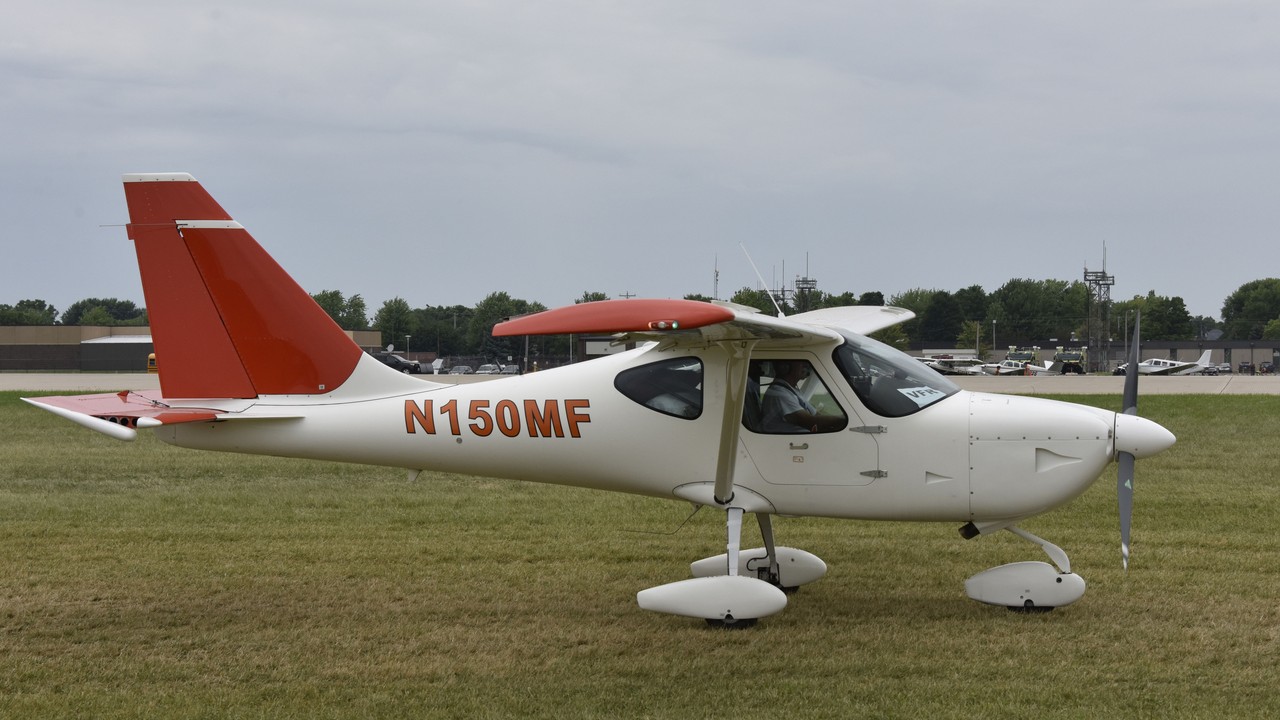
From Kit to Certificate
The Symphony SA-160's origins trace back to the amateur-built GlaStar design by Stoddard-Hamilton. In 1998, OMF Aircraft was established in Neubrandenburg, Germany, by an entrepreneur named Stinnes who had constructed and flown a GlaStar kit aircraft during the 1990s. Recognizing the design's potential as a certified production aircraft, Stinnes founded OMF Flugzeugwerk to transform the experimental aircraft into a factory-built model meeting FAR Part 23 certification standards.
The transformation required extensive engineering changes. Nearly every component was strengthened or redesigned to meet certification requirements, with very few parts remaining common between the original GlaStar kit and the production Symphony. This intentional overbuilding approach was adopted to simplify the certification process, though it significantly increased the aircraft's complexity and cost.
Production Struggles
OMF began manufacturing the Symphony SA-160 in 2001 at their facility in Trois-Rivières, Quebec, Canada. However, the company's ambitious plans were hampered by inadequate financing during the startup phase. After producing 40 aircraft over two years, OMF declared bankruptcy in December 2003, leaving the Symphony program in limbo.
The design found new life when Symphony Aircraft Industries (SAI) acquired the intellectual property rights from OMF Flugzeugwerk in February 2005. SAI resumed production at the same Quebec facility in May 2005, with the first SAI-produced aircraft receiving its FAA Certificate of Airworthiness on May 13, 2005. The company achieved both FAA Type Certification on May 4, 2005, and Transport Canada certification under CAR 523 in March 2005.
Technical Excellence
The SA-160's powerplant was a Lycoming O-320-D2A four-cylinder, horizontally opposed engine producing 160 horsepower. OMF selected this engine over more powerful alternatives like the 180-horsepower O-360 or the 125-horsepower Continental IO-240B, determining that the O-320 provided the optimal balance of power and mechanical reliability. The engine drove a fixed-pitch, two-blade MT propeller constructed of stainless steel.
The aircraft incorporated a GAW-2 airfoil designed for low stall speeds and high durability. Its tricycle landing gear featured three broad-treaded tundra wheels with hydraulic disc brakes, enabling operations from unprepared airstrips and short runways. The nose wheel was steered through differential braking on the rudder pedals, providing precise ground handling in confined spaces.
Market Position
SAI marketed the Symphony SA-160 for personal use, touring, and flight training applications. The day-VFR-equipped version carried a price tag of $120,000, positioning it as a certified alternative to homebuilt aircraft. Production gradually increased from two aircraft per month in early 2005 to three per month by fall 2005, reaching five aircraft monthly by 2006.
The company pursued additional certifications for enhanced capabilities, including a Ballistic Recovery Systems full-aircraft parachute system and Avidyne glass cockpit instrumentation. Future variants were planned, including the SA-180 with 180 horsepower and a version powered by a 200-horsepower Lycoming IO-390 engine promising cruise speeds of 148 knots.
Final Chapter
Despite technical success and growing production, Symphony Aircraft Industries faced financial difficulties. The company declared bankruptcy and ceased operations on January 22, 2007, after losing its lead investor. Total production across both OMF and SAI reached approximately 80-90 aircraft.
Following SAI's collapse, a former lead investor attempted to restart production through North American Factory (NAF), forecasting annual production of 50 to 80 aircraft by 2012. In July 2008, another new company announced intentions to resume manufacturing at the Trois-Rivières plant by late 2009, though these efforts did not materialize into sustained production.
Legacy
The Symphony SA-160 represented an ambitious attempt to bridge the gap between experimental and certified aircraft markets. While production numbers remained modest, the aircraft demonstrated that homebuilt designs could successfully transition to factory certification. As of 2023, at least one SA-160 maintained valid FAA registration, indicating that examples of this short-lived but technically accomplished aircraft continue flying today.
The Symphony's story illustrates both the potential and challenges of small aircraft manufacturing, where technical excellence alone cannot guarantee commercial survival without adequate financing and market conditions.