
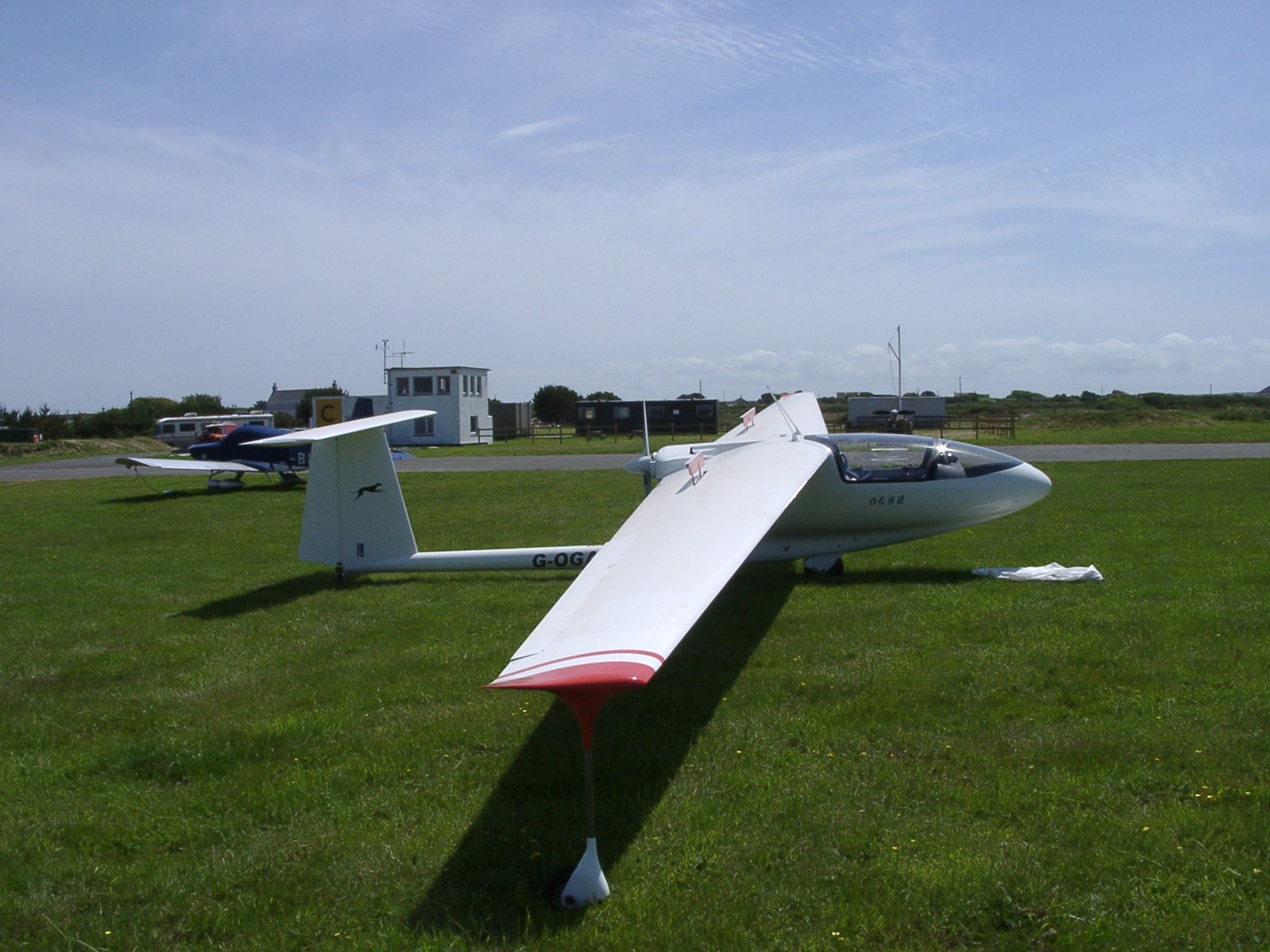
Revolutionary Training Concept
The SZD-45 Ogar emerged from a revolutionary approach to glider pilot training, combining the soaring capabilities of a sailplane with the reliability of powered flight. Designed by Dipl.-Ing. Tadeusz Labuc, the aircraft represented SZD's bold entry into the motorglider market, targeting the growing demand for advanced training aircraft that could operate independently of tow planes and winches. The Ogar's name, meaning "hound" in Polish, reflected its tenacious and reliable character in the training environment.
Technical Innovation
The Ogar's most distinctive feature was its T-tail configuration mounted on a tubular duralumin boom that passed beneath the propeller disc. This innovative design solved the critical problem of propeller wash interference with conventional tail surfaces while maintaining the clean airflow characteristics essential for soaring performance. The aircraft employed mixed construction techniques, combining a single-spar cantilever wooden wing with molded plywood stressed skin covered in fiberglass, demonstrating SZD's transition toward composite materials that would define their future designs.
The wing utilized the sophisticated Wortmann FX-61-168/1261 airfoil, specifically chosen for its excellent low-speed characteristics and soaring performance. With an aspect ratio of 16.2, the wing provided the high lift-to-drag ratio essential for extended gliding flight while maintaining sufficient structural strength for the aircraft's aerobatic certification.
Engine Evolution
The Ogar's development reflected the challenges of finding reliable powerplants for specialized applications. The prototype flew with a 45-horsepower Stark-Stamo four-cylinder air-cooled engine, but production realities forced rapid adaptation. When Stamo engines became unavailable, SZD switched to the 68-horsepower Limbach SL 1700EC four-cylinder horizontally-opposed engine for the SZD-45A production variant.
Further engine evolution came in 1978 with the SZD-45-2 Ogar-F variant, powered by the 60-horsepower Franklin 2A-120 two-cylinder air-cooled horizontally-opposed engine. This Franklin-powered version first flew on March 13, 1979, and became the standard for later production aircraft. For the American market, SZD adapted dual-ignition, turbocharged Revmaster/Volkswagen VW 2962 engines, demonstrating the manufacturer's flexibility in meeting diverse certification requirements.
The Manufacturer's Golden Era
SZD's development of the Ogar coincided with the company's emergence as the world's largest glider manufacturer by the end of the 1970s. Founded over 70 years earlier, SZD had manufactured more than 5,000 gliders for global customers by the time of Ogar production. The company's 1972 transition to composite materials with the successful JANTAR competition series provided the technical foundation for the Ogar's advanced construction techniques.
The Ogar program represented SZD's strategic diversification beyond pure sailplanes into the growing motorglider market. This expansion demonstrated the company's recognition of changing training requirements in the gliding community, where traditional methods using tow planes and winches were becoming increasingly expensive and logistically complex.
International Success and Export Markets
Despite limited production of only 66 aircraft, the Ogar achieved remarkable international penetration with 41 examples exported to demanding aviation markets. The aircraft found customers in both East and West Germany during the Cold War era, demonstrating its appeal across political boundaries. Swedish, British, and American operators also embraced the type, with each market requiring specific engine and equipment modifications to meet local certification standards.
The aircraft's certification for simple aerobatics expanded its training utility beyond basic motorglider instruction to include upset recovery and advanced maneuvering training. This capability distinguished the Ogar from many contemporary training aircraft that were limited to normal category operations.
Training Revolution
The Ogar's side-by-side seating configuration revolutionized glider training by enabling direct instructor-student interaction impossible in traditional tandem sailplanes. The 22-kilogram fuel capacity provided sufficient endurance for extended training flights while maintaining the aircraft's 700-kilogram maximum takeoff weight within reasonable limits for student operations.
With an empty weight of 470 kilograms, the Ogar achieved an excellent power-to-weight ratio that enabled both powered climb performance and impressive soaring capabilities when the engine was shut down. This dual nature allowed instructors to demonstrate powered aircraft procedures and pure gliding techniques within a single flight, dramatically improving training efficiency.
Legacy and Influence
Although production ended in 1979, the SZD-45 Ogar established important precedents for subsequent motorglider development. Its successful integration of soaring performance with reliable powered flight capabilities influenced later designs throughout the aviation industry. The aircraft proved that specialized training aircraft could achieve commercial viability despite limited production runs when properly matched to specific operational requirements.
The Ogar's technical innovations, particularly its T-tail boom configuration and mixed construction techniques, contributed to the broader evolution of light aircraft design. Today, surviving examples serve as testament to SZD's engineering excellence during the company's golden era of glider production, when Polish aviation technology achieved global recognition for innovation and reliability.