
Development and Design Philosophy
The T-101 Grach emerged from an ambitious vision to modernize Soviet-era utility aviation during Russia's turbulent post-communist transition. Design work commenced in September 1991 at Aeroprogress Corporation's Utility Aircraft Division, with the explicit goal of creating a contemporary successor to the venerable Antonov An-2 biplane that had dominated short-haul transport roles across the Soviet Union for decades.
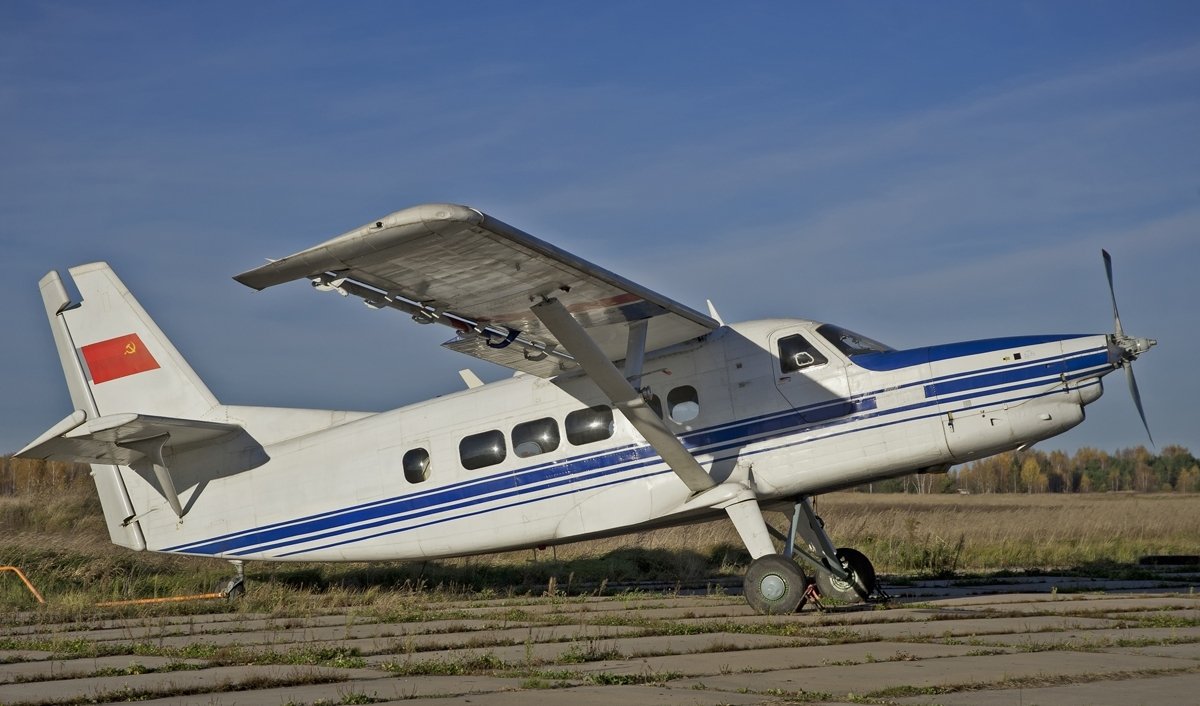
Engineers prioritized three critical design objectives: low acquisition cost, exceptional reliability, and the ability to operate from unprepared airstrips. The resulting aircraft featured a strut-braced high-wing configuration with fixed tailwheel landing gear, deliberately echoing the An-2's rugged simplicity while incorporating modern turboprop technology. Construction of the prototype began in April 1992, with the first aircraft taking flight on December 7, 1994, bearing registration FLARF-01466.
Technical Innovation and Performance
The T-101's powerplant represented a significant technological advancement over its biplane predecessor. The single Mars TVD-10B turboprop engine, manufactured in Omsk and producing 706 kilowatts (947 shaft horsepower), drove an AV-24AN three-blade constant-speed propeller equipped with both reverse pitch and full feathering capabilities. This sophisticated propeller system enhanced the aircraft's utility for operations from unpaved surfaces, allowing for shorter landing rolls and improved ground handling.
Fuel was stored in six wing-mounted tanks with a combined capacity of 1,200 liters, providing the T-101 with a maximum range of 1,270 kilometers when carrying minimal payload. With full passenger load, range decreased to 700 kilometers. The aircraft achieved a maximum speed of 300 kilometers per hour at 3,000 meters altitude, with a more economical cruise speed of 250 kilometers per hour.
Production Struggles and Limited Success
Series production commenced in January 1993 at the Moscow Aviation Production Organisation factory in Lukhovitsy, but the program immediately encountered the harsh economic realities of 1990s Russia. Despite initial optimism, only two aircraft had been delivered by mid-2001, with a third on order. The production situation appeared promising in March 2002 when parts for 50 aircraft were reportedly under construction, with 25 sets ready for assembly, but this ambitious expansion never materialized.
The T-101's commercial debut occurred in July 2000 when one aircraft was leased to operators in the remote Chukotka region for six months. A second aircraft found service with an undisclosed operator in early 2001. By late 2001, an Asian customer was negotiating for four additional aircraft, and the manufacturer quoted a unit price of approximately 700,000 US dollars.
The Manufacturer's Challenge
Aeroprogress Corporation, also known as ROKS-Aero, faced severe financial constraints throughout the T-101's development. The company collaborated closely with the Moscow Aviation Production Association (MAPA), which handled final assembly and flight testing at their Lukhovitsky facility. In an attempt to expand market appeal, Aeroprogress developed a westernized variant designated T-201, which was unsuccessfully marketed under the Khrunichev name.
The economic turmoil of post-Soviet Russia proved insurmountable for the small manufacturer. Despite producing a technically sound aircraft that met its design objectives, Aeroprogress lacked the financial resources and market access necessary to compete effectively in the global utility aircraft market.
Operational Capabilities and Intended Roles
The T-101 was designed for diverse civilian applications including passenger transport, cargo hauling, agricultural operations, patrol missions, aerial photography, search and rescue, and general airborne operations. Its 15-passenger capacity or 1,400-kilogram cargo load made it suitable for serving remote communities across Russia's vast territory.
The aircraft's short takeoff and landing capabilities, combined with its wide center-of-gravity range, enabled operations from unprepared airstrips that larger aircraft could not access. These characteristics directly addressed the operational niche that had made the An-2 indispensable across the Soviet Union.
Legacy of Unfulfilled Potential
The T-101 Grach ultimately represents one of Russia's most promising but unsuccessful aircraft programs of the 1990s. Despite sound engineering and practical design objectives, the aircraft never achieved meaningful production numbers or commercial success. No evidence exists of additional prototypes beyond the initial flight test aircraft, and the program appears to have quietly ended in the early 2000s.
The T-101's failure illustrates the broader challenges facing Russian aviation manufacturers during the economic transition period, when even technically competent designs could not overcome financial constraints and market disruption. Today, the T-101 remains a largely forgotten footnote in aviation history, known primarily to specialists and aviation enthusiasts rather than achieving its intended role as the An-2's modern successor.