
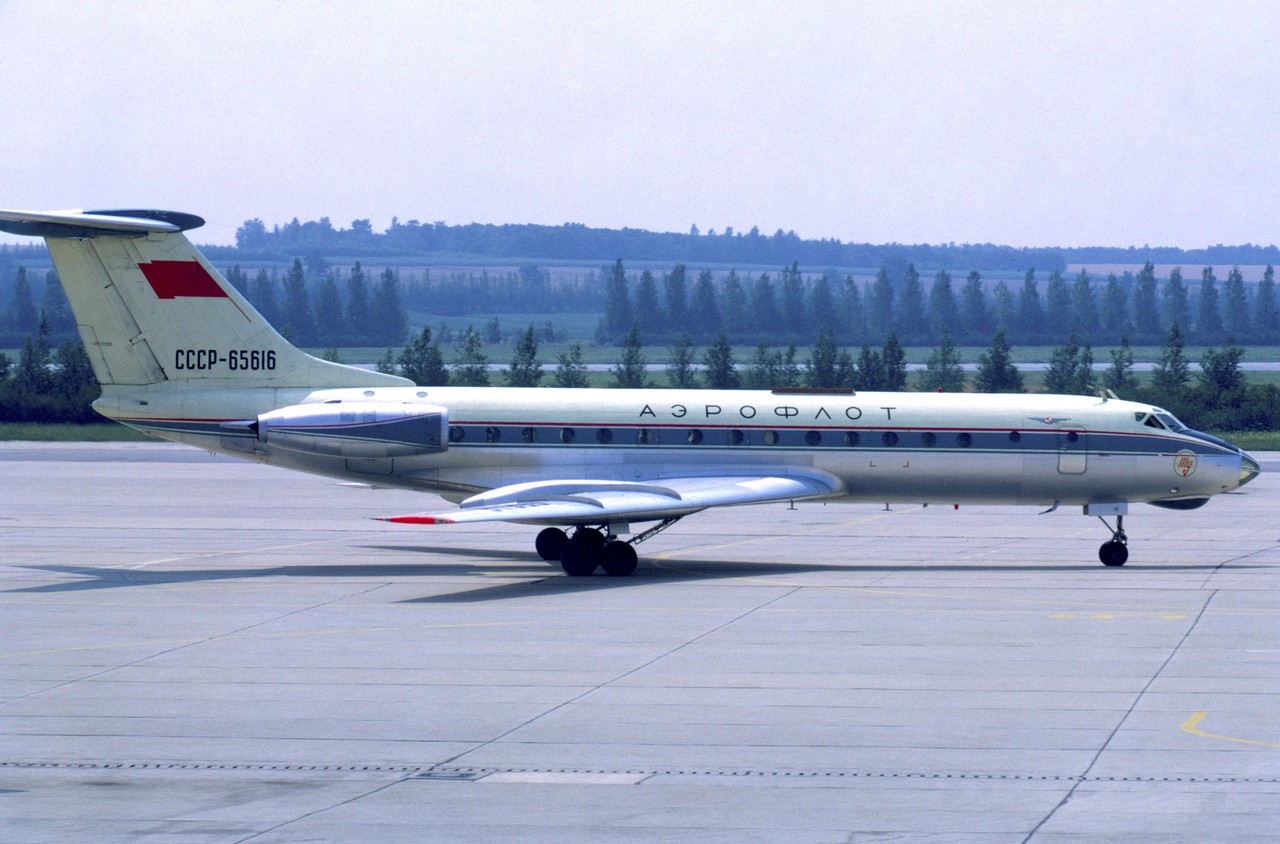
Service History
The Tu-134 transformed Soviet aviation when Aeroflot introduced it to service on September 12, 1967, with simultaneous flights from Moscow to Adler and Stockholm. As the first Soviet airliner to receive ICAO certification for international routes, it opened new possibilities for the state carrier's global expansion. By the 1970s, the aircraft had become the backbone of short-haul operations throughout the Soviet sphere, with major operators including LOT Polish Airlines, Malév Hungarian Airlines, and Interflug all adopting the type in 1968.
The aircraft's prevalence extended far beyond the Warsaw Pact, serving airlines in Afghanistan, Angola, Bulgaria, Czechoslovakia, East Germany, Hungary, North Korea, Peru, Romania, Sudan, Syria, and Yugoslavia. At its peak in 2006, 245 Tu-134s remained operational, with 162 based in Russia alone. However, European noise restrictions implemented after 2002 severely limited its international operations, forcing operators to seek alternatives for Western routes.
Design Innovation
Soviet Premier Nikita Khrushchev's 1960 encounter with the French Sud Aviation Caravelle directly inspired the Tu-134's development. The Tupolev design bureau, led by Andrei Tupolev's engineering team, created the aircraft as an evolution of the Tu-124 to replace Aeroflot's aging Ilyushin Il-14 piston airliners. The design philosophy centered on rear-mounted engines to reduce cabin noise and improve wing airflow characteristics.
The prototype, initially designated Tu-124A with registration SSSR-45075, underwent significant modifications following the 1963 crash of a British Aircraft Corporation One-Eleven. Engineers increased the tailplane area by 30 percent to enhance stability and repositioned the engines on wing-mounted stubs rather than fuselage mounting. The aircraft was formally redesignated Tu-134 on November 20, 1963, reflecting these substantial changes.
The Manufacturer
Tupolev emerged from Andrei Tupolev's design bureau established in the 1920s, initially focusing on military bombers that would define Soviet air power for decades. The company's expertise in large aircraft construction made it a logical choice when the Soviet government sought to develop a modern airliner following Khrushchev's Western aircraft observations. Manufacturing occurred primarily at the Kharkov Aviation Production Association, demonstrating the distributed nature of Soviet aerospace production.
Today, Tupolev operates as part of Russia's United Aircraft Corporation following post-Soviet consolidation efforts. The company's legacy extends far beyond the Tu-134, encompassing legendary military aircraft like the Tu-95 Bear bomber and the supersonic Tu-144 airliner, though the Tu-134 remains its most successful commercial aircraft by production numbers.
Engine and Technical Specifications
The Tu-134's twin Soloviev D-30 turbofan engines represented advanced Soviet propulsion technology of the 1960s. These low-bypass turbofans, manufactured by the Soloviev Design Bureau, provided reliable service throughout the aircraft's operational life, though their noise signature would eventually prove problematic for international operations. The Tu-134A variant received upgraded powerplants that improved overall performance and fuel efficiency.
The aircraft's 35-degree swept wings and distinctive T-tail configuration created a clean aerodynamic profile that distinguished it from contemporary Western designs. Crew requirements remained modest with two pilots and cabin crew, typical for aircraft of this size and era. The design proved robust enough to accommodate multiple variants, from the original 64-seat configuration to the stretched Tu-134B with capacity for 96 passengers.
Variants and Military Applications
While primarily designed for civilian service, the Tu-134 spawned several military variants that served specialized roles within Soviet and Warsaw Pact air forces. The Tu-134UBL and Tu-134 UBK functioned as crew trainers, including a unique navalized version for carrier operations training. Bomber and navigation training variants designated Tu-134BSh and Tu-134Sh-1/Sh-2 featured bomb racks for realistic combat simulation.
The Tu-134SKh agricultural survey variant demonstrated the design's adaptability beyond passenger transport. These military applications, while limited in scope, showcased the aircraft's versatility and contributed to the overall production numbers that made the program economically viable.
Production Legacy and Decline
Production continued from 1966 through 1989, with 854 aircraft completed including two prototypes. This achievement made the Tu-134 the most-produced Soviet airliner in history, surpassing all other domestic commercial aircraft programs. The NATO reporting name "Crusty" reflected Western military recognition of its significance within Soviet aviation capabilities.
The aircraft's operational decline accelerated after the 2011 RusAir Flight 9605 crash that killed 47 of 52 occupants, prompting Russian authorities to implement grounding orders in 2012. Aeroflot retired its final Tu-134 on January 1, 2008, while the last Russian commercial flight occurred on May 22, 2019. Today, virtually no Tu-134s remain in passenger service, marking the end of an era that once saw these distinctive aircraft connecting cities across three continents.